Help identifying this Tumbling object in a night sky photo from Namibia

Join the discussion
Registration is free. Ask a follow-up in this thread, or start your own.
54 replies · 7K views
timmdeeg
Gold Member
Messages
1,592
Reaction score
376
TL;DR
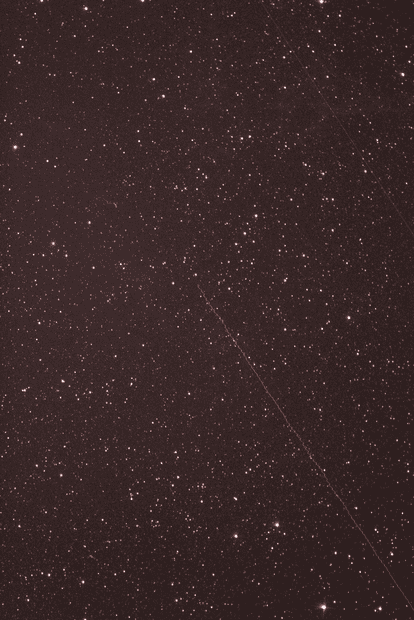
Question: What tumbling object causes this trajectory?
I have received this image from someone in Namibia recently at the Kiripotib Astrofarm.

Has anyone an idea what could cause such a strange trajectory?
1698002375517.png
 
Astronomy news on Phys.org
timmdeeg said:
TL;DR Summary: Question: What tumbling object causes this trajectory?

Has anyone an idea what could cause such a strange trajectory?

The line in the top right is a satellite track. It shows that the telescope was steady, and the stars show it was tracking.

The partial track could be a high altitude aircraft, flying on autopilot through disturbed air with variable crosswinds, which explains the wandering. It appears to have a strobe light that marks a series of dots along its path.
 
Reply
  • Like
Likes   Reactions: FactChecker and russ_watters
Hosea Kutako International Airport, Windhoek, Namibia, is overflown by international flights between Capetown and Western Europe, and between Johannesburg and the East Coast USA.
 
Reply
  • Like
Likes   Reactions: russ_watters
Vanadium 50 said:
Why do you say "tumbling", which implies rotation. Is there something I am missing?
Are you on a small screen? If so you'll need to zoom in quite a bit to see that the track is jagged. Something corkscrewing along doesn't seem implausible as an a priori explanation for it.
 
I have made hundreds of such photos myself (for astrophotography) and never saw anything comparable.

Lights of airplanes show parallel tracks, whereas "amplitude" and "wavelength" of this curve are quite constant which seems to indicate that something rotates. But if correct this would require that the object reflects/emits light apart from its center of mass. The satellite track above (photo OP) is much more faint which could indicate, that this object is much closer. - Also very weird, the object suddenly becomes visible without transition.

a crop
1698047120579.png
 
Reply
  • Informative
  • Wow
Likes   Reactions: pinball1970 and phinds
timmdeeg said:
Also very weird, the object suddenly becomes visible without transition.
What do you mean by that?
We do not know which way it travelled. The end of the track on the image could be the start or end of the camera exposure, or entry or exit from the Earth's shadow, or they might have just turned the light off. How can we be sure it is not a computer modified fake image, designed to waste our time?

We have no idea of the details of the image. Photographer, date, time window of exposure, lat/lng of observatory, RA/Dec of telescope, magnification, is North Up, identity of three bright stars in the field?

The obvious observation is that it must remain a UFO, until you can provide sufficient details to make identification possible.
 
Reply
  • Like
Likes   Reactions: russ_watters and phinds
Ibix said:
Something corkscrewing along
I would not call that "tumbling". I would simply call it "rotation".

I would restrict the word "tumbling" to motion about a body's intermediate principal axis. Unlike the other two axes, this is unstable. I don't see that here. I don't see anything that can't be explained by a spinning object that is more reflective in parts,
 
Vanadium 50 said:
I would not call that "tumbling". I would simply call it "rotation".
Yes agreed. It is as if a rotating lengthy object reflects light at one end quite uniformly.

@Baluncore I know the person from whom I have got this the image, no doubt about seriousness. North is up.

Such lightframes as we call them show about one to some degrees of the sky depending on the focal-length of the scope. Of course I could ask for more details, e.g. date, exposure time ... but don't think that would help to resolve the puzzle.

EDIT Something else, looking at the first image: if one follows the track down to the left, the amplitudes are decreasing for some "wavelengths", then increasing and below decreasing again.
 
Last edited:
russ_watters said:
Calling them "tumbling" is a thing and not worth the quibble vs "rotating", but they don't usually look like that. Usually they are just linear dashes. See:
https://www.satobs.org/tumble/tumbleintro.html

It would need to be a very large satellite for it to look like zig-zagging unless it is at very high magnification.
Which would make me think it is relatively close. However, from a single observation it is most likely impossible to identify unless a candidate can be found. A rocket launch with a discarded "tumbling" stage for example.
Regards Andrew
 
Oh it's much more wibbly-wobbly* than I thought!

  • Its large-scale path is not straight; it wobbles side-to-side (see long reference line).
  • And its small-scale path is (inasmuch as the resolution will allow) not consistent (see short ticks, lower right).

1698077669233.png


*technical term

I would suggest that
  • the side-to-side wobble is also periodic:
1698077602594.png


And, for the record, the satellite track in the upper right corner shows that none of the wobbles are camera artifacts:
1698078035034.png
 
Last edited:
Reply
  • Informative
Likes   Reactions: phinds
FactChecker said:
My vote goes with @Baluncore 's post #4 -- an airplane on autopilot with blinking strobe lights. There appears to be some oscillation in the autopilot system.
I don't see how that would produce this zig-zag:

1698078152559.png

It does not appear to be merely the on/off of a strobe light. It's continuous, and it oscillates side-to-side.

It really appears to me to be a complex spiral.
 
DaveC426913 said:
I don't see how that would produce this zig-zag:

It does not appear to be merely the on/off of a strobe light. It's continuous, and it oscillates side-to-side.

It really appears to me to be a complex spiral.
Two lights; one on, one flashing, not quite on the same line.

I agree the airplane explanation is most likely.
 
Reply
  • Like
Likes   Reactions: DaveC426913
If we knew the magnification, or star identification, we could evaluate the angular dimensions, so linear size of an aircraft at 36,000 ft, or a long rocket body in LEO.
What is the period in time of the pattern in the image?

Aircraft have strobe lights on wingtips and tail. There are also less bright continuous beacon lights on all flying aircraft. When you cannot see the light source directly, the skin of the aircraft or the contrail(s), may be illuminated by the continuous beacons or strobes.

The strobes now have accurately fixed rates, but often alternate, so are not synchronised. Boeing and Airbus employ different individual strobe systems, Boeing use equal spaced single pulses, Airbus often have a regular double pulse from each strobe, that is easier to follow at a distance.
 
Reply
  • Like
Likes   Reactions: russ_watters
Perhaps I can obtain some more details.

From time to time I have an aircraft, but being deleted I can't show such an image. The main impression is straight lines in different colors and bigger in size.Here some stars HD.... from astrometry.net
1698092946902.png
 
Reply
  • Love
Likes   Reactions: DaveC426913
Wow! You found it!

It is a very teeny section of the sky. So small I cannot show it and its context in the same pic.

1698095834209.png

Maybe somebody can work out the length of that path thats visible. It's tiny, on the order of a degree.

Here it is with Equatorial Coords (those are the ones that are time-agnostic, right?).

1698097489109.png


1698096946204.png


I'm not sure where to take this next. We still don't know what time or season this is.
 

Attachments

  • 1698095076393.png
    1698095076393.png
    49.3 KB · Views: 172
Last edited:
Reply
  • Like
Likes   Reactions: berkeman
Last edited:
Reply
  • Like
  • Wow
Likes   Reactions: DennisN, russ_watters, Baluncore and 1 other person
Oh my goodness. 💡

There are fireflies in Africa.
And there are fireflies that pulse rather than flash.
 
Last edited:
Butterfly effect, but with fireflies?
 
Reply
  • Haha
Likes   Reactions: DaveC426913
I still wonder whether rotation could clarify this issue.
Lets assume we look at the rotational plane which is stabilised by gyroscopic forces. And further that a part of the object reflects sunlight, then depending on its speed and its rotational frequency such a track could result. - If so then the rotation period should be deducible from track details and the exposure time 181s.

Here are the data, hopefully helpful.

1698155416699.png


IMG_2152.CR2 10.Aug.2023 23:43

Name: IMG_2152.CR2

Maße: 2592 x 3888

Dateigröße: 11,6MB (12.130.712)

Kameramarke: Canon

Kameramodell: Canon EOS 1000D

Blendeneinstellung: F0

Blende: Finf

Brennweite: 1000 mm

Belichtungszeit: 181 s


Belichtungskorrektur: 0 EV

ISO-Empfindlichkeit: 1600

Urspr. Dat./Uhrz.: 10.08.23 23:43:05

Datum/Uhrz. digital: 10.08.23 23:43:05

Weißabgleich: Manual

Belichtungsmessung: Multi-segment

Blitz: No, compulsory

Belichtungsprogramm: Manual

Belichtungsmodus: Manual

Farbraum: sRGB

Ausrichtung: right, top

x-Maße in Pixel: 3888

y-Maße in Pixel: 2592

x-Auflösung: 72

y-Auflösung: 72

Auflösungseinheit: inch
 
N 50° 30' 0.00" E 7° 31' 36.97"
That is near Koblenz, between Cologne and Frankfurt in Germany.
Frankfurt, air-traffic central for Germany.

What a wild goose chase this has become. We are wasting our time.
 
Reply
  • Like
Likes   Reactions: sophiecentaur, Vanadium 50 and russ_watters
Baluncore said:
N 50° 30' 0.00" E 7° 31' 36.97"
That is near Koblenz, between Cologne and Frankfurt in Germany.
Frankfurt, air-traffic central for Germany.

What a wild goose chase this has become. We are wasting our time.
I think the photo is from Namibia, but the OP is from Germany. And it appears the OP is just dabbling with their locale in a hypothetical exercise.
 
Last edited:
I got this image, which shows two stars on the track, not hidden by something. Not sure if this is of any help.

1698164249752.png