Java Help-Improving runtime complexity of the method

Click For Summary
The discussion focuses on optimizing a method that identifies the largest cell sequence where the sum of elements is divisible by 3. Initially, the runtime complexity is noted as O(n^3), but a proposed solution reduces it to O(n^2). Suggestions for further improvement include using a cumulative sum approach to avoid redundant calculations, thus eliminating the innermost loop in the existing method. Additionally, the use of Kadane's algorithm is recommended as an alternative for finding the maximum subarray sum, which can also be adapted to determine the size of the largest sequence with a sum divisible by 3. The goal is to achieve an optimal solution with O(n) complexity for this specific problem.
moshiko
Messages
2
Reaction score
0
Hello everyone,
Looking for a more efficient solution to method 'what', in terms of run-time complexity and space.
The method finds the largest cell sequence that the organs sum is divided by 3.(Correct me if I'm wrong)
As it seems runtime complexity here is O(n ^ 3).
I came to solution of O(n ^ 2), is there a more effective solution? Explain please,
Thanks for the helpers !
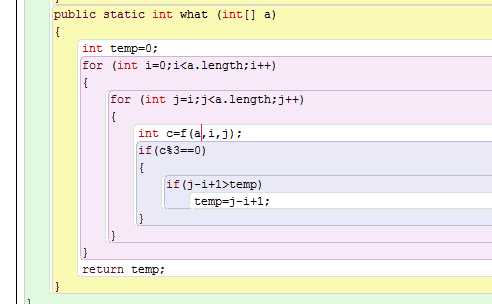
HrtOq9r.png
NT6Oi4w.jpg
 
Technology news on Phys.org
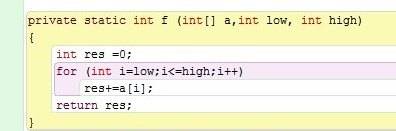
It seems you are resumming things over and over in the f method

f(a,0,3) means sum elements a[0..3]

then you do f(a,0,4) which means sum elements a[0..4]

why not remember the sum and just add a[4] to it?

This will eliminate the innermost loop in the f method.
 
As a good rule of thumb, correct algorithms have the potential to contribute the most to efficiency.

If I understand what this code is supposed to do, I would consider a different algorithm - Kadane's maximum subarray algorithm.
https://en.wikipedia.org/wiki/Maximum_subarray_problem
 
Hmm - found this in my code store, made simple example in C
Code:
#include <stdio.h>
#include <stdlib.h>
#include <limits.h>

// Kadanes Algorithm  in C
// Parameters:
// a array of integers
// sz number of elements in the array

int max_sum_subarr(int *a, const size_t sz)
{
    int i=0;
    int local_mx = INT_MIN;
    int mx_ending = 0;
    for (i = 0; i < sz; i++)
    {
        mx_ending = mx_ending + a[i];
        if (local_mx < mx_ending)
            local_mx = mx_ending;
        if (mx_ending < 0)
            mx_ending = 0;
    }
    return local_mx;
}
int main(int argc, char **argv)
{
   size_t sz=7;
   int a[7]={1 , 4, -1, -7, 3, 2, 1 };
   
   printf("maximum sub array = %d\n", max_sum_subarr(a, sz) );
   
   return 0;
}

Note the complexity change.
 
I need to find algorithm to method that return the size of largest sequence that his amounts divisible by 3, in O N complexity..
for example, for array {0,0,1,1,1,1,1} the method return 5 . {0,0,1,1,1}
 
Learn If you want to write code for Python Machine learning, AI Statistics/data analysis Scientific research Web application servers Some microcontrollers JavaScript/Node JS/TypeScript Web sites Web application servers C# Games (Unity) Consumer applications (Windows) Business applications C++ Games (Unreal Engine) Operating systems, device drivers Microcontrollers/embedded systems Consumer applications (Linux) Some more tips: Do not learn C++ (or any other dialect of C) as a...

Similar threads

  • · Replies 2 ·
Replies
2
Views
2K
  • · Replies 13 ·
Replies
13
Views
3K
Replies
4
Views
2K
  • · Replies 4 ·
Replies
4
Views
3K
Replies
7
Views
2K
  • · Replies 0 ·
Replies
0
Views
1K
Replies
29
Views
5K
  • · Replies 3 ·
Replies
3
Views
2K
  • · Replies 1 ·
Replies
1
Views
4K
  • · Replies 65 ·
3
Replies
65
Views
7K