What Does Delta Gn Represent in the MIT Chemistry Course Equation?

Click For Summary
SUMMARY

The discussion centers on the calculation of the vacancy diffusion coefficient using the equation D = Do * exp(-Ea + Delta Gn)/RT from an MIT chemistry course. Delta Gn is identified as Gibbs free energy, although the original question lacks additional energy values besides activation energy (Ea). The correct vacancy diffusion coefficient at 750°C is determined to be 5.5e-8 mm²/s, emphasizing the distinction between vacancy diffusion and atomic diffusion. Key points include the importance of using dimensionless exponential terms and accurate unit conversions.

PREREQUISITES
  • Understanding of Gibbs free energy in thermodynamics
  • Familiarity with activation energy (Ea) concepts
  • Knowledge of diffusion mechanisms, specifically vacancy diffusion
  • Proficiency in unit conversions between mm²/s and m²/s
NEXT STEPS
  • Research the role of Gibbs free energy in chemical reactions
  • Learn about vacancy diffusion mechanisms in materials science
  • Study the derivation and application of the Arrhenius equation
  • Explore the significance of prefactors in diffusion equations
USEFUL FOR

Chemistry students, materials scientists, and engineers involved in diffusion studies and thermodynamic calculations will benefit from this discussion.

guiromero
Messages
18
Reaction score
0
Homework Statement
Assume that a material has an activation energy for substitutional self diffusion migration energy of 250 kJ/mol and a Do prefactor of 100 mmm2/s. Calculate the following quantities for this material (express all your answers in units of mm2/s):
a) Calculate the vacancy diffusion coefficient at 750°C"
Relevant Equations
D = Do * exp(-Ea/RT)
Hello,

I have a doubt in a question from a chemistry MIT course:

My attempt is attached. The formula given in the lecture is D = Do * exp(-Ea + Delta Gn)/RT
However, they don't explain what Delta Gn is, I suppose it is Gibbs free energy, but as the statement doesn't give any other extra energy value despite of the activation energy (Ea), I didn't include Gn in the equation.

The correct answer is: 5.5e-8 mm2/s.

Does anyone have knowledge about this subject and would be able to help me?

Thanks a lot.
 

Attachments
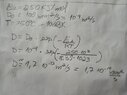
  • 20230424_195000.jpg
    20230424_195000.jpg
    41.4 KB · Views: 149
Last edited by a moderator:
Physics news on Phys.org
guiromero said:
Homework Statement: Assume that a material has an activation energy for substitutional self diffusion migration energy of 250 kJ/mol and a Do prefactor of 100 mmm2/s. Calculate the following quantities for this material (express all your answers in units of mm2/s):
a) Calculate the vacancy diffusion coefficient at 750°C"
Not really familiar with this stuff but (in the absence of other replies) this might help a bit…

The question asks for the “vacancy diffusion coefficient”. It’s asking about how fast vacancies, not atoms, diffuse.

It seems that you have calculated the ‘usual’ diffusion coefficient (for atoms).

Maybe more information is needed to answer the question. Check that you have the complete/accurate question.

Also, a few other points which are worth noting:

Exponential terms are dimensionless (have no units) so there was no need to convert from mm²/s to m²/s and then back again to mm²/s.

You converted 1.7x10⁻¹⁷ m²/s to 1.7x 10⁻¹⁴ mm²/s. That’s incorrect.

The symbol for ‘kilo’ is lower case ‘k’. So kilojoule is kJ not KJ.
 
  • Like
Likes   Reactions: BvU
If the diffusion occurs by a vacancy mechanism, the self-diffusion coefficient is given by the product of the vacancy diffusivity ##D_V## and the vacancy concentration ##[V]: D_{self}=[V]D_V##
 

Similar threads

  • · Replies 2 ·
Replies
2
Views
2K
  • · Replies 4 ·
Replies
4
Views
3K
  • · Replies 1 ·
Replies
1
Views
3K
  • · Replies 1 ·
Replies
1
Views
9K
Replies
4
Views
22K
  • · Replies 1 ·
Replies
1
Views
10K
Replies
2
Views
2K
  • · Replies 3 ·
Replies
3
Views
11K
  • · Replies 1 ·
Replies
1
Views
11K