(help optimize ciruit) 555 burst

  • Thread starter Thread starter barrettrouton
  • Start date Start date
  • Tags Tags
    Ciruit
Click For Summary

Discussion Overview

The discussion centers around optimizing a circuit using a 555 timer to create a three-round burst capability for an airsoft gun. Participants explore the design, functionality, and potential improvements of the circuit, including the use of microcontrollers versus the 555 timer, and considerations for triggering mechanisms and component protection.

Discussion Character

  • Exploratory
  • Technical explanation
  • Debate/contested

Main Points Raised

  • One participant describes their circuit design based on trial and error and seeks feedback on its optimization and component choices, particularly regarding the necessity of a MOSFET.
  • Another participant suggests using a microcontroller instead of a 555 timer for greater flexibility and ease of programming, questioning the need for simplification.
  • A participant identifies the circuit as a standard Monostable configuration for the 555 timer and notes the importance of adding a diode across the relay to protect the FET from switching voltages.
  • Concerns are raised about the behavior of the circuit when the trigger is held down, with a suggestion that dedicated Monostable chips might avoid the issue of the output staying on if the trigger is released.
  • One participant expresses satisfaction with the output staying on for a desired duration, indicating their intention to achieve semi, burst, and full firing modes with the circuit.
  • A suggestion is made to add a pull-up resistor to pin 2 of the 555 timer to enhance reliability, contingent on whether it is already included in the design.

Areas of Agreement / Disagreement

Participants express differing opinions on the use of the 555 timer versus microcontrollers, with no consensus on the optimal approach. There are also varying perspectives on the circuit's functionality and design considerations, indicating an unresolved discussion regarding the best practices for this application.

Contextual Notes

Participants mention potential limitations in the current circuit design, such as the need for component protection and the behavior of the output when the trigger is held down. There is also a lack of clarity regarding the triggering mechanism and the specific requirements of the airsoft gun's circuit.

barrettrouton
Messages
2
Reaction score
0
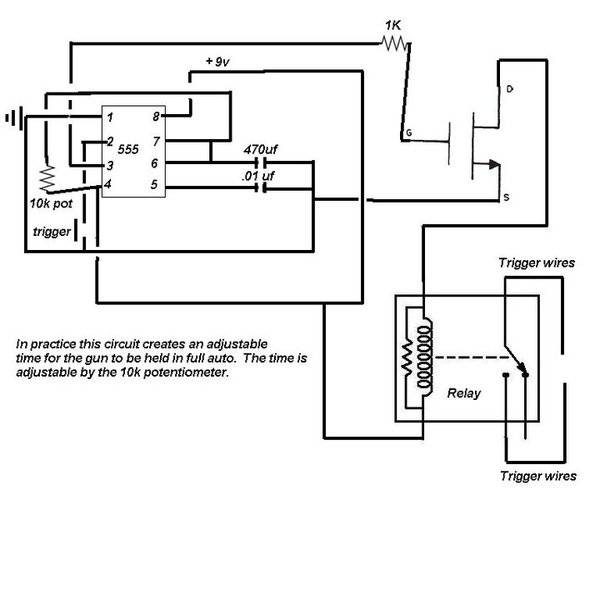
Hi all I'm building a circuit that will interconnect with my airsoftgun to provide 3 round burst capabilities. Basically it flips a relay for a set amount of time based on the value set by a pot. This closes the circuit that would normally be full auto, but for a set amount of time. I have produced this circuit mainly based on trial and error. I have no idea if this is the optimum way to do this. I don't know if the mosfet is needed or if I could find a mosfet that could drive the airsoft gun. I'm posting this circuit diagram below so I can get some feed back and determine whether or not this is the best route of action. (sorry about the diagram I just used paint)
burst.jpg
 
Engineering news on Phys.org
Well, if it were me I'd use a microcontroller instead of a 555. There's so much more flexibility you get out of them, and if you want to change the timing you just reprogram, no turning pots or soldering required. Every electronics geek needs to have microcontrollers.

But aside from that, if it works for you, what's the problem? You just want to make it simpler?

One thing that would be helpful would be to know what exactly is going with the triggering mechanism.

Here's what I'd do, I'd run a wire from the ground of the rifle's battery out to negative terminal of your multimeter, and measure the voltage on both ends of the trigger while open, then the voltage when closed. That would give us a little clue as to what is happening. I would also measure the current when closed.

If you can get a picture of the circuitry inside, that might also be helpful. Make sure to get both sides of the board.
 
That looks like a standard Monostable circuit for the 555.

You would normally add a diode across the relay to protect the FET from switching voltages.
Like this:
[PLAIN]http://dl.dropbox.com/u/4222062/555%20mono.PNG

That circuit has the disadvantage that you have to let go of the trigger before the timing is finished or the output will stay turned on. If the delay is 2 seconds or so, this may not be a problem.
Dedicated Monostable chips like the 74C221, 74C121 etc do not have this problem.

The 555 may be able to drive the relay directly but if you already have the FET in there, you may as well leave it.

If you get it firing when you first turn it on, remove the capacitor on pin 5.
 
Last edited by a moderator:
Perfection said:
Well, if it were me I'd use a microcontroller instead of a 555. There's so much more flexibility you get out of them, and if you want to change the timing you just reprogram, no turning pots or soldering required. Every electronics geek needs to have microcontrollers.

But aside from that, if it works for you, what's the problem? You just want to make it simpler?

One thing that would be helpful would be to know what exactly is going with the triggering mechanism.

Here's what I'd do, I'd run a wire from the ground of the rifle's battery out to negative terminal of your multimeter, and measure the voltage on both ends of the trigger while open, then the voltage when closed. That would give us a little clue as to what is happening. I would also measure the current when closed.

If you can get a picture of the circuitry inside, that might also be helpful. Make sure to get both sides of the board.

Appreciate the help, I decided to use the 555 because of its availability and cheapness. I'm more of a computer person so I did think about rigging an arduino. I know that sounds like overkill but I was going to put other stuff on it like an ammo counter as well, but like I said I'll probably stick with the ol 555 for now. As for the gun's circuit board, there is none just a high output 9.6v nimh battery, a motor, and a switch. Selecting the type of fire is done mechanically. I'm actually planning on running my circuit off of a separate battery because of the high fluctuations involved with the primary battery.

vk6kro said:
That looks like a standard Monostable circuit for the 555.

You would normally add a diode across the relay to protect the FET from switching voltages.
Like this:
[PLAIN]http://dl.dropbox.com/u/4222062/555%20mono.PNG

That circuit has the disadvantage that you have to let go of the trigger before the timing is finished or the output will stay turned on. If the delay is 2 seconds or so, this may not be a problem.
Dedicated Monostable chips like the 74C221, 74C121 etc do not have this problem.

The 555 may be able to drive the relay directly but if you already have the FET in there, you may as well leave it.

If you get it firing when you first turn it on, remove the capacitor on pin 5.

I actually like the fact that the output will stay on. My desired effect is basically if I tap the trigger it will stay on for ~1.5 seconds. I can hold this down and the output will stay on indefinitely so ultimately I have semi, burst, and full. Burst and full behind handled by this circuit. Thanks for the diode thing I have no idea about electronics I usually just modify and guess so you probably just save my fet. Thanks a bunch guys.
 
Last edited by a moderator:
Pin 2 of the 555 should really have a pull-up resistor to the +9 volt supply, too.

That is about 10 K from pin 2 to +9V.
If you circuit is working, you probably already have this resistor fitted. If not, it will be more reliable with it in there.
 

Similar threads

Replies
6
Views
7K
Replies
2
Views
6K
  • · Replies 10 ·
Replies
10
Views
5K
  • · Replies 1 ·
Replies
1
Views
4K
  • · Replies 10 ·
Replies
10
Views
3K
Replies
4
Views
2K
  • · Replies 1 ·
Replies
1
Views
2K
Replies
10
Views
5K
  • · Replies 2 ·
Replies
2
Views
595
  • · Replies 7 ·
Replies
7
Views
4K