Help- Physics Momentum Lab Sources of Error

Click For Summary
SUMMARY

The discussion centers on identifying potential sources of error in a grade 12 physics momentum lab involving a 2D collision on a frictionless surface. Key factors include the precision of measurement instruments, such as the scale sensitivity of the stopwatch used to time the collisions. The setup involved a glass tube and a garbage can to create a frictionless environment, which may also introduce variables affecting the accuracy of momentum calculations. Participants are encouraged to consider the limitations of their equipment and the methodology employed during the experiment.

PREREQUISITES
  • Understanding of basic physics concepts, specifically momentum and collision types.
  • Familiarity with experimental design and setup for physics labs.
  • Knowledge of measurement precision and its impact on experimental results.
  • Experience with timing devices and their accuracy in scientific experiments.
NEXT STEPS
  • Research the effects of measurement precision on experimental outcomes in physics.
  • Learn about different types of collisions and their characteristics in momentum experiments.
  • Investigate common sources of error in physics experiments and how to mitigate them.
  • Explore advanced techniques for measuring momentum in collision experiments.
USEFUL FOR

This discussion is beneficial for high school physics students, educators teaching physics lab courses, and anyone interested in improving experimental accuracy in momentum studies.

TaintedLove
Messages
9
Reaction score
0
Hi Everyone! I'm a grade 12 physics student and we conducted a momentum lab. On a frictionless surface, we conducted a simple 2D collision and using the data gathered from that, we had to calculated the momemtums and indicate what type of collision had taken place... that was all fine and done but now I'm having difficulty thinking of possible sources of error? Could someone please help me out. Below I'll post a picture of the apparatus.
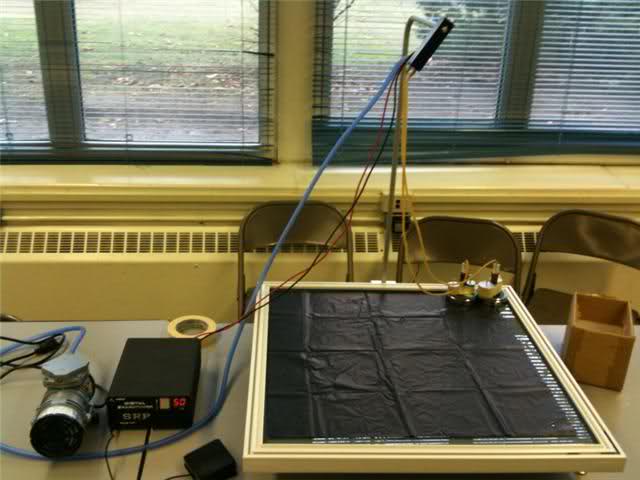
293ua0p.jpg
 
Physics news on Phys.org
It depends on what measurements you took, and the equipment you used to do it.
Could you give a little more information?
For a start: do you know the precision (scale sensitivity) of the instruments?
 
Well, it was a glass tube, covered with a garbage can and the system was set up in such a way, that when it was turned on, it was supposed to be frictionless. We collided the two masses and used a stop watch to find out the time.
 

Similar threads

  • · Replies 1 ·
Replies
1
Views
4K
  • · Replies 3 ·
Replies
3
Views
23K
  • · Replies 2 ·
Replies
2
Views
43K
  • · Replies 1 ·
Replies
1
Views
22K
  • · Replies 4 ·
Replies
4
Views
7K
  • · Replies 4 ·
Replies
4
Views
15K
Replies
8
Views
4K
  • · Replies 17 ·
Replies
17
Views
4K
  • · Replies 2 ·
Replies
2
Views
2K
  • · Replies 16 ·
Replies
16
Views
14K