Help proving triangle inequality for metric spaces

Click For Summary
The discussion revolves around proving the triangle inequality for a specific distance function in metric spaces. Participants express difficulty in manipulating fractions to achieve the desired form for the proof, particularly in using terms like Xk-Zk and Zk-Yk. There is debate about the validity of certain transformations involving denominators and whether they increase or decrease the fractions involved. The concept of absolute differences is also explored, with an emphasis on the properties of the function x/(1+x) being increasing. Overall, the thread highlights the complexities of proving the triangle inequality in this context.
lucasLima
Messages
17
Reaction score
0
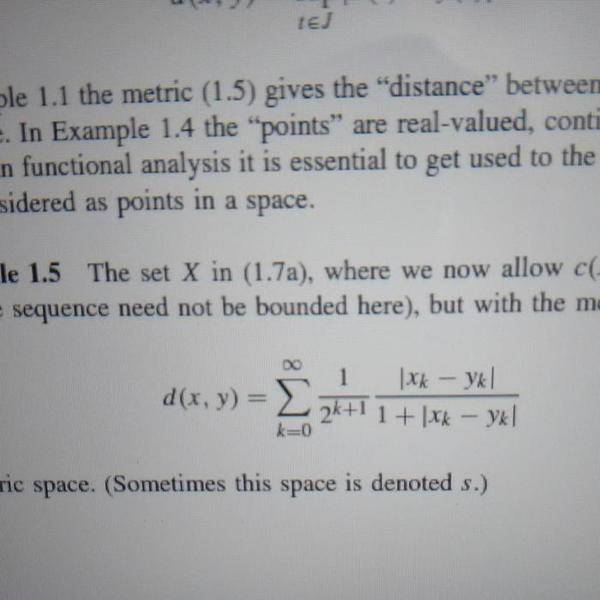
So, i need to proof the triangle inequality ( d(x,y)<=d(x,z)+d(z,y) ) for the distance below
5XzC654.jpg

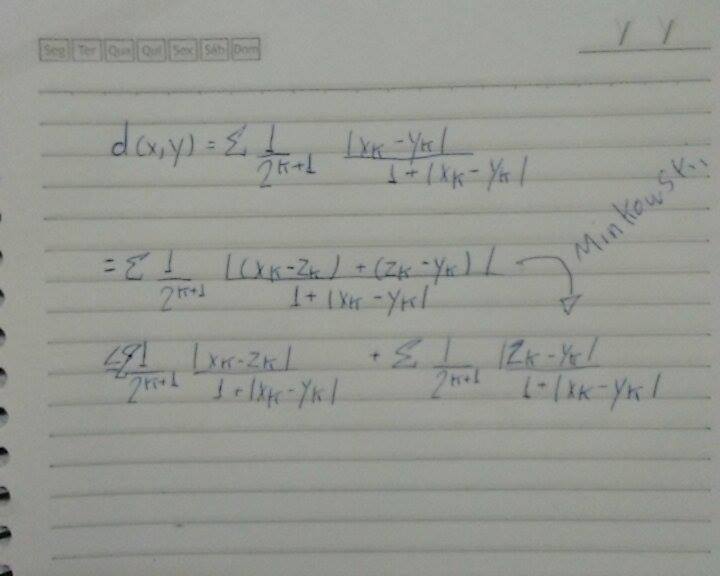
But I'm stuck at
S6sjolB.jpg


In those fractions i need Xk-Zk and Zk-Yk in the denominators, not Xk-Yk and Xk-Yk. Thanks in advance
 
Physics news on Phys.org
a/(1+a) = 1 - 1/(1+a)
Then you just have to transform the denominator and not both parts. Not sure if that is the best approach, but it is the one I would try first.
 
I used somthing similar instead Minkowski, i did (a+b)/(1+a+b) <= a/(1+a) + b/(1+b)
0Ko8ooz.jpg
f
 
I don't think that is a valid transformation with the denominator. You change 1+|g+f| to 1+|g|+|f| which might increase the fraction.
 
Last edited:
mfb said:
I don't think that is a valid transformation with the denominator. You change 1+|g+f| to 1+|g|+|f| which might reduce the fraction.
But in that case g and f are > 0, so in no way will reduce the fraction. |g|+|f|>|g+f| only if g or f is <0
 
You don't know that about f and g (which are the raw differences, e.g. xk-zk).

"reduce" in the last post should be "increase", of course.
 
(Thank you for all your help s far) What if i told you that |a-b+b-c| = |a-b| + |b-c|? I'm having a little trouble prooving that but I'm pretty confident.
 
Not in general.

a=2, b=5, c=1
1 = 3 + 4?
 
You should use the fact that the function x/(1+x)=1-1/(1+x) is increasing.
 

Similar threads

  • · Replies 2 ·
Replies
2
Views
2K
  • · Replies 19 ·
Replies
19
Views
3K
  • · Replies 6 ·
Replies
6
Views
3K
  • · Replies 8 ·
Replies
8
Views
2K
  • · Replies 10 ·
Replies
10
Views
3K
  • · Replies 5 ·
Replies
5
Views
4K
  • · Replies 1 ·
Replies
1
Views
1K
  • · Replies 7 ·
Replies
7
Views
8K
  • · Replies 9 ·
Replies
9
Views
2K
  • · Replies 8 ·
Replies
8
Views
4K