Discussion Overview
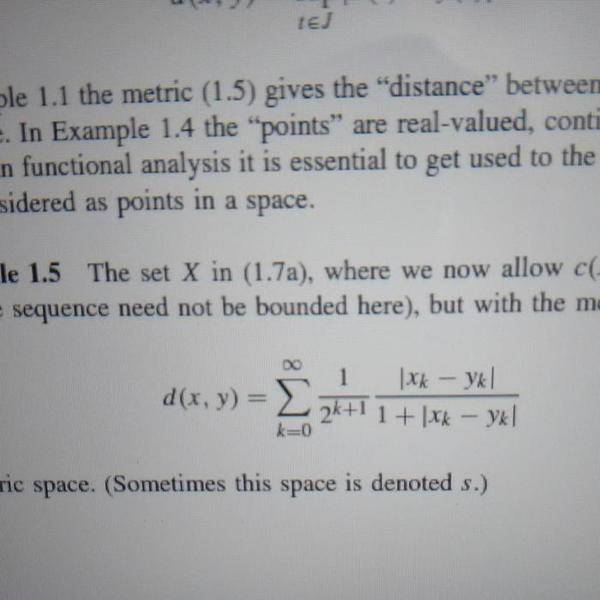
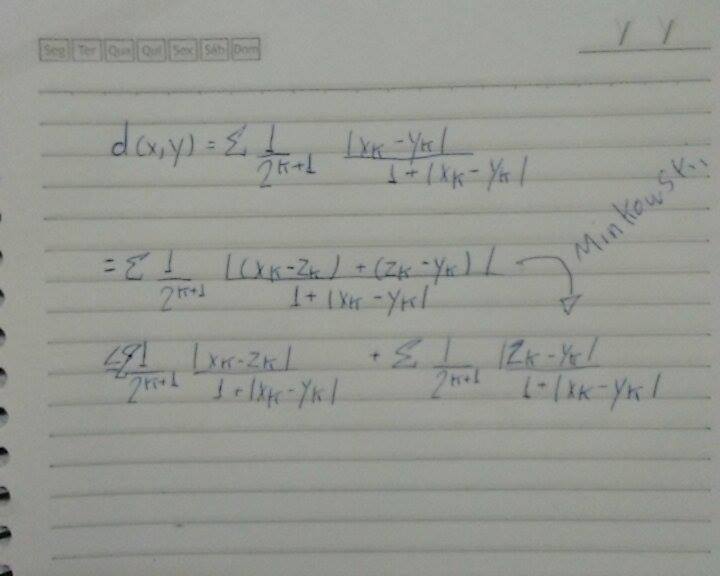
The discussion revolves around proving the triangle inequality for metric spaces, specifically the inequality d(x,y) ≤ d(x,z) + d(z,y). Participants explore various mathematical transformations and approaches to tackle the proof, while expressing uncertainty about certain steps and methods.
Discussion Character
- Technical explanation
- Mathematical reasoning
- Debate/contested
Main Points Raised
- One participant expresses difficulty in proving the triangle inequality and seeks help with specific fractions in the proof.
- Another participant suggests a transformation involving the expression a/(1+a) = 1 - 1/(1+a) as a potential approach, though they are unsure of its efficacy.
- A different participant mentions using a similar approach to Minkowski's inequality, proposing the inequality (a+b)/(1+a+b) ≤ a/(1+a) + b/(1+b).
- Some participants challenge the validity of certain transformations involving denominators, debating whether they increase or decrease the fractions involved.
- One participant questions the generality of a proposed equality |a-b+b-c| = |a-b| + |b-c|, providing a counterexample to illustrate their point.
- Another participant suggests using the property that the function x/(1+x) = 1 - 1/(1+x) is increasing as a potential avenue for the proof.
Areas of Agreement / Disagreement
Participants express differing views on the validity of certain mathematical transformations and the generality of proposed equalities. There is no consensus on the best approach to proving the triangle inequality, and the discussion remains unresolved.
Contextual Notes
Participants note limitations in their assumptions regarding the positivity of certain variables and the implications of transformations on the fractions involved. The discussion reflects ongoing uncertainty about the steps required to prove the triangle inequality.