Help understanding position operator eigenfunction derivation

Click For Summary

Discussion Overview

The discussion centers on the derivation of the position operator eigenfunction as presented in Griffiths' book, particularly the characterization of the Dirac delta function in this context. Participants explore the mathematical and conceptual implications of using the delta function versus other potential representations of eigenfunctions, addressing both theoretical and interpretative aspects.

Discussion Character

  • Debate/contested
  • Technical explanation
  • Conceptual clarification

Main Points Raised

  • One participant questions why the position operator eigenfunction is described as "nothing but the Dirac delta function," suggesting that a simple function could also serve as an eigenfunction.
  • Another participant agrees that the delta function is not a proper eigenfunction in a mathematical sense, but notes that the proposed function has zero norm, which complicates its interpretation in quantum mechanics.
  • A different participant emphasizes that generalized eigenvectors of self-adjoint operators exist outside the Hilbert space and belong to a dual space, indicating that they are distributions rather than functions.
  • Further contributions clarify that while the delta function and other generalized eigenfunctions are useful in quantum theory, they should not be treated as normalizable states, as they do not fulfill the same probabilistic interpretations.
  • One participant highlights the importance of distinguishing between pure states and generalized eigenvectors, noting that the latter can only be normalized to the delta distribution.
  • Another participant suggests that the notation used for generalized eigenfunctions can mislead beginners into thinking they can be treated like normalized states, advocating for a clearer introduction to these concepts without relying on bra-ket notation.

Areas of Agreement / Disagreement

Participants express differing views on the appropriateness of using the Dirac delta function as an eigenfunction, with some supporting its use for simplification while others criticize it for potential misunderstandings. There is no consensus on the best approach to teaching these concepts, indicating ongoing debate.

Contextual Notes

Participants note limitations related to the mathematical treatment of generalized eigenfunctions and the implications of using the Dirac notation, particularly regarding the normalization and probabilistic interpretation of states in quantum mechanics.

bob900
Messages
40
Reaction score
0
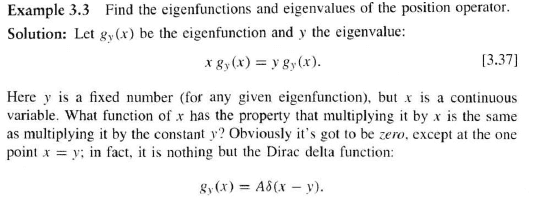
I'm having trouble understanding the derivation of the the position operator eigenfunction in Griffiths' book :

griffiths said:
npp154.png

How is it "nothing but the Dirac delta function"?? (which is not even a function).

Couldn't g_{y}(x) simply be a function like (for any constant y)

g_{y}(x) = 1 | x=y
g_{y}(x) = 0 | elsewhere

Then we have, x * g_{y}(x) = y*g_{y}(x), so it is indeed an eigenfunction of the x operator. And it happens to be a normal function. So why does he say it's 'nothing but Delta'?
 
Physics news on Phys.org
Hi Bob900,

you are completely right. The delta function is not an eigenfunction of the operator x in a mathematical sense; your function is. The problem of your function is that is has zero norm, so it does not fit into Born interpretation.

The delta function does not fit either, but textbooks use it due to wish to simplify life and treat every operator in the same way as the Hamiltonian, in particular to write abstract formulas

<br /> \hat x |x_0\rangle = x_0 |x_0\rangle<br />

and

<br /> |\psi\rangle = \int c(x) |x\rangle dx<br />

This Dirac method is not perfect and was criticized, because it suggests something that is not mathematically true. Also, it easily leads to mistaken interpretations of calculations.
The good part is, one can avoid this formalism, just by sticking to normalizable states, but it requires some effort (so it is not popular).
 
This is also not correct. It's correct that the generalized eigenvectors of essentially self-adjoint operators on Hilbert space are not part of the Hilbert space but of the dual of the smaller subspace, where this operator is defined. It's a distribution. All this is mathematically well developed. A mathematical rigorous formulation, which is very close to the physicists' handwaving approach is known under the name "rigged Hilbert space". You find a nice exposition of this methods in the textbook by Galindo and Pascual.
 
This is also not correct. It's correct that the generalized eigenvectors of essentially self-adjoint operators on Hilbert space are not part of the Hilbert space but of the dual of the smaller subspace, where this operator is defined. It's a distribution. All this is mathematically well developed.

Vanhees71, Bob900.

vanhees71 is completely right about the mathematics of generalized eigenfunctions. Of course, the delta distribution and other generalized eigenfunctions, like the exponential function on R, are useful in QT.

The problem with the Dirac symbol |x_0\rangle I meant is that it misleads one to regard |x_0\rangle or \delta(x-x_0) as \psi functions obeying the same rules and having the same probabilistic meaning as the normalized functions, (say, of the hydrogen Hamiltonian). But the role of the delta distribution or the other generalized eigenfunction, like e^{ikx}, is different; they do not play the role of the \psi function themselves, but they can be used to express the \psi function only when under the integral, like in

<br /> \psi(x) = \int \psi(x&#039;) \delta(x&#039;-x) dx&#039;<br />

or
<br /> \psi(x) = \int c(k) e^{ikx} dk/(2\pi)<br />


I have found useful comments on the use and meaning of delta function in QT in Landau & Lifgarbagez, Sec. 6 (these authors do not use the Dirac notation) and in the paper 29-1 "On "Improper" functions in quantum mechanics" in Fadeev, Selected works, V.A. Fock, Chapman&Hall, 2004; perhaps they will be useful to you.
 
This is indeed a very important point that is not so well explained in many textbooks. In the bra-ket formalism you have to distinguish between vectors representing (pure) states and (generalized) eigenvectors of essentially self-adjoint operators which are belonging to a larger space, i.e., to the dual space of the operators' domain, where they are well defined. This domain is a dense subspace of Hilbert space.

The state vectors by definition always belong to the true Hilbert space and are normalizable to one, i.e., they fulfill \langle \psi | \rangle \psi=1.

Generalized eigenvectors belonging to spectral values of the obsevable operators that are in the continuous part of the spectrum, can only be "normalized" to the \delta distribution. For the position operator you have only a continuous spectrum which is the intire \mathbb{R}^3. If you normalize the corresponding generalized eigenvectors according to
<br /> \langle \vec{x} | \vec{x}&#039; \rangle=\delta^{(3)}(\vec{x}-\vec{x}&#039;)
then the wave function is given by
\psi(\vec{x})=\langle{\vec{x}}|{\psi}\rangle,
and due to completeness we have
1=\langle \psi|\psi \rangle=\int_{\mathbb{R}^3} \mathrm{d}^3 \vec{x} \; \langle \psi|\vec{x} \rangle \langle \vec{x}|\psi \rangle=\int_{\mathbb{R}^3} \mathrm{d}^3 \vec{x} \; \psi^*(\vec{x}) \psi(\vec{x})=\int_{\mathbb{R}^3} \mathrm{d}^3 \vec{x} \; |\psi(\vec{x})|.
It's very much the same for the momentum operator. The generalized momentum eigenstate is denoted by |\vec{p} \rangle with \vec{p} \in \mathbb{R}^3, and one can also build the position representation of the corresponding distribution. If we also normalize the momentum eigenfunction to the \delta distribution it reads
\langle \vec{x} | \vec{p} \rangle=\frac{1}{(2 \pi)^{3/2}} \exp(\mathrm{i} \vec{p} \cdot \vec{x}).
From this you get the momentum-wave function from the position wave function by introducing a completeness relation in the following way
\tilde{\psi}(\vec{p})=\langle \vec{p}|\psi \rangle = \int_{\mathbb{R}^3} \mathrm{d}^3 \vec{x} \langle \vec{p}| \vec{x} \rangle \langle{\vec{x}}|{\psi} \rangle = \int_{\mathbb{R}^3} \mathrm{d}^3 \vec{x} \frac{1}{(2 \pi)^{3/2}} \exp(-\mathrm{i} \vec{p} \cdot \vec{x}) \psi(x).
This means that the momentum-space wave function is the Fourier transform of the position-space function. That's a unitary transformation on the space L^2 (after completion from the domain of the position and momentum space operators to the whole Hilbert space).
 
Vanhees71, you explained it well, and if used by an experienced user, the |x> notation works.

In much worse position is a beginner, who naturally thinks that |x_0> is a kind of quantum state that can enter the expressions

<br /> \langle x_0| x_0 \rangle,<br />

or

<br /> \langle x_0 |\hat x | x_0 \rangle .<br />

But these do not have a meaning and for this reason I think it is inappropriate to use the same notation |x> for generalized eigenfunctions as for the normalized states |\psi\rangle.

The generalized functions are important, but I think one should introduce them via the language of distributions, free of bra-ket notation and free of Hilbert space, like in the book by Landau&Lifgarbagez.

But this is a matter of taste, so Bob900, if you are still thinking about this, I recommend to read the references we gave above and also Dirac's book Principles of Quantum Mechanics, where he introduced |x\rangle, and make up your own mind.
 

Similar threads

  • · Replies 22 ·
Replies
22
Views
3K
  • · Replies 1 ·
Replies
1
Views
1K
  • · Replies 8 ·
Replies
8
Views
2K
  • · Replies 1 ·
Replies
1
Views
3K
  • · Replies 14 ·
Replies
14
Views
2K
  • · Replies 60 ·
3
Replies
60
Views
8K
  • · Replies 1 ·
Replies
1
Views
2K
  • · Replies 59 ·
2
Replies
59
Views
6K
  • · Replies 3 ·
Replies
3
Views
3K
  • · Replies 9 ·
Replies
9
Views
2K