Help understanding refraction in water

  • Thread starter Thread starter SaltMiner
  • Start date Start date
  • Tags Tags
    Refraction Water
Click For Summary

Homework Help Overview

The discussion revolves around the concept of refraction in water, specifically addressing a problem involving an observer standing in the sea and estimating the position of a shiny object beneath the surface. The original poster reflects on a lecture note that presents a scenario where the object appears to be 1 meter ahead, questioning the accuracy of this representation in light of their understanding of refraction.

Discussion Character

  • Exploratory, Assumption checking, Conceptual clarification

Approaches and Questions Raised

  • Participants explore the implications of refraction on the perceived position of the object and the sea floor. Some question whether the object should appear directly above its actual position or if horizontal distance is affected. Others discuss the role of depth cues and the potential for different interpretations based on the observer's perspective.

Discussion Status

The conversation is ongoing, with participants offering various interpretations of the problem and discussing the nuances of how refraction affects perception. Some guidance has been provided regarding the use of different visual cues, but there is no explicit consensus on the correct interpretation of the scenario.

Contextual Notes

Participants note assumptions such as calm water and a level sea floor, as well as the observer's height and the refractive indices of air and water. There is also mention of the potential for confusion arising from the relationship between the apparent and real depths in the context of refraction.

SaltMiner
Messages
6
Reaction score
3
Homework Statement
I think an old lecture note problem on refraction is wrong and I am right.
Relevant Equations
none (I think) although the general solution would involve Snell's Law.
I recently had some trouble understanding refraction but after I finally understood where I went wrong (thanks to the people on this forum) I went back to my old lecture notes because I thought that what I recently learned didn't fit right with something that had previously been presented in my introductory to physics course. Here it is:

"You are standing waist deep in the sea on a calm day and spot something shiny that seems to be 1 metre ahead of you. Where actually is this shiny thing?"

Assumptions:
Calm water (smooth surface)
Sea floor is level
Height = 1.78m
Waist = half of height
n_air = 1
n_water = 1.33

Now my problem isn't in working out the answer because that whole process was presented in the lecture power point. My problem is that I thought that when refraction occurred in such a scenario as this, where the object appears to be should be directly above where it actually is. That is to say, there is no horizontal change in distance, only vertical due to refraction.

So, the image given was this:
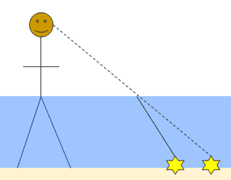
lec1.png


But what I think it should have been is this:
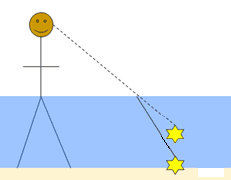
lec2.png


So if I am right in this, then the question was wrong to begin with. The object should still be 1 meter away from you, or if it actually is closer to you, it should appear that way as well.

Am I correct in this? Thanks.
 
  • Like
Likes   Reactions: Delta2
Physics news on Phys.org
SaltMiner said:
Homework Statement:: I think an old lecture note problem on refraction is wrong and I am right.
Relevant Equations:: none (I think) although the general solution would involve Snell's Law.

I recently had some trouble understanding refraction but after I finally understood where I went wrong (thanks to the people on this forum) I went back to my old lecture notes because I thought that what I recently learned didn't fit right with something that had previously been presented in my introductory to physics course. Here it is:

"You are standing waist deep in the sea on a calm day and spot something shiny that seems to be 1 metre ahead of you. Where actually is this shiny thing?"

Assumptions:
Calm water (smooth surface)
Sea floor is level
Height = 1.78m
Waist = half of height
n_air = 1
n_water = 1.33
In this case, the idea behind the question is that the target object is sitting on the flat bottom of the lake, pond, river or whatever. So the observer is not depending on binocular vision for his depth cues. He is, instead, projecting his line of sight to an ideal level bottom and estimating distance from the intersection of line of sight and sea floor.

There is a bit of an art to the process of examining a question and trying to guess at which physical principles the writer wishes to explicitly probe and which are being ignored for the moment. You will not always be able to read the writer's mind correctly.
 
Last edited:
  • Like
Likes   Reactions: SaltMiner
Because the OP is looking at a more detailed answer than is required, it is fair game and relevant to point out that - due to that same refraction - the sea floor itself will not appear at the real depth - nor, in fact, will it appear level.

So the two apparently contradictory answers can actually be reconciled. The viewer will actually perceive this:
1633472078559.png
 
  • Informative
  • Like
Likes   Reactions: SaltMiner and hmmm27
  • Like
Likes   Reactions: Steve4Physics and SaltMiner
Steve4Physics said:
I believe the correct diagram should be like this
https://upload.wikimedia.org/wikipedia/commons/c/cc/Pencil_in_a_bowl_of_water.svg
(with the tip of the pencil equivalent to the shiny object).

I found the diagram here
https://physics.stackexchange.com/q...d-in-the-concept-of-apparent-depth-real-depth
and there is a related discussion.
That approach is using the virtual focus point (in the vertical plane) as the distance cue. That is not the only possible cue that could be used.

For instance, one can use the virtual focus point in the horizontal plane (i.e. binocular vision) as the distance cue and get a different answer.

When one learns about optics in first year physics, messy things like astigmatism are not mentioned. But they are real. You can have a optical apparatus where ray tracing in the vertical plane gives you one answer while ray tracing in the horizontal plane gives another. That is the situation here.

As I've suggested upthread, one might instead use the intersection of sea floor and projected line of sight as the distance cue.

Three possible approaches. Three possible diagrams. For me, the stipulation in the problem statement that the sea floor is level reveals the intent of the question setter.
 
  • Like
Likes   Reactions: SaltMiner
jbriggs444 said:
In this case, the idea behind the question is that the target object is sitting on the flat bottom of the lake, pond, river or whatever. So the observer is not depending on binocular vision for his depth cues. He is, instead, projecting his line of sight to an ideal level bottom and estimating distance from the intersection of line of sight and sea floor.

There is a bit of an art to the process of examining a question and trying to guess at which physical principles the writer wishes to explicitly probe and which are being ignored for the moment. You will not always be able to read the writer's mind correctly.

Yeah, the following slides (that I've added at the end here) make it clear what they were asking for. I do get that. But this question was presented in the presentation just after describing refraction and just after describing Snell's Law so I'm having trouble reconciling the question itself and refraction especially after the last thread I made which also involved refraction.

So, am I correct in thinking that, yes, the apparent position of the object in this scenario SHOULD remain at the same distance away from the viewer but appear closer to the surface?

1.png
2.png
3.png
 
SaltMiner said:
So, am I correct in thinking that, yes, the apparent position of the object in this scenario SHOULD remain at the same distance away from the viewer but appear closer to the surface?
Assuming the viewer's head is upright and using binocular vision, yes. If it were tilted to one side, or with one eye closed, then the diagram in post #5 would be appropriate.
The diagrams in post #7 are wrong in all scenarios since they show the image as further away.

jbriggs444 said:
one might instead use the intersection of sea floor and projected line of sight as the distance cue.
Why would the sea floor not be subject to exactly the same change in apparent position? Or are you suggesting the viewer would subconsciously take the sea floor to be flat? That is not my experience of the phenomenon. I recall it appearing as though you are standing in a hollow, with the sea floor rising as you look further away (but asymptotically tangential to the surface, not as shown in post #5).

If looking down at an angle ##\alpha## to the horizontal and seeing sea floor at a true depth of h, the apparent depth would be ##h\frac{\sin(\alpha)}{\sqrt{n^2-\cos^2(\alpha)}}##.
 
  • Like
Likes   Reactions: SaltMiner and hutchphd

Similar threads

  • · Replies 4 ·
Replies
4
Views
806
  • · Replies 11 ·
Replies
11
Views
2K
  • · Replies 3 ·
Replies
3
Views
1K
  • · Replies 7 ·
Replies
7
Views
2K
  • · Replies 2 ·
Replies
2
Views
2K
Replies
3
Views
2K
  • · Replies 24 ·
Replies
24
Views
3K
  • · Replies 7 ·
Replies
7
Views
3K
  • · Replies 11 ·
Replies
11
Views
7K
  • · Replies 1 ·
Replies
1
Views
1K