Help understanding textbook on Landau Ginzburg theory

Click For Summary
SUMMARY

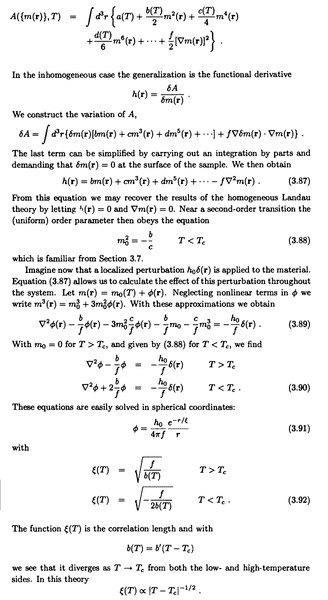
The discussion focuses on the Landau Ginzburg theory of phase transitions, specifically analyzing the equation $$b(T) = b'(T - T_c)$$. The equation suggests that the function b(T) is redefined in relation to its original definition, with the prime symbol indicating a transformation rather than a derivative. The context involves free energy A associated with a scalar field m(r), interpreted as magnetization, and the implications of coordinate changes on the functions b and b'. The discussion also explores the mathematical relationship between the functions f(x) and g(x) in the context of coordinate transformations.

PREREQUISITES
  • Understanding of Landau Ginzburg theory
  • Familiarity with phase transitions in statistical mechanics
  • Knowledge of scalar fields and their physical interpretations
  • Basic calculus, particularly function transformations
NEXT STEPS
  • Study the derivation and implications of the Landau Ginzburg free energy equations
  • Explore the mathematical properties of coordinate transformations in field theory
  • Learn about phase transition phenomena in statistical mechanics
  • Investigate the role of scalar fields in condensed matter physics
USEFUL FOR

Physicists, particularly those specializing in condensed matter physics, students studying statistical mechanics, and researchers interested in phase transitions and field theory applications.

MisterX
Messages
758
Reaction score
71
This question is about the Landau Ginzburg of phase transitions which seem to take this classical field theory form.
I don't understand the meaning of the 2nd to last equation
$$b(T) = b'(T -T_c) $$
does that mean b(T) has be redefined in the previous two equations relative to the original definition of ##b(T)##. Does the prime ##\prime## indicate a derivative? Here is the entire case, with ##A## being the free energy of some scalar field m(r), which may be interpreted as magnetization. T is temperature.
h0Sh8TK.png
 
Physics news on Phys.org
It's a coordinate change; both ##b## and ##b'## are functions. Suppose ## f(x) = (x - a)^2 ##. What is ## f(x-a) ## ? Does ##f(x) = f(x-a)## ? If not, can you find ##g(x)## such that ##f(x-a) = g(x) ##?
 

Similar threads

  • · Replies 19 ·
Replies
19
Views
3K
  • · Replies 4 ·
Replies
4
Views
3K
  • · Replies 10 ·
Replies
10
Views
2K
  • · Replies 5 ·
Replies
5
Views
3K
  • · Replies 4 ·
Replies
4
Views
2K
  • · Replies 6 ·
Replies
6
Views
1K
  • · Replies 5 ·
Replies
5
Views
2K
  • · Replies 31 ·
2
Replies
31
Views
8K
  • · Replies 12 ·
Replies
12
Views
2K
  • · Replies 12 ·
Replies
12
Views
2K