Help with best aerodynamic shape of undertray for maximum downforce?

Click For Summary

Discussion Overview

The discussion revolves around the optimal aerodynamic shape of an undertray for maximizing downforce in vehicles, particularly in the context of Formula 1. Participants explore various shapes, including wing and venturi designs, and consider the implications of technical regulations on aerodynamic performance.

Discussion Character

  • Exploratory
  • Debate/contested
  • Technical explanation

Main Points Raised

  • Some participants propose that the best theoretical shape for an undertray could be a classic venturi shape with a diffuser or a wing shape.
  • One participant highlights the significant financial investment Formula 1 teams make in computational fluid dynamics (CFD) to analyze aerodynamic shapes, suggesting that the problem is complex and well-studied.
  • Another participant references a book on vehicle aerodynamics, indicating that side skirts are a crucial variable in downforce generation.
  • Some participants argue that the current designs of F1 undertrays are constrained by technical regulations, which limit the shapes that can be used to maximize downforce.
  • There is a mention of the 2022 regulations reintroducing ground effect, which may change the dynamics of downforce generation compared to previous years.
  • One participant describes the effects of downforce on vehicle handling, noting the challenges drivers face with understeer and oversteer due to aerodynamic changes during racing.
  • Another participant questions the validity of claims about optimal shapes, suggesting that without regulations, the designs would differ significantly from current standards.

Areas of Agreement / Disagreement

Participants express a mix of agreement and disagreement regarding the influence of regulations on aerodynamic design. While some acknowledge the constraints imposed by the FIA, others argue about the theoretical possibilities without such limitations. The discussion remains unresolved regarding the optimal shape for maximum downforce.

Contextual Notes

Participants reference specific technical regulations and historical context related to aerodynamic design in Formula 1, indicating that the discussion is influenced by evolving rules and the historical development of ground effect aerodynamics.

John Mcrain
Messages
435
Reaction score
28
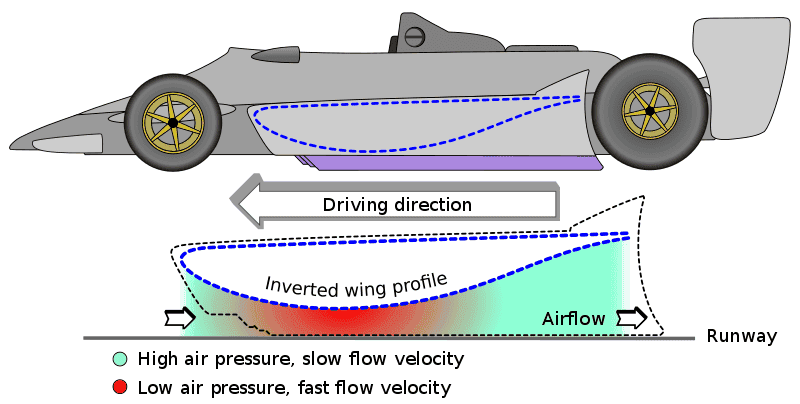
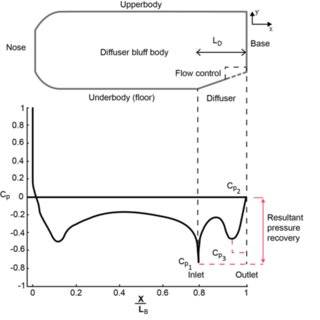
What is best theoretical shape of undertray for maximum downforce , maybe wing shape or venturi shape?

classic "venturi shape" with diffuser
2-D-illustration-of-the-pressure-behavior-along-the-underbody-with-a-2-stage-pressure_Q320.jpg
"wing shape"

hl.png
 
Engineering news on Phys.org
When you find out please do let us know or, better for you, sell the information to the Formula 1 teams. I guarantee you will have so much money you will never need to work another day in your life.

Formula 1 teams spend millions and millions on huge supercomputers, CFD programs and CFD specialists to analyse this very problem so I doubt you will get that much help here. A quick web search found this 2005 paper from Sauber reviewing the problem: Supercomputing in F1 – Unlocking the Power of CFD. This was their their supercomputer then.

Albert.jpg


As an aside I visited a very competitive F1 team in the 80s (they won a title) and was told the downforce on each single (one each side) horizontal side wing (about 10ft long? x 1ft wide?) was, IIRC, about 800 lbs while the composite structure weighed just a few pounds. Their car would indeed easily run upside down on the ceiling of the Monte Carlo tunnel without falling off.

There was another interesting effect - the downforce bottomed the car onto the suspension mounts with the springs fully compressed. The car then effectively had no suspension so the driver was battered and beaten at every bump. Vertical side wings or skirts kept air from flowing in from the side.

With downforce, the car under steered. Without downforce, the car oversteered.

The Brazilian Grand Prix circuit track was especially bumpy at the time and, when the car went over a bump, the vertical side wings lost contact with the ground allowing air to leak in and the downforce fell dramatically. The fully compressed springs then immediately threw the car up which increased the venturi throat at the front pulling in much more air which violently jerked the car down.

As the driver was cornering at 160mph or more he was continuously fighting with the car repeatedly going from full understeer to full oversteer and back again in fractions of a second and with him getting thumped every time the suspension bottomed and every time the springs pushed the car back up.

I was pleased I wasn't an F1 driver.
 
Last edited:
  • Like
  • Informative
Likes   Reactions: boneh3ad, hutchphd and berkeman
This is discussed in Aerodynamics of Road Vehicles, 4th Edition, by Wolf-Heinrich Hucho on pages 392 through 397.
Ground Effect.jpg

The most important variable is apparently side skirts.

A related area is rear diffusers. Rear diffusers are discussed here: https://ecomodder.com/forum/showthread.php/what-diffuser-38410.html. The figure in Post #9 is from the same edition of Hucho.

The book by Hucho is highly recommended. Over 900 pages of vehicle aerodynamic goodness: https://www.amazon.com/dp/0768000297/?tag=pfamazon01-20. There is apparently a 5th Edition with 1300 pages: https://www.sae.org/publications/books/content/r-430/.

If you want to study the aerodynamics of your vehicle without spending a lot of money, this book by Julian Edgar is good: https://www.amazon.com/dp/1787112837/?tag=pfamazon01-20
 
  • Informative
Likes   Reactions: berkeman and hutchphd
Frodo said:
When you find out please do let us know or, better for you, sell the information to the Formula 1 teams. I guarantee you will have so much money you will never need to work another day in your life.

Formula 1 teams spend millions and millions on huge supercomputers, CFD programs and CFD specialists to analyse this very problem so I doubt you will get that much help here. A quick web search found this 2005 paper from Sauber reviewing the problem: Supercomputing in F1 – Unlocking the Power of CFD. This was their their supercomputer then.

View attachment 275886

As an aside I visited a very competitive F1 team in the 80s (they won a title) and was told the downforce on a single side wing - about 10ft long? x 1ft wide? - was, IIRC, about 800 lbs while the composite structure weighed just a few pounds. Their car would indeed easily run upside down on the ceiling of the Monte Carlo tunnel without falling off.

There was another interesting effect - the downforce bottomed the car onto the suspension mounts with the springs fully compressed. The car then effectively had no suspension so the driver was battered and beaten at every bump. The vertical side wings kept the air from flowing in from the side.

The Brazilian Grand Prix circuit was especially bumpy at the time and, when the car went over a bump, the side wings lost contact with the ground allowing air to leak in and the downforce to fall. The fully compressed springs then immediately threw the car up which increased the venturi throat at the front pulling in much more air which jerked the car down hard.

With downforce, the car oversteered. Without downforce the car understeered.

As the driver was cornering at 160mph or more he was continuously fighting with the car repeatedly going from full oversteer to full understeer and back again in fractions of a second and with him getting thumped every time the suspension bottomed and every time the springs pushed him up.

I was pleased I wasn't an F1 driver.
You are wrong.They are limited by technical regulation.They know well which shape produce max downforce if there is no rules which they must strictly follow..
If rule say you must have flat floor ,you can't have curved floor,which is far better then flat which now use.

FIA must regulate amount of downforce because of safety,so they achieve this by limits in floor design..
 
  • Haha
  • Skeptical
Likes   Reactions: davenn and berkeman
John Mcrain said:
You are wrong.They are limited by technical regulation.
Wrong about what exactly? I found his reply quite helpful and interesting...
 
  • Like
Likes   Reactions: russ_watters
berkeman said:
Wrong about what exactly? I found his reply quite helpful and interesting...
F1 car is best possible but only for given rules for that year,so every part of F1 is not aerodynamicly optimal, as it would be if rules don't exist...
So if there is no-rules F1 undertray will never looks like they do now.

My question refers for no rules...

If no rules,wheels will never be open,underrtray will never be flat with sharp transition to diffuser,etc etc

https://www.fia.com/regulation/category/110
 
John Mcrain said:
You are wrong ... If rule say you must have flat floor, you can't have curved floor, which is far better than flat which now use.

FIA must regulate amount of downforce because of safety, so they achieve this by limits in floor design.
Correct for 2021.

But the Formula 1 rules change in 2022 after which the primary source of downforce will be the underside of the car. See 2022 Formula One World Championship which says
Aerodynamics and bodywork
The [Formula 1 2022] technical regulations will reintroduce the use of ground effect for the the first time since they were banned in the 1980s ... making the underside of the car the primary source of aerodynamic grip.
You also need to be aware of "Porpoising" - see Ground effect (cars).
"Porpoising" is a term that was commonly used to describe a particular fault encountered in ground effect racing cars.

Racing cars had only been using their bodywork to generate downforce for just over a decade when Colin Chapman's Lotus 78 and 79 cars demonstrated that ground effect was the future in Formula One, so, at this point, under-car aerodynamics were still very poorly understood. To compound this problem the teams that were keenest to pursue ground effects tended to be the more poorly funded British "garagiste" teams, who had little money to spare for wind tunnel testing, and tended simply to mimic the front-running Lotuses (including the Kauhsen and Merzario teams).

This led to a generation of cars that were designed as much by hunch as by any great knowledge of the finer details, making them extremely pitch-sensitive. As the centre of pressure on the sidepod aerofoils moved about depending on the car's speed, attitude, and ground clearance, these forces interacted with the car's suspension systems, and the cars began to resonate, particularly at slow speeds, rocking back and forth - sometimes quite violently. Some drivers were known to complain of sea-sickness. This rocking motion, like a porpoise diving into and out of the sea as it swims at speed, gives the phenomenon its name. These characteristics, combined with a rock-hard suspension, resulted in the cars giving an extremely unpleasant ride. Ground effects were largely banned from Formula One in the early 1980s, but Group C sportscars and other racing cars continued to suffer from porpoising until better knowledge of ground effects allowed designers to minimise the problem.
 
Last edited:
  • Like
Likes   Reactions: davenn
John Mcrain said:
F1 car is best possible but only for given rules for that year,so every part of F1 is not aerodynamicly optimal, as it would be if rules don't exist...
So if there is no-rules F1 undertray will never looks like they do now.

My question refers for no rules...
Nonsense. There are always rules (aka, design constraints). You just haven't said what they are (and maybe haven't thought of them yet).
 
russ_watters said:
Nonsense. There are always rules (aka, design constraints). You just haven't said what they are (and maybe haven't thought of them yet).
 
  • #10
John Mcrain said:

Is that the application/purpose of your question? So, then constraints include things like acceleration, braking and turning.

Also, presumably I'd be disqualified from the race if I tried to enter it with a helicopter?

And what about this scenario requires aerodynamic downforce at all? What if my car is powered by a thrust-vectored turbojet? And if those are constraints, what about a fan (vacuum pump) driven downforce generator (like the opposite of a hovercraft)?
 
Last edited:
  • Haha
Likes   Reactions: hutchphd

Similar threads

  • · Replies 1 ·
Replies
1
Views
2K
  • · Replies 8 ·
Replies
8
Views
5K
  • · Replies 4 ·
Replies
4
Views
3K
  • · Replies 7 ·
Replies
7
Views
7K
  • · Replies 1 ·
Replies
1
Views
11K
Replies
0
Views
2K
Replies
2
Views
1K
Replies
4
Views
3K
Replies
2
Views
2K
Replies
18
Views
3K