Help with determining distance where electric potential is 0

Click For Summary

Homework Help Overview

The problem involves determining the distance from a +4.0nC charge to a point along the line between two charges where the electric potential is zero. The context is within electrostatics, specifically focusing on electric potential due to point charges.

Discussion Character

  • Exploratory, Mathematical reasoning

Approaches and Questions Raised

  • The original poster attempts to apply the formula for electric potential and set up an equation to find the point where the total potential is zero. Some participants suggest solving the equation for the variable r, while others express difficulty in simplifying the fractions involved.

Discussion Status

The discussion includes attempts to manipulate the equation, with some participants providing guidance on solving for r. There is a mention of a participant resolving their confusion, indicating some progress in understanding the problem.

Contextual Notes

Participants note challenges with the algebraic manipulation required to solve the equation, and there is an indication of varying interpretations of the problem setup.

Hannah7h
Messages
39
Reaction score
0
Member advised to use the homework template for posts in the homework sections of PF.
Question states 'Determine the distance from the +4.0nC charge to the point, along the straight line between the charges, where the electric potential is zero.'
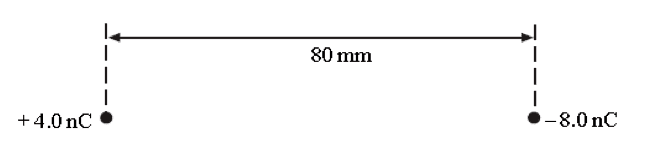
upload_2016-5-29_16-5-50.png


This is as far as I've got: so I've used V=Q/4pi(epsilon0)r and then set it so V1+V2=0 (to find the point where the resultant electric potential is zero). Then the 4pi(epsilon0) can just be ignored as it is a constant, therefore V1=Q1/R1 and then V2=Q2/R2 therefore Q1/R1 + Q2/R2 = 0 so then (substituting in the values), 4x10^-9/r - 8x10^-9/ (80x10^-3) -r = 0 AND now I'm not sure where to go from this point

Thank you for any help
 
Physics news on Phys.org
do the sum between fractions and solve the equation in ##r## ...
 
Ssnow said:
do the sum between fractions and solve the equation in ##r## ...

yeah that's the bit I can't seem to do my answer keeps coming out at 7000
 
Ssnow said:
do the sum between fractions and solve the equation in ##r## ...

No worries I've got it now thanks!
 

Similar threads

Replies
2
Views
1K
Replies
5
Views
1K
Replies
2
Views
764
  • · Replies 3 ·
Replies
3
Views
2K
  • · Replies 16 ·
Replies
16
Views
2K
  • · Replies 3 ·
Replies
3
Views
2K
  • · Replies 3 ·
Replies
3
Views
3K
  • · Replies 2 ·
Replies
2
Views
2K
  • · Replies 2 ·
Replies
2
Views
1K
Replies
1
Views
3K