Help with, I am sure, a really simple circular motion problem

Click For Summary
SUMMARY

The discussion focuses on understanding angular velocity in the context of circular motion, specifically in relation to an axe throwing problem from a Brilliant physics unit. The key formula derived is ω = θ/T, where θ is the angle in radians and T is the period of rotation. The user seeks clarification on the transition from ω = θ/T to ω = 2π × v(tangential)/l, where l represents the radius of the circle. The conversation highlights the importance of grasping angular velocity and its relationship with tangential velocity and the circumference of the circle.

PREREQUISITES
  • Understanding of angular velocity (ω) and its formula.
  • Familiarity with tangential velocity (v(tangential)) in circular motion.
  • Knowledge of radians and their application in physics.
  • Basic grasp of circular motion concepts, including period (T) and circumference.
NEXT STEPS
  • Study the relationship between angular velocity and tangential velocity in circular motion.
  • Explore the concept of radians and their significance in physics.
  • Learn about the derivation of formulas related to circular motion, including ω = 2πv(tangential)/l.
  • Review practical applications of angular velocity in real-world scenarios, such as rotational dynamics.
USEFUL FOR

Students and enthusiasts of physics, particularly those interested in circular motion and angular velocity concepts, as well as individuals taking courses like Brilliant in physics.

Nathi ORea
Messages
82
Reaction score
22
Misplaced Homework Thread
Summary: I am just trying to go through a Brilliant physics unit. I came across this axe throwing question which I don't get at all how they get the answer.
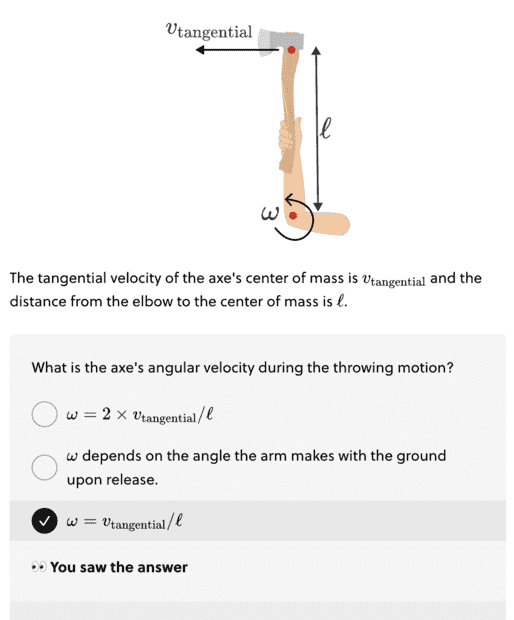
Screen Shot 2022-09-15 at 3.41.38 pm.png

You can see the answer there.

So their explanation is;

'In going around the circle, the red point moves through an angle of
θ = 360° or θ = 2π, and its angular velocity is simply ω = θ/T
'

Now I actually thought that would be the answer.. Just 2πl/T, but they continue

'ω = θ/T
= 2π X v(tangential)/l
= v(tangential/
l'

I guess I am stuck on how they got from ω = θ/T to ω = 2π X v(tangential)/l

I can see how they simplified ω = 2π X v(tangential)/l to ω = v(tangential/l'

I am just doing this Brilliant course because I find it interesting and want to learn more about how our world works. I am certainly no maths wiz.. lol. but I appreciate any help.
 
Physics news on Phys.org
\omega=\frac{\theta}{T}
=\frac{\theta l}{T l}=\frac{\frac{\theta l}{T}}{l}=\frac{v}{l}
 
  • Like
Likes   Reactions: Nathi ORea
anuttarasammyak said:
\omega=\frac{\theta}{T}
=\frac{\theta l}{T l}=\frac{\frac{\theta l}{T}}{l}=\frac{v}{l}
Thanks for replying.
I think I know why you put an ‘l’ next to theta (because that gives you the actual distance around the circle) but why does T have an ‘l’.

I feel so dumb…lol
 
As a math rule
\frac{a}{b}=\frac{al}{bl}
Multiplying a same number to numerator and denominator does not alter the number.
 
  • Like
Likes   Reactions: Nathi ORea
##2\pi l=v_{tangential}T=circumference\ of\ circle##, where T is the period of rotation. So, $$T=\frac{2\pi l}{v_{tangential}}$$
 
  • Like
Likes   Reactions: Nathi ORea
Nathi ORea said:
Thanks for that. I misunderstood what 'angular velocity' actually meant.

I have been trying to work it out, but the whole angular velocity and radians thing is not coming very intuitively to me at all... lol
You are welcome.
One full turn per second equals 6.28... radians/second.

Circle_radians.gif
 
  • Like
Likes   Reactions: Nathi ORea

Similar threads

  • · Replies 11 ·
Replies
11
Views
2K
  • · Replies 6 ·
Replies
6
Views
2K
  • · Replies 3 ·
Replies
3
Views
3K
  • · Replies 29 ·
Replies
29
Views
2K
Replies
2
Views
2K
  • · Replies 2 ·
Replies
2
Views
2K
  • · Replies 7 ·
Replies
7
Views
5K
  • · Replies 8 ·
Replies
8
Views
3K
  • · Replies 3 ·
Replies
3
Views
3K
  • · Replies 2 ·
Replies
2
Views
2K