Nathi ORea
- 82
- 22
Misplaced Homework Thread
Summary: I am just trying to go through a Brilliant physics unit. I came across this axe throwing question which I don't get at all how they get the answer.
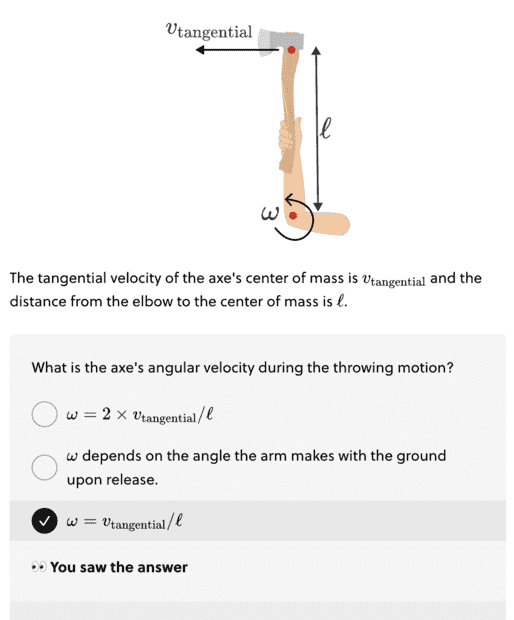
You can see the answer there.
So their explanation is;
'In going around the circle, the red point moves through an angle of
θ = 360° or θ = 2π, and its angular velocity is simply ω = θ/T'
Now I actually thought that would be the answer.. Just 2πl/T, but they continue
'ω = θ/T
= 2π X v(tangential)/l
= v(tangential/l'
I guess I am stuck on how they got from ω = θ/T to ω = 2π X v(tangential)/l
I can see how they simplified ω = 2π X v(tangential)/l to ω = v(tangential/l'
I am just doing this Brilliant course because I find it interesting and want to learn more about how our world works. I am certainly no maths wiz.. lol. but I appreciate any help.
You can see the answer there.
So their explanation is;
'In going around the circle, the red point moves through an angle of
θ = 360° or θ = 2π, and its angular velocity is simply ω = θ/T'
Now I actually thought that would be the answer.. Just 2πl/T, but they continue
'ω = θ/T
= 2π X v(tangential)/l
= v(tangential/l'
I guess I am stuck on how they got from ω = θ/T to ω = 2π X v(tangential)/l
I can see how they simplified ω = 2π X v(tangential)/l to ω = v(tangential/l'
I am just doing this Brilliant course because I find it interesting and want to learn more about how our world works. I am certainly no maths wiz.. lol. but I appreciate any help.
