Help with parts (b), (c) and (e)

3 replies · 2K views · last reply
Joe20
Messages
53
Reaction score
1
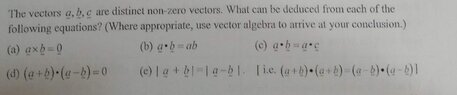
I have some difficulties answering part (b), (c) and (e).

Help is appreciated.
 
Attachments
  • Printed exercise on distinct non-zero vectors a, b, c with five parts: (a) a×b = 0; (b) a·b = ab; (c) a·b = a·c; (d) (a+b)·(a−b) = 0; (e) |a+b| = |a−b|, i.e. (a+b)·(a+b) = (a−b)·(a−b).
    Picture4.jpg
    23.6 KB · Views: 141
(b) If you write out the formula for the dot product, what do you get? Now compare that with the RHS. What can you conclude?

(c) Again, I would write out the formulae for the dot products. What can you conclude?

(e) I would think about this one geometrically. Try drawing a few examples and see what you come up with.
 
Ackbach said:
(b) If you write out the formula for the dot product, what do you get? Now compare that with the RHS. What can you conclude?

(c) Again, I would write out the formulae for the dot products. What can you conclude?

(e) I would think about this one geometrically. Try drawing a few examples and see what you come up with.
Hi Ackbach,

Thanks for the advice. I am not very sure what is meant by thinking it geometrically and drawing a few examples in part (e). Would further advice on this. Thanks.
 
Alexis87 said:
Hi Ackbach,

Thanks for the advice. I am not very sure what is meant by thinking it geometrically and drawing a few examples in part (e). Would further advice on this. Thanks.

Well, here's another hint: $\mathbf{a}-\mathbf{b}=\mathbf{a}+(-\mathbf{b})$. So, comparing $\mathbf{a}+\mathbf{b}$ with $\mathbf{a}+(-\mathbf{b})$ gives you some information about what's going on. Geometrically, how does $\mathbf{b}$ compare with $-\mathbf{b}?$