Solve Confusing Inductor Question: Finding Parts b,c,d - Help Needed

Click For Summary

Discussion Overview

The discussion revolves around a complex inductor question, specifically focusing on parts b, c, and d of the problem. Participants are seeking clarification on the application of sign conventions, the derivation of equations, and the behavior of currents and voltages in the circuit.

Discussion Character

  • Exploratory
  • Technical explanation
  • Debate/contested
  • Mathematical reasoning

Main Points Raised

  • One participant questions the presence of a negative sign in front of the integral in part b and the choice of +5 instead of -5, suggesting it may relate to the passive sign convention.
  • Another participant agrees that the voltage and current do not seem to follow the usual sign convention, indicating that current flows from voltage + to voltage - may not apply here.
  • A different participant proposes that the equation VLeq = V3.2 + V0 arises from the sign convention of currents and the definitions of current directions between i0, i1, and i2.
  • One participant suggests using Kirchhoff's Voltage Law (KVL) to analyze the circuit, providing a specific equation involving dio/dt, vo, and di1/dt.
  • Another participant shares a perspective on determining which component supplies power and which receives it, indicating that i1(0) = -6 amps suggests it supplies power, while i0 must receive power, affecting current direction.
  • A later reply advises to guess a simple component for the black box and use the provided v(t) to find i(0), suggesting verification through time constant calculations.

Areas of Agreement / Disagreement

Participants express differing views on the application of sign conventions and the derivation of equations, indicating that multiple competing interpretations remain unresolved.

Contextual Notes

There are limitations regarding the assumptions made about the circuit elements, the definitions of current directions, and the specific conditions under which the equations are derived. Some mathematical steps remain unresolved.

tesla58
Messages
2
Reaction score
0
Summary: Confusing Inductor question
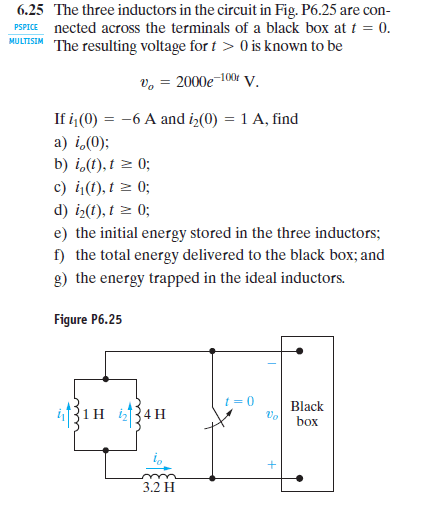
trouble.png
I've been in trouble with a question for whole days , trouble is finding parts b,c and d.
------
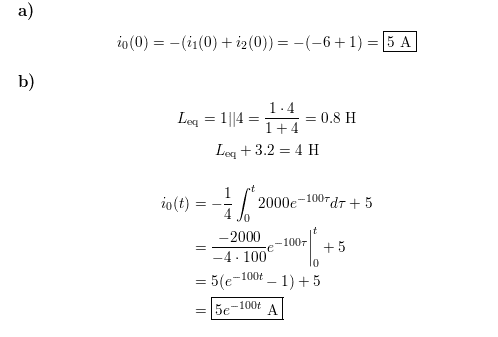
b.png
in the solving of part b WHEN we find i0(t) ,why minus is in front of integral(-1/4 coefficient one) and why +5 why not -5 ? I think it relates passive sign convention but i do not know how to determine it.
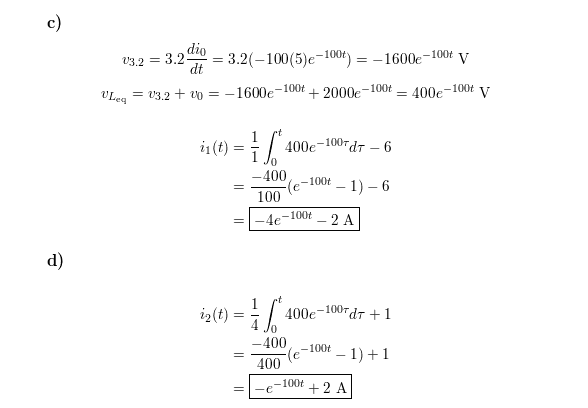
c d.png
and also part c VLeq = V3.2 + V0 where does this equation come from ? Please some help and sorry for the bad english and if i open the thread to wrong place.
 
Physics news on Phys.org
Hi.
tesla58 said:
in the solving of part b WHEN we find i0(t) ,why minus is in front of integral(-1/4 coefficient one) and why +5 why not -5 ? I think it relates passive sign convention but i do not know how to determine it.
Voltage and current here do not seem to follow usual sign convention, "current flows from voltage + to voltage -". I think it is the reason why.

tesla58 said:
where does this equation come from ?
It also comes from sign convention of currents. Oposite direction of ##v_{3.2}## and ##v_0## comes from opposite direction definition between current ##i_0## and currents ##i_1## and ##i_2## .
 
Hint: Determine what element is in black box, and find its value, setting t=0 in the equation v(t)=2000*e^-100t
 
In my opinion the KVL circulation it has to be:
-3.2*dio/dt+vo+1*di1/dt=0 and if
di1/dt+di2/dt=-dio/dt and 1*di1/dt=4*di2/dt then
dio/dt*(3.2+0.8)=-Vo
At t=0- Vo=0 [the switch is still close].
io[0-]=5
confused inductor.jpg

io=-1/4∫vo|t=0+ to t=t| +5[io t=0-]
 
I think I found a way. İt is about which one supply power to the circuit and which one receive. So here i1(0)=-6
in the beginning the most big current 6 amp it means that it supply power to the circuit ,according to sign convention current must be the direction of voltage increase and we also should consider that i1 acctually downward.And i0 must receive power so its current direction is direction of voltage drop.Finally we implement KVL
analysis.
ssssss.png
 
1. guess a really simple component for the black box
2 .then the given v(t) is a big hint once you've found i(0)
3. Verify that your guess is correct by computing a time constant involving the inductors and the black box.

The rest is straight-forward.
 

Similar threads

  • · Replies 6 ·
Replies
6
Views
3K
  • · Replies 9 ·
Replies
9
Views
3K
  • · Replies 6 ·
Replies
6
Views
1K
Replies
1
Views
1K
  • · Replies 12 ·
Replies
12
Views
3K
  • · Replies 20 ·
Replies
20
Views
3K
  • · Replies 1 ·
Replies
1
Views
2K
  • · Replies 5 ·
Replies
5
Views
3K
  • · Replies 1 ·
Replies
1
Views
2K
  • · Replies 0 ·
Replies
0
Views
3K