Help with Static Equilibrium question

Click For Summary
SUMMARY

The discussion centers on solving a static equilibrium problem involving a uniform ladder leaning against a frictionless wall. The ladder's mass is denoted as 'm', its length as 'L', and the coefficient of static friction between the ladder and the ground is 0.43. To determine the minimum angle at which the ladder will not slip, participants emphasize the importance of drawing a Free Body Diagram (FBD) to identify all forces acting on the ladder and applying equilibrium conditions for both translational and rotational forces.

PREREQUISITES
  • Understanding of static equilibrium principles
  • Knowledge of Free Body Diagrams (FBD)
  • Familiarity with forces and moments in physics
  • Basic grasp of trigonometric functions, particularly sine
NEXT STEPS
  • Study the concept of static friction and its role in equilibrium problems
  • Learn how to construct and analyze Free Body Diagrams (FBD)
  • Explore the conditions for translational and rotational equilibrium
  • Investigate the application of trigonometric functions in physics problems
USEFUL FOR

Students studying physics, particularly those focusing on mechanics and static equilibrium, as well as educators looking for teaching strategies in problem-solving techniques.

bjm5295
Messages
1
Reaction score
0
If anyone can help me out, i'd really appreciate it. I'm not necessarily looking for the answer, but more how to get to the answer. Thank a lot.

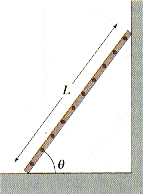
A uniform ladder of mass m and length L leans at an angle
theta.gif
against a frictionless wall, Fig. 9-61. If the coefficient of static friction between the ladder and the ground is 0.43, what is the minimum angle at which the ladder will not slip?
9_61.gif


P.S. Whats theta mean? =X For whatever reason I never learned what it means in Physics 1.
 
Last edited by a moderator:
Physics news on Phys.org
The Greek letter theta is usually used for the angle in such problems.
For your picture, the moment arm for the horizontal force at top of the ladder
is given by L sin(theta). Draw a Free body diagram and work from that.
 
As always, start by identifying all the forces acting on the ladder. Actually draw them on your diagram with proper labels.

Once you've done that, apply the conditions for equilibrium, both translational and rotational.

Hint: What's the maximum possible horizontal force that the floor can exert on the ladder?
 

Similar threads

Replies
6
Views
3K
  • · Replies 20 ·
Replies
20
Views
2K
Replies
2
Views
4K
Replies
8
Views
1K
Replies
3
Views
2K
  • · Replies 9 ·
Replies
9
Views
3K
Replies
2
Views
2K
  • · Replies 13 ·
Replies
13
Views
3K
  • · Replies 3 ·
Replies
3
Views
7K
  • · Replies 8 ·
Replies
8
Views
3K