Is the Slipping Ladder Problem a Torque or Static Equilibrium Problem?

  • Context: Undergrad 
  • Thread starter Thread starter Hereformore
  • Start date Start date
  • Tags Tags
    Slipping Torque
Click For Summary

Discussion Overview

The discussion centers around the conceptual understanding of the slipping ladder problem, specifically whether it should be classified as a torque problem or a static equilibrium problem. Participants explore the relationship between torque and static equilibrium in the context of analyzing forces and torques acting on a ladder.

Discussion Character

  • Conceptual clarification
  • Debate/contested

Main Points Raised

  • One participant expresses confusion about the nature of torque-ladder problems, questioning whether they are primarily torque problems or static equilibrium problems.
  • Another participant asserts that static equilibrium implies both the sum of forces and the sum of torques are zero, suggesting that static equilibrium problems inherently involve torque considerations.
  • A participant acknowledges the need for static equilibrium in analyzing such problems, noting the difficulty in visualizing the ladder rotating and emphasizing the importance of equilibrium for accurate analysis.
  • It is noted that forces exert torques even in static equilibrium, which leads to the conclusion that understanding torque is essential for analyzing the problem, despite the ladder not rotating.

Areas of Agreement / Disagreement

Participants generally agree that static equilibrium and torque are interconnected, but there remains some uncertainty about the implications of slipping and the visualization of the ladder's behavior in these scenarios.

Contextual Notes

Participants highlight the complexity of visualizing the ladder's behavior when slipping occurs, which may affect their understanding of the torque and equilibrium relationship.

Hereformore
Messages
61
Reaction score
0
I'm a little confused as to the conceptual premise behind torque-ladder problems? Like "at what height up the ladder is the man and ladder most likely to slip?"

I understand how to solve such problems, but i have trouble understanding how it is a torque problem.

Is it a torque problem or rather a static equilibrium problem?
I know they're kind of the same thing, but as a torque problem, I can't imagine the object actually rotating. Rather i imagine it slipping but once it starts slipping the torque conditions constantly change as the angle theta of the ladder against the ground changes.

As an equilibrium problem, it makes sense because in static equilibrium using torue allows us to use more information to understand the force interactions.

Am I "right" in being confused about this as a traditional torque problem?
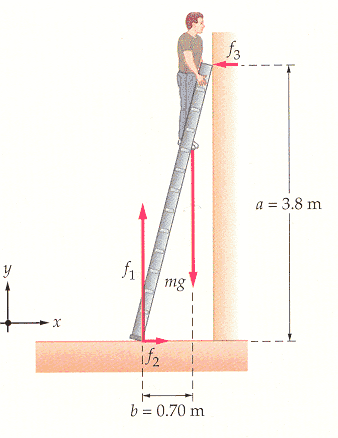
upload_2014-10-17_16-5-18.png
 

Attachments

  • upload_2014-10-17_16-1-28.png
    upload_2014-10-17_16-1-28.png
    40.8 KB · Views: 3,598
Physics news on Phys.org
Hereformore said:
Is it a torque problem or rather a static equilibrium problem? I know they're kind of the same thing,
As you mention, they are essentially the same thing. Specifically, static equilibrium means that the sum of the forces are zero and also that the sum of the torques are 0. So any static equilibrium problem has a torque problem buried inside.
 
DaleSpam said:
As you mention, they are essentially the same thing. Specifically, static equilibrium means that the sum of the forces are zero and also that the sum of the torques are 0. So any static equilibrium problem has a torque problem buried inside.
I see. So in considering such scenarios, it has to be in static equilibrium right? I guess it just seems odd that the question asks about a scenario outside of equilibrium, when you can really only accurately determine what's going on when it is in equilibrium.

It threw me off because i was trying to picture the ladder rotating and it didnt make sense to me. But it's more exploiting the torque at equilibrium right?
 
Hereformore said:
But it's more exploiting the torque at equilibrium right?
Right. The forces still exert torques at equilibrium, even though at equilibrium it is not rotating and all of the torques sum to 0.
 

Similar threads

  • · Replies 10 ·
Replies
10
Views
2K
  • · Replies 7 ·
Replies
7
Views
3K
  • · Replies 37 ·
2
Replies
37
Views
4K
  • · Replies 40 ·
2
Replies
40
Views
7K
  • · Replies 14 ·
Replies
14
Views
2K
  • · Replies 11 ·
Replies
11
Views
4K
  • · Replies 9 ·
Replies
9
Views
6K
  • · Replies 1 ·
Replies
1
Views
1K
Replies
43
Views
3K
  • · Replies 4 ·
Replies
4
Views
4K