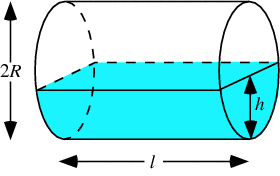
Hieght of a volume in a cylinder on its side, with known volume.

  • Thread starter Thread starter GeorgeWBush
  • Start date Start date
  • Tags Tags
    Cylinder Volume
Click For Summary
SUMMARY

The discussion focuses on calculating the height (h) of liquid in a horizontally positioned cylinder given its volume (V), length (L), and radius (R). The user has a formula for volume as a function of these parameters but encounters difficulties when attempting to isolate h. The relevant equation involves the inverse cosine function, specifically \cos^{-1}(\frac{R-h}{R}), which complicates the algebraic manipulation. The user seeks alternative methods, potentially involving calculus, to derive h directly.

PREREQUISITES
  • Understanding of cylindrical geometry and volume calculations
  • Familiarity with algebraic manipulation and polynomial expansion
  • Knowledge of trigonometric functions, particularly inverse cosine
  • Basic calculus concepts for exploring alternative solutions
NEXT STEPS
  • Research methods for isolating variables in trigonometric equations
  • Explore calculus techniques for solving for height in cylindrical volumes
  • Learn about numerical methods for approximating solutions to complex equations
  • Investigate software tools like MATLAB or Python for computational geometry
USEFUL FOR

Students, engineers, and mathematicians involved in fluid dynamics, geometric calculations, or any professionals needing to determine liquid heights in cylindrical containers.

GeorgeWBush
Messages
6
Reaction score
0
This is my first post and is for an applied project (not for a class) but I thought this was the best place to ask for help.


Homework Statement


Given a cylindar on its side, with volume V, length L, and Radius R, what is height (h) of liquid. I have fomula for volume as a function of radius, length, and height, but when I try to solve for h, things get difficult.

Homework Equations


CylindricalSegment_1002.gif

and
http://mathworld.wolfram.com/images/equations/CylindricalSegment/equation2.gif

The Attempt at a Solution


1) divide both sides by L
2) square both sides
3) expand polynomials
4) get stuck, post this message
 
Last edited by a moderator:
Physics news on Phys.org
Did you come up with that formula or was it provided and you have to solve for h?

\cos^{-1}(\frac{R-h}{R})=\frac{\mbox{adjacent}}{\mbox{hypotenuse}}
 
Last edited:
It was provided for me and I'm trying to solve for h. It is possible that there is a different approach to the problem that solves for h directly (via caluclus) but I have not found it.
 

Similar threads

  • · Replies 31 ·
2
Replies
31
Views
3K
Replies
2
Views
3K
  • · Replies 2 ·
Replies
2
Views
2K
  • · Replies 9 ·
Replies
9
Views
2K
  • · Replies 5 ·
Replies
5
Views
2K
  • · Replies 2 ·
Replies
2
Views
4K
  • · Replies 9 ·
Replies
9
Views
2K
Replies
3
Views
2K
Replies
7
Views
2K
  • · Replies 3 ·
Replies
3
Views
4K