High-Power LEDs -- Maximum 'Lumen-Density'?

  • Thread starter Thread starter Solid-Statist
  • Start date Start date
  • Tags Tags
    Leds Maximum
Click For Summary
SUMMARY

The discussion centers on the maximum lumen density achievable with high-power LED arrays printed on semiconductor wafers. Participants highlight the efficiency of high-power LEDs, such as the 3000W LED Flood Light from Lsleds, which utilizes 72 lamps, each producing approximately 8000 lumens. Key considerations include the dimensions of LED dies, with a typical size of 1.4mm for high-power applications, and the thermal load capacity, which can reach 7.5 W/mm². The conversation emphasizes the importance of semiconductor type and die dimensions in determining lumen density, as well as the impact of cooling methods on performance.

PREREQUISITES
  • Understanding of high-power LED technology and applications
  • Familiarity with semiconductor materials (Si, SiC, GaAs, Sapphire)
  • Knowledge of thermal management in LED systems
  • Basic principles of light output measurement (lumens and watts)
NEXT STEPS
  • Research typical dimensions of high-power LED dies for various semiconductor types
  • Explore thermal management techniques for high-power LED applications
  • Investigate the differences in lumen density between low-power and high-power LEDs
  • Study the impact of multi-junction die configurations on light output consistency
USEFUL FOR

Engineers, product designers, and researchers involved in LED technology, thermal management, and lighting solutions will benefit from this discussion.

Solid-Statist
Messages
12
Reaction score
5
TL;DR
On a LED semiconductor wafer, what is the maximum density of 'light production' per area?
Does the semiconductor substrate matter in maximizing density?
Light-emitting diodes (LEDs) are replacing traditional lighting technology -- such as halogen -- in high-power lamps, as LEDs are much more efficient (Lumens/W) and longer-lasting.

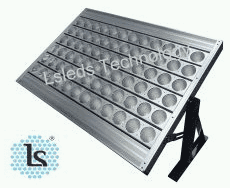
A commercial example of high-power LED flood lights: High Power 3000W LED Flood Light - Lsleds
1654623262149.png
NOTE: The above Chinese unit has an array has 72 lamps, so each lamp's LED semiconductor(s) consume about 42W, which translates to as much as 8000 lumens from a single lamp.​

QUESTIONS:

What is the maximum density of high-power LED arrays that can be printed on a semiconductor wafer, with the metrics of Lumens-output or Watts-consumed per area? (This is independent of packaging the semiconductors into a subassembly and considerations of cooling during operation.)

Is maximum density of high-power LED arrays a function of semiconductor type? (Si, SiC, GaAs, Sapphire, etc)
 
Engineering news on Phys.org
I believe this is an ill-considered question. Heat will always be the issue and no one will design an LED die which will melt in milliseconds.
 
hutchphd said:
I believe this is an ill-considered question. Heat will always be the issue and no one will design an LED die which will melt in milliseconds.
No doubt that would be true with conventional LED packaging.

This was just a theoretical question. Perhaps if it's rephrased...

Assuming that you have a tank of liquid nitrogen (or cooling equiv) to keep the LED die temp at/below its maximum limit ... what is the maximum density of high-power LED arrays that can be printed on a semiconductor wafer, with the metrics of Lumens-output or Watts-consumed per area?
 
Solid-Statist said:
what is the maximum density of high-power LED arrays that can be printed on a semiconductor wafer, with the metrics of Lumens-output or Watts-consumed per area?
It may be easiest just to find out what a typical high power LED die's dimensions are, since the scribe lines to break the wafer into die will be small compared to the die dimensions. Will that give you what you need? Do you know the typical die dimensions for some high power LED die that you are looking at?

I'll page @nsaspook since this question is right in the middle of his wheelhouse.

Also, I did a Google search on high power led fabrication wafer and got some pretty good hits. Here are a couple of them in case they help:

https://www.planetanalog.com/led-single-die-solutions-for-high-power-products/

https://www.universitywafer.com/silicon-based-gan-led-wafer.html
 
  • Like
  • Informative
Likes hutchphd, dlgoff, Solid-Statist and 1 other person
berkeman said:
It may be easiest just to find out what a typical high power LED die's dimensions are, since the scribe lines to break the wafer into die will be small compared to the die dimensions. Will that give you what you need? Do you know the typical die dimensions for some high power LED die that you are looking at?
Yes, that methodology would work great to determine the state-of-the-art 'maximum lumen density' of LED technology. I don't (yet) know much about existing "typical die dimensions for some high power LED die", but know what to ask. Perhaps if I re-rephrase the questions:

In high-power LED subassemblies that you may be familiar with, what is the semiconductor-die dimension and its lumen/wattage-rating? What semiconductor substrate is used?

Also, nice googling skills. Great article on 'single-die solutions', learned a lot ... thanks so much!
 
  • Like
Likes hutchphd and berkeman
Solid-Statist said:
I don't (yet) know much about existing "typical die dimensions for some high power LED die", but know what to ask.

I think you can get a reasonable estimate of the die size from this figure from the first link that I posted to the Plessey power LED information:

1654629225275.png


...and the datasheet info for their 7070 series LED that the article talks about. It looks like the base is 7mmX7mm, so if you assume that the drawing above is to scale, that will let you estimate the dimensions of that die. Datasheet info found here:

https://uk.rs-online.com/web/p/leds/1696969
 
  • Like
Likes Solid-Statist
berkeman said:
It looks like the base is 7mmX7mm, so if you assume that the drawing above is to scale, that will let you estimate the dimensions of that die.

Let’s give this a shot…
1654621667297.png


In the drawing, the high-power LED die is about 1/5th the length of the 7x7mm package, so the die length would be 1.4mm and its area about 2mm^2.

The Plessey datasheet notes a power level of up to 15W for the device, so that would mean the maximum thermal load on the die could reach 7.5 W/mm^2, or over 4800 W/sqin. Does that sound right?
 
hutchphd said:
Here's some low-power small ones :
https://www.i-micronews.com/wafer-level-micro-led-matrix-delivers-high-brightness-at-2540dpi/
The Plessey mentioned by @berkeman is likely a multi-junction die (probably 3 in series} so slightly different in design. The devil is in the detail.

From a relative standpoint, how much do "low-power" LEDs differ from high-power LEDs in their maximum lumen- or power-density?

The Plessey paper on LED Single-Die Solutions notes that this configuration has an advantage over "multi-junction die" in that there is no dimming or shadowing in the light output at the gaps between dies (see below).

1654622801780.png
 

Similar threads

  • · Replies 15 ·
Replies
15
Views
3K
Replies
2
Views
2K
Replies
2
Views
3K