How accurate can the shadow of a large sundial be?

  • Thread starter Thread starter Jonathan212
  • Start date Start date
  • Tags Tags
    Shadow
Click For Summary
SUMMARY

The accuracy of a sundial is influenced by its size, with larger sundials potentially offering improved precision due to sharper shadows. However, factors such as the Earth's rotation, atmospheric refraction, and the angular diameter of the Sun introduce complexities that can lead to cumulative errors of several minutes over time. The Jantar Mantar sundial in India, built in 1734, is noted for its remarkable accuracy of within 2 seconds, despite these challenges. Understanding the interplay of these factors is crucial for optimizing sundial design and functionality.

PREREQUISITES
  • Understanding of Earth's rotation and its impact on time measurement
  • Familiarity with atmospheric refraction and its effects on light
  • Knowledge of the equation of time and analemma for solar time correction
  • Basic principles of optics, particularly related to diffraction and light behavior
NEXT STEPS
  • Research the design principles of the Jantar Mantar sundial for insights into achieving high accuracy
  • Explore the effects of atmospheric refraction on solar observations
  • Learn about the equation of time and how to apply it for sundial corrections
  • Investigate optical systems like sextants for enhanced solar time readings
USEFUL FOR

Individuals interested in horology, astronomers, and engineers designing sundials or studying solar timekeeping methods will benefit from this discussion.

Jonathan212
Messages
198
Reaction score
4
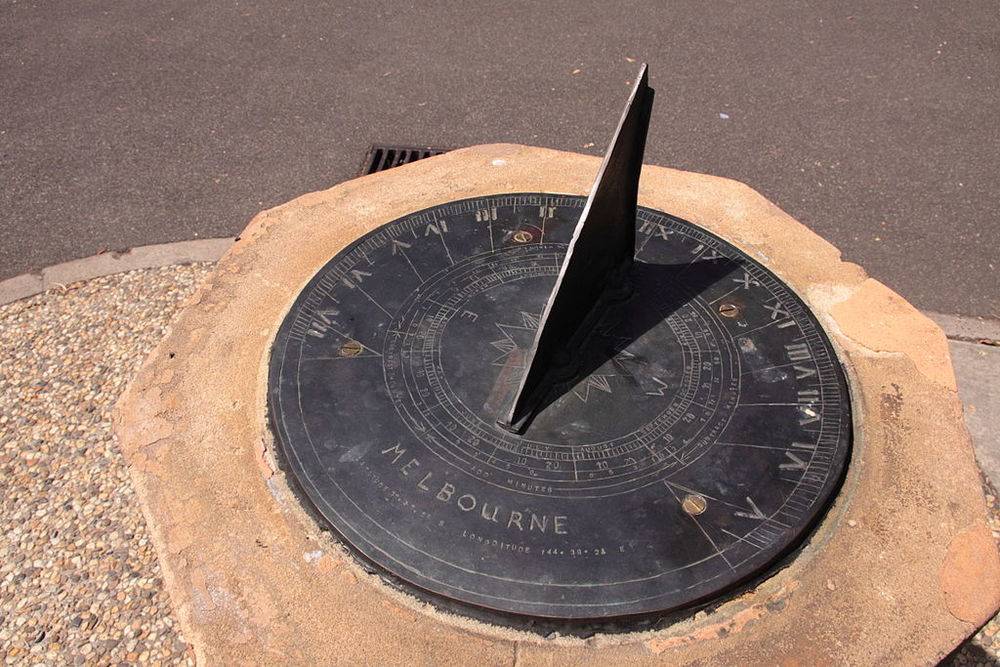
Saw a sundial the other day and it occurred to me that a larger one would be more accurate. But then shadows get less sharp at a distance so there is a trade-off.

1024px-Melbourne_sundial_at_Flagstaff_Gardens.jpg


What would be the maximum accuracy that can be achieved by making a sundial larger?
 
Engineering news on Phys.org
Here's what I would expect is the biggest source of uncertainty:

Earth rotates around its own axis every 23h 56m 4.1s
The day is longer because the Earths move a bit further in its orbit around the Sun, so the Sun is at a slightly different angle on the next day. This adds 235.9 seconds to the day.
The orbit of the Earth around the Sun is has an eccentricity of 0.0167. This means that the distance to the Sun changes by 3.3% over the year between aphelion and perihelion. According to Keplers second law, this means that the Earth is 3.3% faster on its orbit on perihelion, compared to aphelion. This effect makes an ideal sun dial error oscillate with an amplitude of about +-4 seconds over the year.

After further thinking, I figured I messed up. The effect is cumulative over months, so the error builds to at least a few minutes.
 
Last edited:
Jonathan212 said:
What would be the maximum accuracy that can be achieved by making a sundial larger?
The Earth rotates relative to the Sun at 15° per hour. It takes 4 minutes to move by 1°. The Sun has a diameter of 0.5° so it appears to move one diameter in 2 minutes. That limits the ability to read the position of the shadow on a sundial.
Accurate solar times can be read using a simple optical system like a sextant, where the angle to the edges of the solar disk are read.

You need to know the date so you can correct the ±15 minutes for the equation of time.
https://en.wikipedia.org/wiki/Equation_of_time#Graphical_representation
https://en.wikipedia.org/wiki/Analemma
 
  • Like
  • Informative
Likes Spinnor and anorlunda
There must be another factor too when all others have been taken into account, and that is light diffusion. A skyscraper's shadow must not be as sharp as the size of the sun dictates but less.
 
Heat haze along the atmospheric path of the light from the Sun may cause some shimmer, but that should be small compared with the angular diameter of the Sun, it is not a problem when using a sextant for navigation.

A bigger effect will be the elevation of the sun near dawn and dusk due to difrefraction by the atmospheric pressure gradient. That difrefraction should not be a problem near midday.

https://en.wikipedia.org/wiki/Atmospheric_refraction#Values
 
Last edited:
I have this picture in my mind of seawaves entering a harbour and becoming less straight at the corners. Aren't light waves that have just cleared an object less flat than unopposed light waves entering a sextant? We have the numbers for sun diameter etc, what are the numbers for the effect due to the wave nature and wavelength of light?
 
Optical telescopes, camera apertures and lenses work OK, so why should a sextant or sundial be different?

Knife-edge diffraction bleeds a small amount of energy passing a knife edge into the shadow zone. The energy affected is only that which passes a few wavelengths from the knife edge. The wavelength of light is extremely small compared with the size of a gnomon, or a building, so the proportion of light diffracted is minuscule.

The Sun produces a very wide spectrum of light. Knife edge diffraction will really only be visible for monochromatic light passing within a few wavelengths of a sharp edge.
 
  • Like
  • Informative
Likes Klystron and tech99
While the Sun is above the horizon, light from the Sun, (mostly blue), is scattered by the atmosphere which makes the sky look blue. That diffuse blue light illuminates exposed shadows that the direct sunlight cannot reach. Rose coloured glasses should increase the contrast, and your belief in your ability to accurately read a sundial. Why do we not paint sundials red to get a better contrast?
 
  • #10
The Binoy Dial uses a lens on the gnomon to focus sunlight. Seems like that could be more accurate.
 
  • #11
Light turning a few wavelengths to the left means several meters for detectors far enough from the edge.

We have the numbers for sun diameter etc which translate into an angle and the angle translates into 2 minutes of time precision. What are the numbers for the effect due to the wave nature and wavelength of light?
 
  • #12
That's like asking, if the sun were a point source, what would be the maximum accuracy of the sundial once all other factors like analemma etc were corrected for?
 
  • #14
Jonathan212 said:
We have the numbers for sun diameter etc which translate into an angle and the angle translates into 2 minutes of time precision. What are the numbers for the effect due to the wave nature and wavelength of light?
The wavelength of light is so short, and the spectrum so wide, that it has no effect on the accuracy of a sundial. You can improve the accuracy by replacing the plate gnomon with a cylindrical style, and replacing the flat plate with part of a graduated cylinder about the style axis. If the diameter of the style is selected to be 0.5° when viewed from the scale, the shadow of the style will not be asymmetric but will have the mid-line darkest, with light either side. That will improve the resolution by a factor of 4 or more. It would cancel edge diffraction effects, if they were visible, but it cannot reduce the horizon refraction in the few minutes after dawn or before dusk.

Jonathan212 said:
Wow! That angle is big.
That angle will be 90°, but it effects only a thin skin about one micron thick, and then only if the edge is optically straight, and a perfect conductor. Illumination falling in the shadow will be less than 0.1% of that of the sunlit area, so you will not notice it.
 
  • #15
No it won't be 0.1%, it'll be 0.01% at 120 degrees. Without sources to back them up, such numbers are not appreciated.
 
  • #16
Image processing software could easily find the location of the mid point between fully lit and fully shadowed to high precision but not the human eye, unless specially trained and if the sundial is the right size.
 
  • #17
Jonathan212 said:
No it won't be 0.1%, it'll be 0.01% at 120 degrees. Without sources to back them up, such numbers are not appreciated.
You are saying it would be harder to see than I am.
But how can the angle be greater than 90 degrees? If it was greater it would hit the back of the knife edge that diffracted it.
I got the 0.1% from a conservative -60dB on a diffraction chart.
Where did you get your 0.01% ?
 
  • #18
The 0.01% is arbitrary of course, and so is the 120 angle measured from the plane of the knife. Where is the diffraction chart?
 
  • #19
Jonathan212 said:
Image processing software could easily find the location of the mid point between fully lit and fully shadowed to high precision but not the human eye, unless specially trained and if the sundial is the right size.
There is no such thing as fully shadowed. A cloud in the sky to one side and clear of the sun, a nearby building, or an observer wearing a white shirt, will change the level of illumination of the shadow. That will change the critical threshold.

Don't put your faith in DSP until you have discovered the limitations of rose coloured glasses.
 
  • #20
Jonathan212 said:
The 0.01% is arbitrary of course, and so is the 120 angle measured from the plane of the knife.
The light is diffracted as it crosses the knife edge. The light is initially at 90 degrees to the plane of the knife. It then turns to fill the shadow behind the knife. If you measure the angle relative to the plane of the knife the direction becomes 0° or 180°, not 120°. The light still only changes direction by 90° on passing the edge.

Jonathan212 said:
Where is the diffraction chart?
“Electronic Transmission Technology; lines, waves and antennas”. By William Sinnema. 1979. Chapter 8.
 
  • #22
Where is the -3 dB or -6 dB point in that diffraction chart in the Sinnema book?

Stating the obvious once again, those 0.01% and 120 figures are just fake figures made up to help you feel how people might feel when unsubstantiated figures are thrown at them by a stranger online - trying to prove them wrong is missing the point, the point is your figures need backing. Ideally online but that book is ok too, sort of, as long as you're honest. Fully shadowed in the context of the conversation means no straight light from the sun but even with all diffractions taken into account the image processing would be trivial: just fit an expected parametric curve to pixel values along a line in a photograph of the sundial. But we must stay low tech like the eye or it's pointless. Maybe lenses too.

Marcusl, I can΄t find how that big Indian sundial achieves 2 second accuracy. This contradicts calculations by people above, any idea how it might be done?
 
Last edited:
  • #23
As low tech as it gets...

Image6.jpg


It says where the twig's shadow disappears, that's what the time is (marks are every 2 seconds). And you then correct for analemma with a calculator? :smile: But the big shadow is much sharper than the 2 minutes of width expected based on the diameter of the sun.
 
Last edited:
  • #24
A partially occluded sun would have a visible area like this:
CircularSegment_1001.gif

Image8.jpg

Source: http://mathworld.wolfram.com/CircularSegment.html

Therefore the plot of light from fully shadowed to fully lit should look like this:
Image15.jpg

Let's add the diffraction chart on top. Where does -3 dB or -6 dB fall?
 
Last edited:
  • #25
I built a sun dial it is very accurate. Your right a tiny one to fit on a wrist watch is hard to see. A 12" sun dial is easy to read. A 4 ft sun dial shadow is fuzzy but still easy to read. I have not found information for angle of the pointer but the sun dials I have seen were 40 and 45 degree angle. June 21/22 sun is 76 degrees at my house. Dec 21/22 sun is 34 degrees at my house. Angle of sun dial pointer might be best set at 76+34/2=55 degrees for my house but not sure.
 
  • #26
gary350 said:
I have not found information for angle of the pointer but the sun dials I have seen were 40 and 45 degree angle.
The edge (style) of the pointer (gnomon) should be parallel with the axis of Earth's rotation. The slope angle of the gnomon for your location should be your latitude on Earth.

Your June solstice is 76°, while Dec is 34°, so you must be in the northern hemisphere.
The sum and difference of those two solstice elevation angles is interesting.

Split the difference to get the equinox angle (76°+34°)/2 = 55° and we have your latitude on the face of the Earth as 55°North.

The seasons are caused by the Earth's rotation axis being tilted by 23.4° relative to the axis of the Earth's orbital plane about the Sun. (76°–34°)/2 = 21° so there is a 2° error in your solstice measurements. Accurate values should be your latitude ±23.4°.
 
  • #27
Baluncore said:
The edge (style) of the pointer (gnomon) should be parallel with the axis of Earth's rotation. The slope angle of the gnomon for your location should be your latitude on Earth.

Your June solstice is 76°, while Dec is 34°, so you must be in the northern hemisphere.
The sum and difference of those two solstice elevation angles is interesting.

Split the difference to get the equinox angle (76°+34°)/2 = 55° and we have your latitude on the face of the Earth as 55°North.

The seasons are caused by the Earth's rotation axis being tilted by 23.4° relative to the axis of the Earth's orbital plane about the Sun. (76°–34°)/2 = 21° so there is a 2° error in your solstice measurements. Accurate values should be your latitude ±23.4°.

I found answers online but they don't add up? I am at zip code 37129. Online says angle of the sun will be same as my latitude on June 21/22.

Online says, my latitude is 86.39 degrees so sun should be 68.39 degree at solar 12 noon.

Online say, solar 12 noon is 12:50 pm by the clock.

I hammered a stake into the ground at an angle so it makes no shadow at 12:50 pm. Taking a measure off of a level it is not 86 degrees not even close?
 
  • #28
A sundial gives solar time. Think of it in those terms. Basically, your local time is calibrated by the sun passing over your local meridian being midday. This is true wherever you are. You may correct this for the difference between local and time zone meridians to obtain the local time zone solar time etc. However, the position of the shadow is subject to atmospheric refraction and that is not a constant but largely influenced by temperature & pressure. When I did geodesy, we did these correction for both astro obs (Laplace) and zenith to distant geodetic stations. However large the sun dial, it will be subject to this variation. I expect this will be a major factor in it's direct reading accuracy.
 
  • #29
gary350 said:
I found answers online but they don't add up? I am at zip code 37129.
I google 'latitude of zip 37129' and get 35.9173° N, 86.4491° W

Your longitude is 86.45° West of Greenwich, London, England. That sets your time zone.
Your latitude is 35.9° N, so you are 35.9° North of the equator.

The gnomon of your sundial should have a slope angle of your latitude, 35.9° downwards towards the south, relative to the horizontal.

The solstices are on the 21 or 22, of June or December.
The equinoxes are on the 22 or 23, of March or September.

At the equinox, (or on average), the sun is above the Earth's equator, so it will be 35.9° from the vertical where you are. That will be 90° – 35.9° = 54.1° above your southern horizon.

At the equinoxes, or on average, the sun will reach 54.1° above your southern horizon.
At the summer solstice it will reach 54.1° + 23.4° = 77.5° above your southern horizon.
At the winter solstice it will reach 54.1° – 23.4° = 30.7° above your southern horizon.
 
  • Like
Likes Tom.G
  • #30
Baluncore said:
I google 'latitude of zip 37129' and get 35.9173° N, 86.4491° W

Your longitude is 86.45° West of Greenwich, London, England. That sets your time zone.
Your latitude is 35.9° N, so you are 35.9° North of the equator.

The gnomon of your sundial should have a slope angle of your latitude, 35.9° downwards towards the south, relative to the horizontal.

The solstices are on the 21 or 22, of June or December.
The equinoxes are on the 22 or 23, of March or September.

At the equinox, (or on average), the sun is above the Earth's equator, so it will be 35.9° from the vertical where you are. That will be 90° – 35.9° = 54.1° above your southern horizon.

At the equinoxes, or on average, the sun will reach 54.1° above your southern horizon.
At the summer solstice it will reach 54.1° + 23.4° = 77.5° above your southern horizon.
At the winter solstice it will reach 54.1° – 23.4° = 30.7° above your southern horizon.

How to aim sun dial pointer at solar 12 noon? I think magnet north is wrong. True north is about 4 degree from magnet but which direction?
 

Similar threads

  • · Replies 7 ·
Replies
7
Views
2K
  • · Replies 11 ·
Replies
11
Views
2K
  • · Replies 2 ·
Replies
2
Views
2K
  • · Replies 3 ·
Replies
3
Views
4K
  • · Replies 6 ·
Replies
6
Views
3K
Replies
7
Views
3K
  • · Replies 10 ·
Replies
10
Views
2K
  • · Replies 8 ·
Replies
8
Views
3K
  • · Replies 11 ·
Replies
11
Views
2K
  • · Replies 6 ·
Replies
6
Views
3K