How Can I Calculate the Frequency of the Left Pendulum in a Coupled System?

  • Thread starter Thread starter Fabio010
  • Start date Start date
  • Tags Tags
    Coupled Physical
Click For Summary

Homework Help Overview

The discussion revolves around calculating the frequency of a left pendulum in a coupled pendulum system, where the right pendulum is set into motion first. The original poster describes the setup and the relationship between the two pendulums, noting the influence of the right pendulum's motion on the left pendulum's frequency.

Discussion Character

  • Exploratory, Assumption checking, Mathematical reasoning

Approaches and Questions Raised

  • Participants explore the relationship between the periods and amplitudes of the coupled pendulums, questioning how to derive the frequency of the left pendulum based on the known parameters of the right pendulum. Some participants express confusion regarding the setup and the equations involved.

Discussion Status

There is ongoing exploration of the equations governing the motion of the pendulums, with some participants providing insights into the dynamics of coupled systems. However, there is no explicit consensus on the correct approach or solution, and multiple interpretations of the problem are being discussed.

Contextual Notes

Participants note the complexity of the system and question the clarity of the original problem statement. There are references to specific equations and assumptions about the system's behavior, including the effects of small angles and weak coupling.

Fabio010
Messages
84
Reaction score
0
Coupled physical pendulums (URGENT)

Imagine that you have coupled physical pendulums like this (see image below).
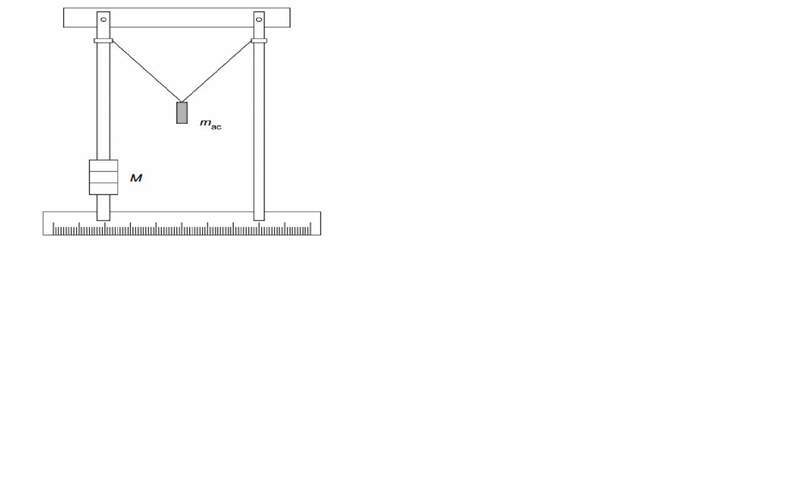
Imagem 1.jpg


mass is in the inferior part of the pendulum.*

Now we let the right pendulum swing without initial speed = 0 with a certain amplitude. As we know, the amplitude of the right pendulum will decrease , increasing the amplitude of left pendulum.

I have the Period for the max amplitude of the right pendulum. When the amplitude of the right pendulum is zero, i have to mark the max amplitude of the left pendulum.

You can see in the following image:
Imagem 2.jpg


L it's approximated 1 meter.

d its caused by the coupled pendulums. it's the distance between the equilibrium point without being coupled to the equilibrium point being coupled.

Now how can i calculate the frequency (v max) of the left pendulum??

I just know the period of the right pendulum. I know the max amplitude in left pendulum. How can i calculate the frequency of the left pendulum?

( frequency is induced by right pendulum)? I really need help, its urgent.
 
Last edited:
Physics news on Phys.org


anyone??is something my problem that is not explicit?


Fabio010 said:
anyone??is something my problem that is not explicit?

TBH, I can't make head or tail of it.


The diagram looks like no coupled pendulum arrangement I've ever seen.

You seem to have a rigid bar on the right - which could be a pendulum except that it has no mass associated.
On the left is another bar, this time with a mass so I assume that IS a pendulum. And between them you have a mass suspended on a cord.

The nearest thing to this in standard physics texts is two pendula coupled by a spring. The analysis of the motion is not simple.
Try http://http://www.theorphys.science.ru.nl/people/fasolino/sub_java/pendula/doublependul-en.shtml


AJ Bentley said:
The diagram looks like no coupled pendulum arrangement I've ever seen.

You seem to have a rigid bar on the right - which could be a pendulum except that it has no mass associated.
On the left is another bar, this time with a mass so I assume that IS a pendulum. And between them you have a mass suspended on a cord.

The nearest thing to this in standard physics texts is two pendula coupled by a spring. The analysis of the motion is not simple.
Try http://http://www.theorphys.science.ru.nl/people/fasolino/sub_java/pendula/doublependul-en.shtml


that link is not working. :/


i found this equations to coupled pendulums.


I= inertial

α and β are angles.

M1 = mass of right pendulum
L1 = length of right pendulum = L2
m2 = mass of left pendl..

For the right pendulum:
I1.d^2α/dt^2 = -1/2.M1.g.L1.sinα - k[sinα - sinβ]

For the left pendulum:

I2.d^2β/dt^2 = -1/2.m2.g.L2.sinβ k[sinα - sinβ]


in the limit of small angles

α,β << 1
so:

I1.d^2α/dt^2 = -1/2.M1.g.L1.α - k[α-β]

I2.d^2β/dt^2 = -1/2.m2.g.L2.β + k[α-β]


if we consider a weak coupled pendulum system, then:

k<<1

and because left pendulum have a mass and a inertia much greater then the right pendulum:

M1>>m2 and I1>>I2

Equation to right pendulum can be simplified to:

I1.d^2α/dt^2 ≈ -1/2.M1.g.L1.α


to left pendulum we have:

I2.d^2β/dt^2 = -[1/2.m2.g.L2.β+ kβ ] + kα

i.e

I2.d^2β/dt^2 + (ωo)^2.β = kα(t)


then

(ωo)^2 = 1/2 * (m2gL2) + k

so the frequency induced by the right pendulum to the left pendulum is:

f = 2.pi/ωo ...

is that right?
 

Similar threads

  • · Replies 27 ·
Replies
27
Views
2K
  • · Replies 9 ·
Replies
9
Views
3K
  • · Replies 16 ·
Replies
16
Views
1K
  • · Replies 6 ·
Replies
6
Views
4K
Replies
17
Views
3K
Replies
17
Views
3K
  • · Replies 3 ·
Replies
3
Views
3K
Replies
7
Views
2K
  • · Replies 8 ·
Replies
8
Views
2K
Replies
14
Views
3K