How can I compute expected return time of a state in a Markov Chain?

Join the discussion
Ask a follow-up here, or get your own question answered by working scientists, mathematicians and engineers — people, not an autocomplete.
Real named experts · corrections over time · the nuance an AI answer skips
7 replies · 7K views
user366312
Gold Member
Messages
88
Reaction score
3
Problem Statement
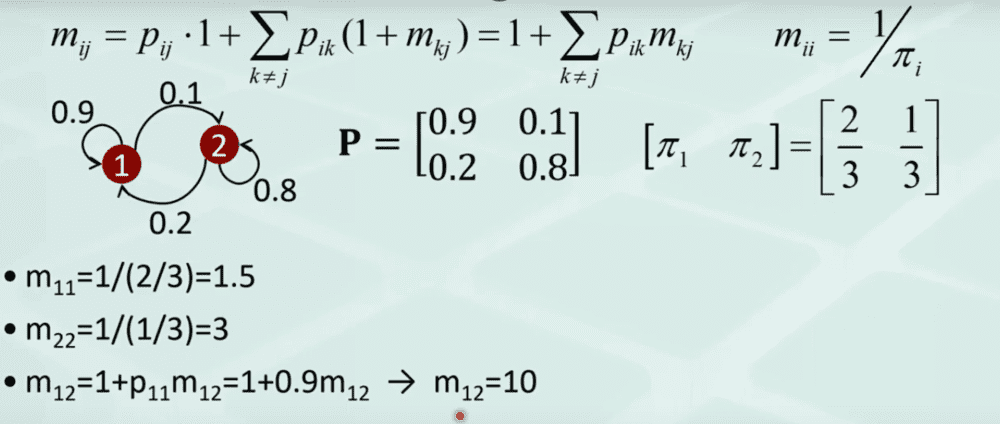
I was watching a YouTube video regarding the calculation of expected return time of a Markov Chain.
I haven't understood the calculation of ##m_{12}##.

How could he write ##m_{12}=1+p_{11}m_{12}##? I have given a screenshot of the video.
241819
 
Last edited by a moderator:
on Phys.org
Orodruin said:
In all cases, you need to take a time step - that is the 1. With probability ##p_{11}##, you will not leave node 1. So you need to add that probability multiplied by the mean time to get to 2 from 1, which is ##m_{12}##.

Why didn't he add 1 in case of ##m_{11}##?

Why is ##m_{12}## on the both side of the equation
 
Orodruin said:
He did.

I don't see it. Coz, he calculated ##m_{11} = \frac{1}{\frac{2}{3}}##

Orodruin said:
Because if you stay at 1, then the expected time to get to 2 will be the expected time to get to 2 from 1.

So, then he should write: ##m_{12} = 1 + p_{11}m_{21}## . But he didn't write that.
 
user366312 said:
I don't see it. Coz, he calculated ##m_{11} = \frac{1}{\frac{2}{3}}##
So, then he should write: ##m_{12} = 1 + p_{11}m_{21}## . But he didn't write that.

Well, it is good he did not write that, because it is wrong.

Just look at the equations
$$m_{ij} = 1 + \sum_{k \neq j} p_{ik} m_{kj}.$$
You have all the ##p_{ij}## given right in the problem, so just going ahead and writing out the equations for the ##m_{ij}## is elementary. You seem to be over-thinking the problem, or in some other way, confusing yourself.

You should realize that there may be more than one way to compute some of the ##m_{ij}##. Using ##m_{11} = 1 + p_{12} m_{21}## is one way (after you have calculated ##m_{21}##), but using ##m_{11} = 1/\pi_1## is another. A useful calculation check is to see whether you get the same value both ways---if you did everything right, you should.
 
Last edited:
  • Like
Likes   Reactions: jim mcnamara
The meaning of the

$$ m_{i,j} = 1+ \sum_{k\neq j} p_{i,k} m_{k,j} $$
formula.

The expected number of steps to get someone from i to j:

One step is definitely a must.

However, besides, if you did not reach j in the first step, but you get into a different k, then look at how many steps you can expect from k to j and you take this expected value with the weight what probability you first step into k.