How Can I Enhance My Deep Sky Images and Identify Celestial Objects?

  • Thread starter Thread starter mad4itpete
  • Start date Start date
Click For Summary
SUMMARY

This discussion focuses on enhancing deep sky images captured with the Seestar S50 telescope. Key specifications include a 250mm aperture and f/5 focal ratio, with images taken at 10 seconds exposure over 50-60 frames, which were stacked using the Seestar's software. Participants emphasize the importance of dark frames and suggest cleaning optics if image quality appears compromised. Overall, the Seestar S50 is praised as a solid entry-level telescope for astrophotography.

PREREQUISITES
  • Understanding of astrophotography principles
  • Familiarity with the Seestar S50 telescope specifications
  • Knowledge of image stacking techniques
  • Basic skills in optical maintenance and cleaning
NEXT STEPS
  • Research advanced image stacking methods using software like DeepSkyStacker
  • Learn about dark frame calibration techniques in astrophotography
  • Explore optical cleaning techniques for telescopes and cameras
  • Investigate upgrading options for telescopes to enhance imaging capabilities
USEFUL FOR

Astronomy enthusiasts, amateur astrophotographers, and anyone seeking to improve their deep sky imaging techniques with entry-level telescopes.

mad4itpete
Messages
4
Reaction score
8
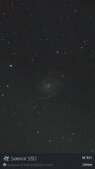
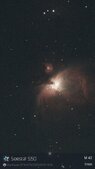
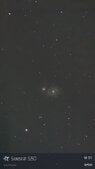
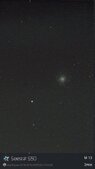
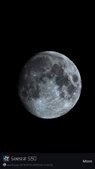
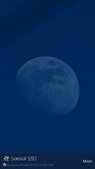
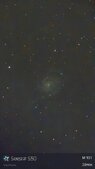
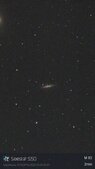
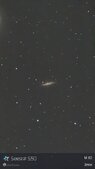
A very good friend asked me to post here obviously a fellow member. The images are from my seestar s50. I'd be grateful for any advice to enhance images and your thoughts on the images.
 

Attachments

  • 1742325672074.jpg
    1742325672074.jpg
    8.2 KB · Views: 32
  • 1741737197332.jpg
    1741737197332.jpg
    22.9 KB · Views: 26
  • 1741200837989.jpg
    1741200837989.jpg
    22 KB · Views: 45
  • 1741770007697.jpg
    1741770007697.jpg
    7.9 KB · Views: 26
  • 1741739318676.jpg
    1741739318676.jpg
    20.4 KB · Views: 46
  • 1741741001098.jpg
    1741741001098.jpg
    13.6 KB · Views: 61
  • 1744131121867.jpg
    1744131121867.jpg
    7.1 KB · Views: 30
  • 1741770426168.jpg
    1741770426168.jpg
    10.2 KB · Views: 27
  • 1741478851303.jpg
    1741478851303.jpg
    23.8 KB · Views: 71
  • 1741769600342.jpg
    1741769600342.jpg
    10.1 KB · Views: 28
  • Like
  • Love
Likes   Reactions: davenn, AlexB23, Drakkith and 4 others
Astronomy news on Phys.org
Welcome to PF. I've moved your thread from the New Member Introduction forum to the Astronomy forum. :smile:
 
Welcome to PF!

Good start if those are among your first! To assist in improving: What are the specs on these images: Aperture, focal ratio/length, camera make/model and settings, exposure (number of exposures)? Did you take dark frames? Do you have raw images? What processing did you do?
 
The images were taken via seestar the exposure time was 10 secs and between 50 - 60 images taken and then stacked by seestar and it's own software.yes I have the raw images. Focal ratio ect is automatically done by the telescope
 
mad4itpete said:
A very good friend asked me to post here obviously a fellow member. The images are from my seestar s50. I'd be grateful for any advice to enhance images and your thoughts on the images.
Cool! The Seestar seems like a great introductory telescope: 250mm f/5 is very reasonable and a 50mm aperture is somewhat resistant to bad seeing conditions. The downside is that there's not much to do to expand/extend the capability of the device since it's fully self-contained, so I'm not sure how much you will use it before you are ready/desirous for an upgrade. I am curious about a few things:

1) since the device uses an alt/az (dobsonian) mount, the field of view should (slowly) rotate as you are acquiring images. I realize that image stacking is included in the device app, but I wonder if you notice any effect if you acquire images for a few hours rather than a few minutes.
2) From the blogs, it looks like you use live view to point the telescope at your target, set focus, etc. How easy is it to go through all that? Do you have to carefully level the scope first?

Edit: from your Mars image, I suspect your front element is dirty, as if there is a thin film present. Do you know how to clean your optics?
 
I thought the same I'm going to leave it on an object for several hours. No it's pretty easy to set up calibrate the compass and level up is easy too got to get 2 circles conjoined. Yea I have optical lense wipes after blowing with compressed air first.
 
mad4itpete said:
A very good friend asked me to post here obviously a fellow member. The images are from my seestar s50. I'd be grateful for any advice to enhance images and your thoughts on the images.
Beautiful nebula and galaxies, man. Astronomers in thr 1800s with the most powerful telescopes would do anything to get images of this quality. Most people today would still struggle to make images of this quality. 10/10 great work.
 
  • Like
Likes   Reactions: Drakkith
AlexB23 said:
Beautiful nebula and galaxies, man. Astronomers in thr 1800s with the most powerful telescopes would do anything to get images of this quality. Most people today would still struggle to make images of this quality. 10/10 great work.
Cheers Alex
 
  • Like
Likes   Reactions: AlexB23
mad4itpete said:
Cheers Alex
You're welcome, brother. It would be nice if the objects were labeled, so folks knew which objects were shown. I know the moon and Orion nebula, but not all the galaxies.
 

Similar threads

  • · Replies 226 ·
8
Replies
226
Views
16K
  • · Replies 1 ·
Replies
1
Views
2K
  • · Replies 3 ·
Replies
3
Views
2K
  • · Replies 17 ·
Replies
17
Views
5K
  • · Replies 25 ·
Replies
25
Views
5K
  • · Replies 5 ·
Replies
5
Views
2K
Replies
4
Views
6K
  • · Replies 2 ·
Replies
2
Views
2K
  • · Replies 8 ·
Replies
8
Views
3K
  • · Replies 30 ·
2
Replies
30
Views
5K