Discussion Overview
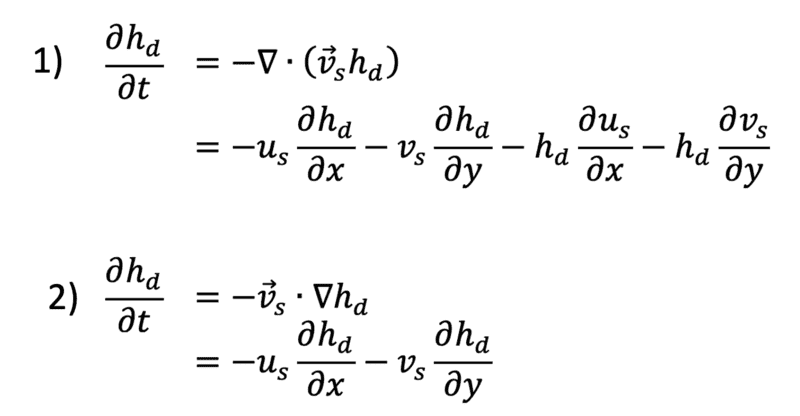
The discussion revolves around the interpretation and modeling of the 2D advection equation in the context of debris transport on a glacier. Participants are exploring the physical differences between equations related to the velocity components and the behavior of the debris layer.
Discussion Character
- Exploratory
- Technical explanation
- Debate/contested
Main Points Raised
- One participant seeks clarification on the physical differences between two equations related to the advection of a debris rock layer on a glacier.
- Several participants request diagrams to clarify whether the velocity components (u and v) represent averages over the thickness of the layer or values at the top.
- There is a question about whether the rock layer is moving as a rigid body or deforming, with one participant asserting that the rocks are not deforming and are instead transported by the ice.
- Another participant suggests that if the rocks are not deforming, then the velocity components u and v do not vary with x and y.
- A participant emphasizes the importance of understanding the physics behind the process and suggests that one should consider how one equation can be derived from another, referencing a previous comment by another participant.
- There is a suggestion that understanding the divergence term related to the change of debris height over time is crucial for grasping the underlying model.
Areas of Agreement / Disagreement
Participants express differing views on the behavior of the debris layer (rigid vs. deforming) and the interpretation of velocity components, indicating that multiple competing views remain in the discussion.
Contextual Notes
Participants have not reached a consensus on the interpretation of the equations or the physical behavior of the debris layer, and there are unresolved questions regarding the definitions of the velocity components.