How Can I Solve for the Equilibrium Constants in These Equations?

Click For Summary

Discussion Overview

The discussion revolves around solving for equilibrium constants in a set of equations related to a chemical system. Participants express challenges in determining these constants, with references to specific equations and values provided in the original post.

Discussion Character

  • Homework-related
  • Mathematical reasoning
  • Debate/contested

Main Points Raised

  • One participant states they are aware that X = 200 and that K_{out} = Cl_{out} from one of the equations, but they struggle to find the equilibrium constants.
  • Another participant requests clarification on the specific question being solved, noting that the equations are presented without context.
  • A participant mentions that the goal is to find concentrations at equilibrium.
  • One participant suggests that the issue may stem from having too many equations that are not all independent, leading to trivial results like 0=0.
  • There is a proposal that the protein forms complexes characterized by a single equilibrium constant, which needs to be calculated from the data.
  • Another participant asserts that the problem can be solved using simple algebra, implying that extraneous information may be complicating the process.
  • One participant notes that substituting values leads to cancellation resulting in 0=0, echoing concerns about the independence of the equations.

Areas of Agreement / Disagreement

Participants express differing views on the nature of the problem, with some suggesting that the equations are not independent while others believe the approach is valid if unnecessary information is disregarded. The discussion remains unresolved regarding the best method to solve for the equilibrium constants.

Contextual Notes

There are indications of missing assumptions and dependencies on the definitions of the equations presented. The discussion highlights potential limitations in the setup of the equations and their interdependencies.

Air
Messages
202
Reaction score
0
Homework Statement
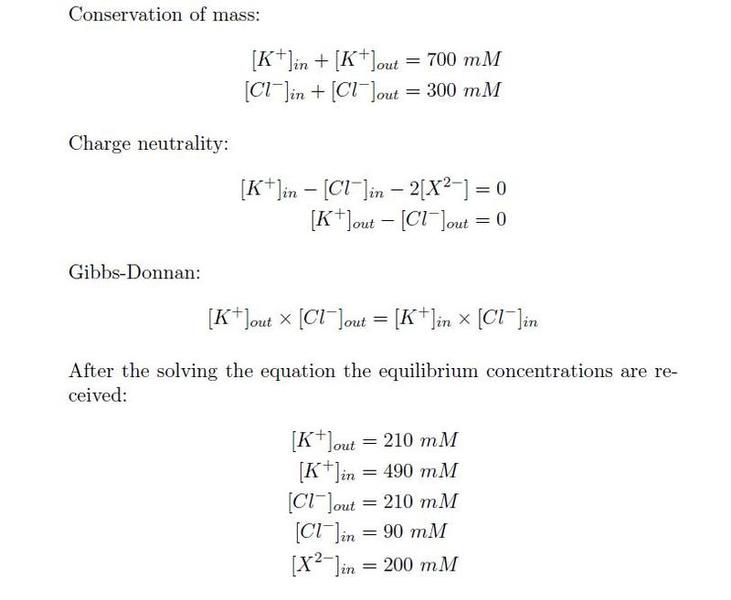
With the 5 equations, the equilibrium contants can be calculated at the bottom. (See image)
P1.jpg


My complication
I am aware that [itex]X = 200[/itex] thus that value remains at that. Also, From the fourth equation [itex]K_{out}[/itex] = [itex]Cl_{out}[/itex]. But, I cannot seem to work out the values. If not simple algebra, what am I missing?
 
Physics news on Phys.org
Won't hurt if you would explain what is the question that you are solving, at the moment you just posted a bunch of equations describing some undefined system.
 
P12.jpg


From this, finding the concentrations at equilibrium.
 
I understand how the equations are set up but I can't seem to solve the maths to get the equilibrium constants. Is there something I am missing? Like I said, I am aware that [itex]X = 200[/itex] thus that value remains at that. Also, From the fourth equation [itex]K_{out}[/itex] = [itex]Cl_{out}[/itex].
 
Simple algebra.

My bet is your problem is related to the fact you have too many equations - they are not all independent, which makes you getting 0=0 type result.
 
By equilibrium constants are we to guess that the protein forms complexes we might call XCl- and XCl2 in non-coperative fashion so it is characterised by a single equilibrium constant which it is required to calculate from the data?

I think you had better cite the entire question.
 
Last edited:
epenguin said:
By equilibrium constants are we to guess that the protein forms complexes we might call XCl- and XCl2 in non-coperative fashion so it is characterised by a single equilibrium constant which it is required to calculate from the data?

I think you had better cite the entire question.

The whole question is posted in post number 3. https://www.physicsforums.com/showpost.php?p=4410136&postcount=3
 
You do realize there is no problem with solving the question using your approach and the simple algebra, it is just a matter of ignoring superfluous information?
 
Borek said:
You do realize there is no problem with solving the question using your approach and the simple algebra, it is just a matter of ignoring superfluous information?

When I substitute into each other, they all just cancel out to 0=0.
 
  • #10
Which is exactly what I wrote in the post #5 - have you read it? That's because the linear equations are not independent. Ignore one of the linear ones and you will get the correct answer.
 

Similar threads

Replies
4
Views
2K
  • · Replies 7 ·
Replies
7
Views
3K
  • · Replies 4 ·
Replies
4
Views
3K
  • · Replies 3 ·
Replies
3
Views
3K
Replies
5
Views
2K
  • · Replies 1 ·
Replies
1
Views
2K
Replies
3
Views
3K
Replies
17
Views
3K
  • · Replies 4 ·
Replies
4
Views
5K
  • · Replies 2 ·
Replies
2
Views
2K