High School How Can Point Particles Have Cross Sections?

Click For Summary
The discussion centers on the concept of point particles in quantum physics and their ability to interact despite having no spatial extent. Participants explore how particles like electrons can have non-zero cross sections, which are essential for interactions, by discussing the role of electric fields and virtual particles in mediating these interactions. The conversation highlights that interactions can occur without direct contact, using examples from electrostatics and quantum mechanics. It is emphasized that the physical size of particles does not determine their ability to interact, as quantum mechanics allows for interactions even among particles considered to be point-like. Overall, the thread seeks to clarify the mechanisms behind particle interactions in the context of the standard model and quantum field theory.
  • #31
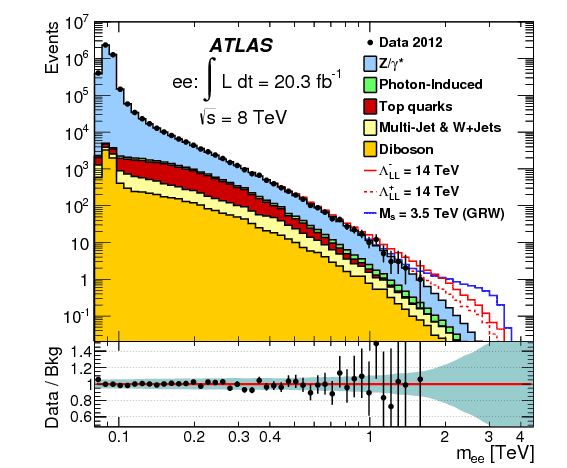
I don't quite understand what sophiecentaur is saying, but here's some data that shows what a non-pointlike behavior would look like:
mass_signal_elec.png


The red lines on the far right is roughly (and this is oversimplifed) what a ~1.5 x 10⁻²⁰ m electron size would look like.
 

Attachments

  • mass_signal_elec.png
    mass_signal_elec.png
    14.6 KB · Views: 572
Physics news on Phys.org
  • #32
What you're missing in your description of a "cross-section" is that it is an interaction cross-section. The interaction being through some field whether it is the electromagnetic field, the weak field, or the chromodynamic field. That's how point particles have cross-sections.
 
  • #33
alantheastronomer said:
What you're missing in your description of a "cross-section" is that it is an interaction cross-section. The interaction being through some field whether it is the electromagnetic field, the weak field, or the chromodynamic field. That's how point particles have cross-sections.
I think that's as much as we can expect and I can cope with that idea. It's actually all we get from any cross section measurement. As far as I remember, talk of an electron cross section seems to be in terms of an upper limit - as in "it must be smaller than this value".
mfb said:
You cannot, that is the point. If electrons would have something like a classical size you could, but they do not have this.
I could understand that the cross section would be different for different interactions - eg for charged and non charged particles but that could be the same for proton / proton cross section and proton / neutron cross section and how it could relate to the KE of an electron. My (mis?)conception is based on a though experiment of what would happen for two beams of electrons fired at one another. The distribution of the scattered beams would depend on the KE, the higher the KE, the narrower would be the 'shadow' of an emerging beam. But you are telling me that would fall down once the energies got high enough. (is that what the graph you posted shows?)
 
  • #34
You get various bumps in the spectrum from the production of new particles at their mass, you get steps from additional reactions that become possible above some thresholds, and similar effects. None of these things have anything to do with a size of an electron.
 
  • #35
mfb said:
You get various bumps in the spectrum from the production of new particles at their mass, you get steps from additional reactions that become possible above some thresholds, and similar effects. None of these things have anything to do with a size of an electron.
But I have always been referring to scattering - which implies direction, not the energies involved. (As with Rutherford scattering and the size of the atom)
 
  • #36
That's what I have shown. If you mean elastic scattering, then say that. Unfortunately that total cross section is infinite. If you ask for the differential cross section above some angle: That is finite, and so far it is simply falling with increasing energy as expected for point particles.
 
  • #37
mfb said:
That's what I have shown. If you mean elastic scattering, then say that. Unfortunately that total cross section is infinite. If you ask for the differential cross section above some angle: That is finite, and so far it is simply falling with increasing energy as expected for point particles.
OK. Thanks. That is the most useful response so far and it answers my original query. Any 'bottom' of this potential well has not been found.
 

Similar threads

  • · Replies 3 ·
Replies
3
Views
2K
  • · Replies 2 ·
Replies
2
Views
3K
  • · Replies 4 ·
Replies
4
Views
2K
  • · Replies 29 ·
Replies
29
Views
4K
  • · Replies 5 ·
Replies
5
Views
2K
  • · Replies 3 ·
Replies
3
Views
2K
  • · Replies 1 ·
Replies
1
Views
3K
  • · Replies 1 ·
Replies
1
Views
754
  • · Replies 1 ·
Replies
1
Views
2K
  • · Replies 1 ·
Replies
1
Views
2K