How Can You Move a Pi Bond Into a Cycloalkane?

  • Thread starter Thread starter Phil Massie
  • Start date Start date
  • Tags Tags
    Bond Pi
Click For Summary

Discussion Overview

The discussion revolves around the transformation of a pi bond into a cycloalkane, specifically focusing on the synthesis of methylcyclohexene. Participants explore various methods and mechanisms involved in this organic chemistry problem, including hydrohalogenation, dehydrohalogenation, and E2 elimination reactions.

Discussion Character

  • Homework-related
  • Exploratory
  • Technical explanation
  • Debate/contested

Main Points Raised

  • One participant suggests starting with hydrohalogenation of the alkene substituent followed by dehydrohalogenation, noting the formation of constitutional isomers and questioning the stability of endocyclic versus exocyclic pi bonds.
  • Another participant agrees on the possibility of different products from an E2 reaction and discusses the implications of product stability and formation ratios.
  • A different viewpoint proposes that hydrohalogenation and dehydrohalogenation may not be necessary, suggesting that an acid-catalyzed E2 elimination could directly yield the endocyclic isomer, with exocyclic products being recycled.
  • Another participant offers a simpler approach involving bromination followed by an E2 reaction using a sterically hindered base like tert-butoxide.

Areas of Agreement / Disagreement

Participants express differing opinions on the necessity of hydrohalogenation and dehydrohalogenation, as well as the stability of endocyclic versus exocyclic products. There is no consensus on the best method to achieve the transformation.

Contextual Notes

Participants reference different mechanisms and assumptions about product stability, but these points remain unresolved. The discussion includes various proposed methods without a definitive agreement on the optimal approach.

Phil Massie
Messages
5
Reaction score
0
Hello. This is driving me a little mad, and some assistance would be hugely appreciated.

Homework Statement


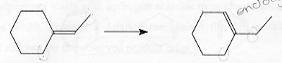
Show how the following transformation can be achieved (more than one step may be involved)
Homework Equations


pf01.jpg


The Attempt at a Solution


The only approach i could come up with was the following:

1. hydrohalogenation of the alkene substituent with H-Cl, putting a Cl on the more substituted C atom and an H on the less substituted C.

2. dehydrohalogenation should then produce constitutional isomers, as there are 3 \beta carbons, 2 of which produce the same molecule (i think) and both constitutional isomers have tri substituted double bonds. the required pruduct is then one of the constitutional isomers, methylcyclohexene.

I just saw in another textbook something about endocyclic \pi bonds being more stable than exocyclic \pi bonds. Is this the case in this problem? and would that mean that the required product would be the only one formed?

Thanks in advance for any help. Its late and i can't think anymore...
 
Physics news on Phys.org
Phil Massie said:
2. dehydrohalogenation should then produce constitutional isomers, as there are 3 \beta carbons, 2 of which produce the same molecule (i think) and both constitutional isomers have tri substituted double bonds. the required pruduct is then one of the constitutional isomers, methylcyclohexene.

I just saw in another textbook something about endocyclic \pi bonds being more stable than exocyclic \pi bonds. Is this the case in this problem? and would that mean that the required product would be the only one formed?


You're correct there are 3 beta hydrogens, with the possibility of two different products from an E2 reaction. I'm not sure about different stabilities of endo/exo cyclic rings, but even if the two products were equally stable and the two reaction pathways had the same activation energy, you would still get 66% the product you were looking for, because there are twice as many ways to form the product you want.
 
Thanks thanks thanks!
really appreciate you taking the time for this :)
I love these forums!
 
You wouldn't even need to hydrohalogenate/dehydrohalogenate. Look at the mechanism of the acid-catalyzed E2 elimination, first step. The product is a carbocation at the 3o carbon. Loss of H+ will give you the endocyclic isomer. Any exocyclic product would be recycled again and eventually the thermodynamic product is obtained.
 
Using what little I know from basic organic chemistry, I would simply 1) brominate and 2) run an E2 reaction using a sterically-encumbered base such as tert-butoxide.
 

Similar threads

  • · Replies 3 ·
Replies
3
Views
6K
Replies
9
Views
4K
Replies
3
Views
4K
Replies
1
Views
11K
Replies
3
Views
7K
  • · Replies 6 ·
Replies
6
Views
30K
Replies
11
Views
5K
  • · Replies 1 ·
Replies
1
Views
7K
  • · Replies 2 ·
Replies
2
Views
3K
  • · Replies 5 ·
Replies
5
Views
5K