How could Euler have gone about creating his buckling formula?

  • Context: Undergrad 
  • Thread starter Thread starter musicgold
  • Start date Start date
  • Tags Tags
    Buckling Euler Formula
Join the discussion
Registration is free. Ask a follow-up in this thread, or start your own.
4 replies · 2K views
musicgold
Messages
303
Reaction score
19
TL;DR
How do some scientist go about finding seemingly simple and elegant formulas to describe complicated situations?
Admittedly Euler was a genius and I am a noob, but I sometimes feel that there must have been a method or process that he followed to go about such problems and came up with these elegant solutions. It couldn't have been just a sudden flash of genius. For example, I wonder how he could have come up with the pi factor or why a square and not a cube for the denominator. If I were to grapple with a `100 times simpler problem, how could I go about creating a formula?
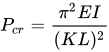
{\displaystyle P_{cr}={\frac {\pi ^{2}EI}{(KL)^{2}}}}

where
{\displaystyle P_{cr}}
, Euler's critical load (longitudinal compression load on column),
E
, modulus of elasticity of column material,
I
, minimum area moment of inertia of the cross section of the column,
L
, unsupported length of column,
K
, column effective length factor
 
Last edited:
  • Like
Likes   Reactions: Delta2
Physics news on Phys.org
I don't know this specific formula, i assume its something from beam theory which i am not good at. But anyway I believe the method or process that Euler followed was simply his commitment and dedication to hard work. Einstein said that genius is 99% hard work and only 1% talent. Certainly Euler had that 1% talent factor but his hard work is indisputable. Even when Euler got totally blind from both eyes, he didn't stop working for science, discovering new things. So i just think that was his secret process/method, serious and hard work.
 
  • Like
Likes   Reactions: Lnewqban
There is a mathematical derivation for that formula. Search Euler column buckling. The Wikipedia link has a derivation that looks like something I saw in a strength of materials class a long time ago, then promptly forgot. Note also the assumptions that go into it.

BTW, I once used an Euler column as an overload spring in a machine. We needed a light weight pushrod that would buckle with a force of about 8 lbs. The Euler column formula really does work. The pushrod was designed for 8 lbs, and it buckled at 8 lbs.
 
  • Like
Likes   Reactions: vanhees71, etotheipi and Paul Colby