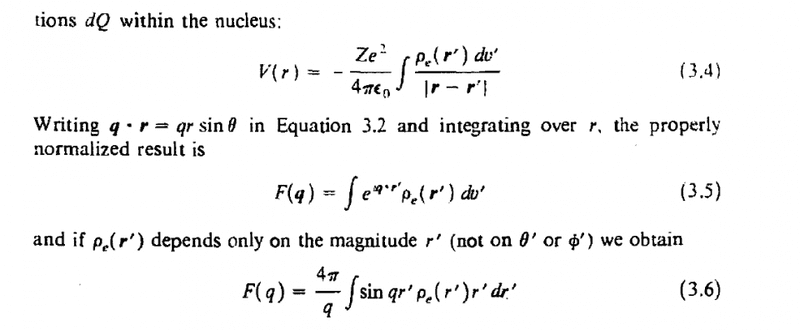
How did this integral come into being?

  • Context: Undergrad 
  • Thread starter Thread starter Josh1079
  • Start date Start date
  • Tags Tags
    Integral
Click For Summary

Discussion Overview

The discussion revolves around the derivation of an integral presented in Krane's "Introductory Nuclear Physics," specifically how equation (3.5) is derived from equations (3.2) and (3.4). Participants express confusion regarding the mathematical steps involved, particularly the substitution of variables and the implications of certain terms in the equations.

Discussion Character

  • Technical explanation
  • Debate/contested
  • Mathematical reasoning

Main Points Raised

  • One participant questions the transition from equations (3.2) and (3.4) to (3.5), expressing confusion about the substitution of variables and the reasoning behind setting q ⋅ r = qrsinθ.
  • Another participant provides a substitution method to simplify the integral, suggesting a change of variables and detailing the steps to compute the integral.
  • Several participants express uncertainty about the presence of a q^2 term in the denominator of equation (3.5) and a q^3 term in equation (3.6), with some suggesting that their calculations indicate these terms should be present.
  • A later reply indicates agreement that there should be a 1/q^2 term in equation (3.5), reflecting a shared concern about the accuracy of the equations presented in the text.
  • One participant raises a question about the convergence of a final expression derived from the integral, suggesting that the integration limits may need to be reconsidered.
  • Another participant references additional sources that yield similar results to Krane's, but notes differences in how the exponential terms are handled.
  • There is a mention of a potential confusion between the scattering amplitude and the form factor in the text, with a participant suggesting that Krane may have omitted a crucial step in the derivation.

Areas of Agreement / Disagreement

Participants express multiple competing views regarding the correctness of the equations and the presence of certain terms. There is no consensus on whether the equations as presented in the text are correct, as several participants point out potential discrepancies and errors.

Contextual Notes

Participants highlight limitations in the original text, including possible missing factors and differences in units between equations. The discussion also reflects uncertainty about the assumptions made in the derivation and the definitions of various quantities involved.

Josh1079
Messages
45
Reaction score
0
Hi, this is actually from a text of Krane's Introductory Nuclear Physics.
I don't really understand how did he arrive (3.5) from (3.2) and (3.4), and the reason for setting q ⋅ r = qrsinθ is also confusing.

This is the first time I post and I'm not really sure whether this is the correct section for this kind of question, so if it's the wrong place to post please just tell me. Thanks!

upload_2016-5-31_20-41-45.png

upload_2016-5-31_20-41-56.png
 
Physics news on Phys.org
Substitute (3.4) into (3.2) to obtain
$$
F(\mathbf q) \propto \int e^{i\mathbf q \cdot \mathbf r} \int \frac{\rho(\mathbf r')}{|\mathbf r - \mathbf r'|} dv' dv = \int \rho(\mathbf r') \left( \int \frac{e^{i\mathbf q \cdot \mathbf r}}{|\mathbf r - \mathbf r'|} dv \right)dv'
$$
Compute the integral in the parentheses first by a change of variable ##\mathbf u = \mathbf r - \mathbf r'##,
$$
\int \frac{e^{i\mathbf q \cdot \mathbf r}}{|\mathbf r - \mathbf r'|} dv = e^{i\mathbf q \cdot \mathbf r'} \int \frac{e^{i\mathbf q \cdot \mathbf u}}{u} dv
$$
where now ##dv = u^2 \sin \theta du\,d\theta\,d\phi##.Here ##\theta## is the angle between ##\mathbf q## and ##\mathbf u##, thus ##\mathbf q \cdot \mathbf u = qu \cos \theta## (I think it should be cosine instead of sine as your source states). The integral above becomes
$$
e^{i\mathbf q \cdot \mathbf r'} \int e^{iqu \cos \theta} u \sin \theta du\,d\theta\,d\phi = -e^{i\mathbf q \cdot \mathbf r'} \int_0^\infty \int_0^\pi \int_0^{2\pi} e^{iqu \cos \theta} u du\,d\cos\theta\,d\phi
$$
Now solve this last integral.
Hint: Solve the integral over ##\theta## first. The integral over ##\phi## is trivial. As for the remaining integral over ##u##, employ a limiting condition by multiplying the integrand with a function of the form ##e^{-bu}##, then apply the limit ##b\to 0## after calculating the integral.
 
  • Like
Likes   Reactions: Charles Link
Question I have-(I tried working this earlier and got something similar to @blue_leaf77 calculation above), but I got that there should be a ## q^2 ## in the denominator of equation (3.5) which will be a ## q^3 ## in the denominator of equation (3.6). Did I compute it incorrectly? I'm double-checking my algebra. I'm hoping the author has (3.5) and (3.6) correct, but I'm not so sure. (If you compute blue_leaf77's last integral with the substitution ## u'=qu ##, you get a ## q^2 ## in the denominator.)
 
Last edited:
Charles Link said:
Question I have-(I tried working this earlier and got something similar to @blue_leaf77 calculation above), but I got that there should be a ## q^2 ## in the denominator of equation (3.5) which will be a ## q^3 ## in the denominator of equation (3.6). Did I compute it incorrectly? I'm double-checking my algebra. I'm hoping the author has (3.5) and (3.6) correct, but I'm not so sure. (If you compute blue_leaf77's last integral with the substitution ## u'=qu ##, you get a ## q^2 ## in the denominator.)
Yes you are right I think there should be ##1/q^2## in equation (3.5).
 
Sorry to resurrect this thread, but I'm not getting it. Like y'all, I have
$$
e^{i\mathbf q \cdot \mathbf r'} \int e^{iqu \cos \theta} u \sin \theta du\,d\theta\,d\phi
$$
When iterated (and doing the ##\phi## part)
$$
2 \pi e^{i\mathbf q \cdot \mathbf r'} \int_0^\infty u \int_{-1}^1 e^{iqu \cos \theta} d\cos \theta \, du
$$
Solving the inner integral
$$
2 \pi e^{i\mathbf q \cdot \mathbf r'} \int_0^\infty u \frac{e^{iqu} - e^{-iqu}}{i q u} du
= \frac{2 \pi}{q} e^{i\mathbf q \cdot \mathbf r'} \int_0^\infty \sin(q u) du
$$
But this final expression does not appear to converge. Does Krane mean that the integration should take place only up to ##r'##?A similar conversation about the nuclear form factor appears here (pg 5): http://www.umich.edu/~ners311/CourseLibrary/bookchapter10.pdf
but he simplifies the expression by eliminating the exponential based on a simplifying assumption that the projectile is unaffected by the potential (?). Another source (http://hitoshi.berkeley.edu/221b/scattering2.pdf equation 16) gets an identical result to Krane.
 
Last edited:
On this last integral, evaluate as @blue_leaf77 suggested as ## I=\int\limits_{0}^{+\infty} \sin(qx) \,dx=\frac{1}{q} \int\limits_{0}^{+\infty} \sin(x) \, dx=\frac{1}{q} \int\limits_{0}^{+\infty} e^{-bx} \sin(x) \, dx ## and then take the limit as ## b \rightarrow 0 ##. I believe the result is ## I=\frac{1}{q} ##. (You get a factor of ## \frac{1}{b^2+1} ## in evaluating the integral).## \\ ## Incidentally, the textbook left off the factor ## Ze^2/\epsilon_o ## in the final result, and it should be a ## q^3 ## in the denominator of equation (3.6) as previously mentioned in post #3. ## \\ ## Also, on your last equation in post #6, the ## 2 \pi ## on the left becomes a ## 4 \pi ## on the right. (There's a factor of ## 2i ## in the denominator of the complex expression for ## \sin{x} ##).
 
Last edited:
Charles Link said:
Incidentally, the textbook left off the factor Ze2/ϵoZe2/ϵo Ze^2/\epsilon_o in the final result, and it should be a q3q3 q^3 in the denominator of equation (3.6) as previously mentioned in post #3. \\
You are right, without knowing the full text it's difficult to tell whether these are mistakes or that the author has said something about the definition in each quantity. Furthermore, the right hand sides of (3.1) and (3.2) have different units.
 
  • Like
Likes   Reactions: RGann and Charles Link
RGann said:
A similar conversation about the nuclear form factor appears here (pg 5): http://www.umich.edu/~ners311/CourseLibrary/bookchapter10.pdf
but he simplifies the expression by eliminating the exponential based on a simplifying assumption that the projectile is unaffected by the potential (?). Another source (http://hitoshi.berkeley.edu/221b/scattering2.pdf equation 16) gets an identical result to Krane.
Additional comment: The Berkeley paper looks like the better of the two, and see equation (15) in the Berkeley paper along with equation (16). They do get the extra ## q^2 ## in the denominator as I have previously mentioned.
 
  • Like
Likes   Reactions: RGann and blue_leaf77
  • #10
I think this is the answer. Strangely, the text seems to confuse the scattering amplitude with the form factor. As Charles says, the extra ##1/q^2## is factored out of the form factor. This is also present in F. Scheck, Electroweak and Strong Interactions, eqns 2.5-2.6. Only Krane seems to skip over this step. Thanks all.
 
  • Like
Likes   Reactions: Charles Link

Similar threads

  • · Replies 8 ·
Replies
8
Views
4K
  • · Replies 5 ·
Replies
5
Views
3K
  • · Replies 2 ·
Replies
2
Views
3K
  • · Replies 1 ·
Replies
1
Views
2K
  • · Replies 5 ·
Replies
5
Views
3K
  • · Replies 2 ·
Replies
2
Views
2K
  • · Replies 1 ·
Replies
1
Views
2K
  • · Replies 1 ·
Replies
1
Views
2K
  • · Replies 8 ·
Replies
8
Views
3K
  • · Replies 29 ·
Replies
29
Views
3K