How Do I Analyze Compressive Stress in a Crane Jib?

  • Thread starter Thread starter ArronJames
  • Start date Start date
  • Tags Tags
    Crane Force
Click For Summary
SUMMARY

The discussion focuses on analyzing compressive stress in a crane jib, specifically for first-year mechanical engineering students. Key methods include summing moments about supports to ensure equilibrium, and recognizing that each member acts as a 2-force member, with tension in the wire and compression in the jib. Essential equations include the sum of forces in the x-direction (ΣFx = 0) and the sum of forces in the y-direction (ΣFy = 0) to solve for unknown forces.

PREREQUISITES
  • Understanding of static equilibrium principles
  • Familiarity with 2-force member analysis
  • Basic knowledge of compressive and tensile forces
  • Proficiency in solving equations involving forces and moments
NEXT STEPS
  • Study the method of joints in truss analysis
  • Learn about the principles of static equilibrium in mechanical systems
  • Explore the concept of force polygons for graphical analysis
  • Review the calculations for compressive stress in structural members
USEFUL FOR

This discussion is beneficial for first-year mechanical engineering students, educators teaching statics, and anyone involved in structural analysis of cranes and similar mechanical systems.

ArronJames
Messages
1
Reaction score
0
im am a first year mech eng student. I am so lost on this question. the image is the diagram I am trying to solve. i think the compressive stress of the crane boom is what is confusing me. i don't want the answer, just where do i start? Force polygon? math?

please tell me how you would solve this. thankyou
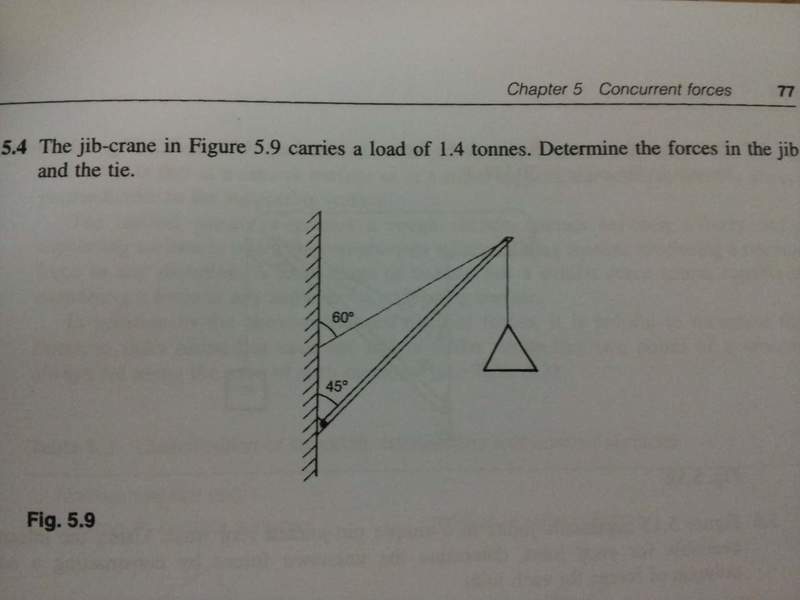

jib crane.jpg

 
Physics news on Phys.org
Is this your first year as a freshmen with no statics under your belt? Or have you already taken the core engineering science and Physics courses? If the latter, sum moments about one of the supports = 0. Each member is a 2-force member...the wire in tension and the jib in compression, with their forces directed axially along the axis of the member. Don't forget sum of Fx = 0 and sum of Fy =0.
 

Similar threads

  • · Replies 3 ·
Replies
3
Views
3K
  • · Replies 14 ·
Replies
14
Views
8K
  • · Replies 2 ·
Replies
2
Views
2K
  • · Replies 10 ·
Replies
10
Views
2K
  • · Replies 69 ·
3
Replies
69
Views
5K
  • · Replies 7 ·
Replies
7
Views
3K
  • · Replies 5 ·
Replies
5
Views
2K
Replies
3
Views
2K
  • · Replies 17 ·
Replies
17
Views
4K
Replies
3
Views
818