How do I calculate charge in these problems?

  • Thread starter chrisych
  • Start date
  • Tags Tags
    Charge
10 replies · 6K views · last reply
chrisych
Messages
32
Reaction score
0
Does anyone know how to calculate these questions?
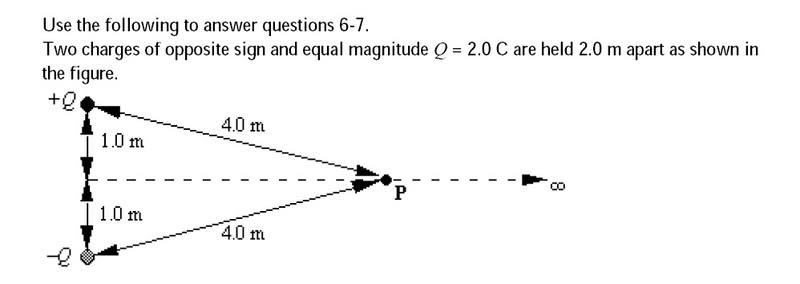
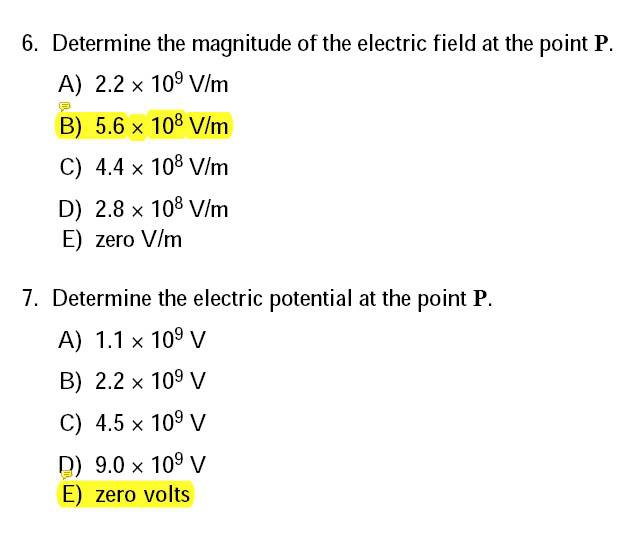
Diagram of two point charges, +Q at top left and -Q at bottom left, 2.0 m apart vertically; a point P lies 4.0 m from each charge on a dashed line extending right to infinity, with labels 1.0 m and 4.0 m.


Multiple-choice questions 6 and 7 on electric field magnitude and electric potential at point P, with answer options A to E and two answers highlighted in yellow.
 
Do your own work, show what you did and where you got stuck, and then you'll get plenty of help.
 
Doc Al said:
Do your own work, show what you did and where you got stuck, and then you'll get plenty of help.

E = V / d (E is electric field strength; V is potential difference; d is separation distance);

W = Q x V (W is workdone; Q is charge; V is potential difference);

Thus, E = W / Q / d = W / (Q x d) and d = 4.0 m;

But I don't know the value of W. How can I find the value of electric field strength at P?
 
You are dealing with point charges here: Look up expressions for the electric field and electric potential at a given distance from a point charge. Note that electric field is a vector, but potential is a scalar.
 
Doc Al said:
You are dealing with point charges here: Look up expressions for the electric field and electric potential at a given distance from a point charge. Note that electric field is a vector, but potential is a scalar.

E = Q / (4 pi eo r^2)

For +Q, E1 = Q / (4 pi eo 4^2) = Q / (64 pi eo)

For -Q, E2 = -Q / (4 pi eo 4^2) = -Q / (64 pi eo)

E1 + E2 = ?

V = Q / (4 pi eo r)

For +Q, V1 = Q / (4 pi eo 4) = Q / (16 pi eo)

For -Q, V2 = -Q / (4 pi eo 4) = -Q / (16 pi eo)

V1 + V2 = 0 and so this is the correct answer?
 
chrisych said:
E = Q / (4 pi eo r^2)

For +Q, E1 = Q / (4 pi eo 4^2) = Q / (64 pi eo)

For -Q, E2 = -Q / (4 pi eo 4^2) = -Q / (64 pi eo)

E1 + E2 = ?
Electric field is a vector, so direction counts. Add them like vectors.

V = Q / (4 pi eo r)

For +Q, V1 = Q / (4 pi eo 4) = Q / (16 pi eo)

For -Q, V2 = -Q / (4 pi eo 4) = -Q / (16 pi eo)

V1 + V2 = 0 and so this is the correct answer?
Good!
 
|E| = sqrt (E1^2 + E2^2)

E1 = 2 / (64 x 3.14 x 8.854 x 10^-12)

E2 = -E1

Thus, |E|

= sqrt (E1^2 + (-E1)^2)

= sqrt (2 x E1^2)

= sqrt (2 x (2 / (64 x 3.14 x 8.854 x 10^-12))^2)

= 15.90 x 10^8 V/m

(But the answer isn't correct)
 
chrisych said:
|E| = sqrt (E1^2 + E2^2)
That would be true if E1 and E2 were perpendicular, but they are not. Consider the horizontal & vertical components of each.
 
Doc Al said:
That would be true if E1 and E2 were perpendicular, but they are not. Consider the horizontal & vertical components of each.

Let theta be the angle between the horizontal line and the hypotenuse,

sin theta = 1 / 4 = 0.25

Take right/upward directions as positive and left/downward directions as negative,

Horizontally,

For +Q, component of E = E cos theta

For -Q, component of E = -E cos theta

Their sums = E cos theta - E cos theta = 0

Vertically,

For +Q, component of E = -E sin theta

For -Q, component of E = -E sin theta

Their sums = -E sin theta -E sin theta = -2E sin theta

|E| = |Horizontal Component of E| + |Vertical Component of E|

|E|

= sqrt ((Horizontal Component of E)^2 + (Vertical Component of E)^2)

= sqrt (0^2 + (-2E sin theta)^2)

= 2E sin theta

= 2E (0.25)

= E / 2

= 5.6 x 10^8 V/m

Am I correct?
 
Last edited:
You got it!
chrisych said:
|E| = |Horizontal Component of E| + |Vertical Component of E|
Typo here; this should be:
|E|^2 = |Horizontal Component of E|^2 + |Vertical Component of E|^2
 
Doc Al said:
You got it!

Typo here; this should be:
|E|^2 = |Horizontal Component of E|^2 + |Vertical Component of E|^2

Thank you very much!