How Do I Calculate the Torque on a Tooth's Root About Point A?

  • Thread starter Thread starter riseofphoenix
  • Start date Start date
  • Tags Tags
    Point Torque
Click For Summary

Homework Help Overview

The discussion revolves around calculating torque in two different scenarios: the torque on a tooth's root due to a dental bracket and the torque exerted by a biceps muscle while holding a carton of milk. The subject area includes concepts from mechanics, particularly involving forces and torques.

Discussion Character

  • Mixed

Approaches and Questions Raised

  • Participants explore the calculation of torque using different force vectors and distances from the axis of rotation. There are attempts to clarify the correct angles and distances involved in the torque calculations. Some participants question the assumptions made regarding distances and angles in their calculations.

Discussion Status

Participants are actively engaging with the problem, providing feedback on each other's calculations and questioning the setup of the problems. Some guidance has been offered regarding the importance of determining the axis of rotation and the distances involved in torque calculations.

Contextual Notes

There are mentions of specific distances given in centimeters that need to be converted to meters for calculations. Participants also discuss the angles between force vectors and the need to clarify the axis of rotation for accurate torque calculations.

riseofphoenix
Messages
294
Reaction score
2
A dental bracket exerts a horizontal force of 83.1 N on a tooth at point B in the figure. What is the torque on the root of the tooth about point A?
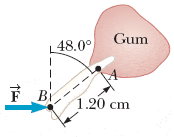
8-p-004.gif


_______ N · m counterclockwise

I just did:

τA = [ (83.1 N)sin 48 ](1.20 cm) = 74.1

Your response differs significantly from the correct answer. Rework your solution from the beginning and check each step carefully.
 
Physics news on Phys.org


The distance is given in cm. You have to use m to get energy in J.
Also, I think the angle between the 2 vectors is 90°+48.0°


ap123 said:
The distance is given in cm. You have to use m to get energy in J.
Also, I think the angle between the 2 vectors is 90°+48.0°

Ohh ok...
thanks!


What about this one?


A cook holds a 1.13-kg carton of milk at arm's length (see the figure below). What force vector F =B must be exerted by the biceps muscle? (Ignore the weight of the forearm. State the magnitude of the force vector FB.)

8-p-009.gif


I tried doing...

1) Fg = ma
Fg = (1,13 kg)(9.81)
Fg = 11.08

2) Ta = (11.08 N)(0.25 m) = 3.997

3) Tb = (FB cos 75)(0.08)
4) Set Ta = Tb

3.997 = (FB cos 75)(0.08)
133 N = FB

INCORRECT: Your response differs from the correct answer by more than 10%. Double check your calculations.


For the carton, the rotation is about the bone joint which is 33cm from the weight vector, not 25cm.

For the torque created by the muscle, draw out the r and F vectors and determine the angle between them from your drawing.


ap123 said:
For the carton, the rotation is about the bone joint which is 33cm from the weight vector, not 25cm.

For the torque created by the muscle, draw out the r and F vectors and determine the angle between them from your drawing.

Ok this is what I did after looking it up online...

1) Determine the horizontal and vetical components of the force exerted by the biceps muscle where you see an angle - make a triangle to determine which side is cos and which side is sin.

Horizontal component
(FB)x = FBsin 75

Vertical component
(FB)y = FBcos 75

2) I googled this but I don't understand the "determining axis of rotation" part...

ƩT: -Fg(25 cm + 8 cm) - (FB)y(8 cm) = 0

-(1.13)(-9.81)(33 cm) - FBcos 75(8 cm) = 0
365.8 - FBcos 75(8 cm) = 0
365.8 = FBcos 75(8 cm)
45.7 = FBcos 75
176.7 N = FB

I don't understand how they got the idea to add [F x r of the WHOLE ARM] MINUS (FB)y(r of PART of the arm)


When the forearm moves, it rotates about the elbow joint - this is the axis of rotation, (imagine a line through the elbow perpendicular to the diagram).
To calculate the torque, you need the force, and the distance of this force from the axis of rotation.

For the carton, the weight vector is 33cm from this axis.
For the biceps muscle, the force in the diagram is 8cm from this axis.


ap123 said:
When the forearm moves, it rotates about the elbow joint - this is the axis of rotation, (imagine a line through the elbow perpendicular to the diagram).
To calculate the torque, you need the force, and the distance of this force from the axis of rotation.

For the carton, the weight vector is 33cm from this axis.
For the biceps muscle, the force in the diagram is 8cm from this axis.

Ohhh ok that makes perfect sense!

So whenever I am dealing with a Torque problem, I ALWAYS have to determine my main axis of rotation??


Yes, this is the first thing you should determine because you need to have the distance from the axis of rotation to the point where the force is being applied.


ap123 said:
Yes, this is the first thing you should determine because you need to have the distance from the axis of rotation to the point where the force is being applied.

Ok thanks!
 

Similar threads

  • · Replies 5 ·
Replies
5
Views
4K
  • · Replies 2 ·
Replies
2
Views
2K
  • · Replies 9 ·
Replies
9
Views
3K
  • · Replies 4 ·
Replies
4
Views
4K
  • · Replies 1 ·
Replies
1
Views
3K
  • · Replies 1 ·
Replies
1
Views
5K
  • · Replies 5 ·
Replies
5
Views
21K
  • · Replies 18 ·
Replies
18
Views
3K
Replies
3
Views
2K
Replies
4
Views
4K