High School How do I determine angle equality in this graph?

Click For Summary
SUMMARY

This discussion focuses on determining angle equality in a geometric diagram involving a circle and tangents. The key method involves extending the line where point "R" is located until it becomes tangent to the circle, allowing for the application of the interior angle sum theorem in triangles. The angles are related through the relationships established in both the larger and smaller triangles formed by these tangents. The conclusion emphasizes the importance of recognizing both triangles to establish angle equality, specifically that angles α and β are equal.

PREREQUISITES
  • Understanding of basic trigonometry concepts
  • Familiarity with the properties of tangents to circles
  • Knowledge of the interior angle sum theorem in triangles
  • Ability to interpret geometric diagrams
NEXT STEPS
  • Study the properties of tangents and their relationships with angles in circles
  • Learn about the interior angle sum theorem in various triangle configurations
  • Explore geometric proofs involving angle relationships in circles
  • Review advanced trigonometric identities and their applications in geometry
USEFUL FOR

Students in physics and mathematics, geometry enthusiasts, and educators looking to enhance their understanding of angle relationships in geometric diagrams.

Const@ntine
Messages
285
Reaction score
18
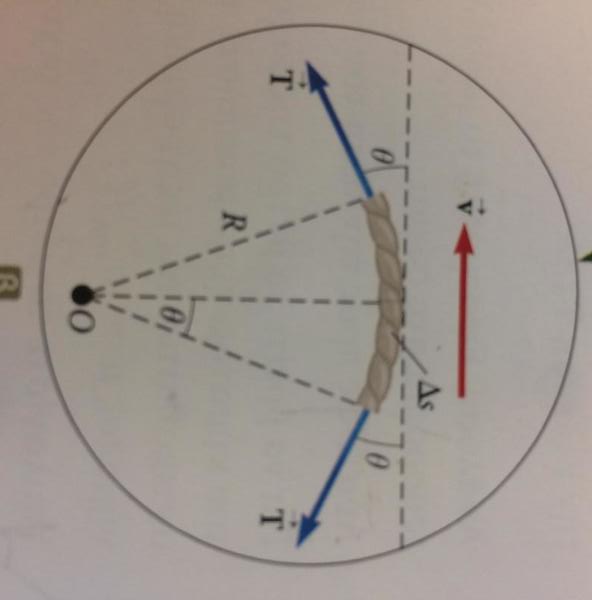
Okay, this might be a tad silly, but I cam across this graph/picture i my physics textbook, and for the life of me I can't figure out how to connect the two angles. Here, have a look:
hR8gI.&token=a42e3b7e-e7c0-4fd5-a32b-4049bd74e282&owa=outlook.live.com&isc=1&isImagePreview=True.jpg


It's not a big part of what the paragraph is about, so in theory I could just skip it, but it's been killing me to not know! Granted, I haven't brushed up on my Trig. for about, what, 3 years now (aside from the basic stuff that I've so far used in First Year Undergrad Physics and Math), so I'm probably missing something.

I tried drawing the "triangles" and trying to find out if there are any opposite/alternate equal angles, but... nothing. The book itself doesn't even mention it beyond the graph, it just takes the equality for granted.

Any kind of help is appreciated!
 
Mathematics news on Phys.org
Continue the line where the "R" is until it its the tangent to the circle, then you can relate the two angles via the interior angle sum in the newly generated triangle.

Overall this is one of the standard diagrams to relate angles to each other, but I remember how it is called.
 
mfb said:
Continue the line where the "R" is until it its the tangent to the circle, then you can relate the two angles via the interior angle sum in the newly generated triangle.

Overall this is one of the standard diagrams to relate angles to each other, but I remember how it is called.
Sorry to ask this, but... could you go a bit more in-depth? From what I understand, that's what you're talking about, right?
SWhvs.&token=536700ef-92a9-4a2d-ac45-79f45f3dfe64&owa=outlook.live.com&isc=1&isImagePreview=True.jpg

But I don't see how I can relate the angles of the triangle, and the angle which is created by the "circle" and the tangent.
 
That is the basic diagram, right.

The angle in the upper left corner is ##\frac \pi 2 - \theta## via the angle sum in the large triangle.

Continue the tangent until it reaches the horizontal tangent. Via the angle sum in the small triangle, the angle between the two tangents is ##\frac \pi 2 - \left(\frac \pi 2 - \theta\right) = \theta##.
 
mfb said:
That is the basic diagram, right.

The angle in the upper left corner is ##\frac \pi 2 - \theta## via the angle sum in the large triangle.

Continue the tangent until it reaches the horizontal tangent. Via the angle sum in the small triangle, the angle between the two tangents is ##\frac \pi 2 - \left(\frac \pi 2 - \theta\right) = \theta##.

Ah, so I draw another tanget, thus creating a smaller triangle, like this:

kc1v0.&token=c0d82f73-3ca7-40f9-bd96-afe1ba4c01a6&owa=outlook.live.com&isc=1&isImagePreview=True.jpg


Yeah, I was focused on just the big triangle and forgot all about the smaller one. Well, that's quite embarassing...

Either way, thanks a ton for the help, twas driving me mad! And I guess I have to brush up on Geometry some time...
 
mfb said:

Ah, so that's the general diagram. Thanks (saved)!

The above one (at my RE) is correct for the "matter at hand" though, right?

PS: English isn't my First Language, so there might be some problems when "converting" the info from English to my native one.
 
Darthkostis said:
The above one (at my RE) is correct for the "matter at hand" though, right?
Sure.
Darthkostis said:
PS: English isn't my First Language
Same here.
 
mfb said:
Sure.

Whew, thank goodness!

mfb said:
Same here.

It's a bit of a hurdle, isn't it? I mean, sure, there are special dictionaries for scientific terms, but still.

Either way, thanks a ton for the help!
 

Similar threads

  • · Replies 4 ·
Replies
4
Views
2K
  • · Replies 4 ·
Replies
4
Views
2K
  • · Replies 6 ·
Replies
6
Views
3K
  • · Replies 2 ·
Replies
2
Views
2K
  • · Replies 2 ·
Replies
2
Views
2K
  • · Replies 6 ·
Replies
6
Views
3K
Replies
2
Views
1K
  • · Replies 2 ·
Replies
2
Views
2K
  • · Replies 9 ·
Replies
9
Views
4K
  • · Replies 4 ·
Replies
4
Views
3K