How do I find components of a vector at a given angle?

  • Thread starter Thread starter Dylex
  • Start date Start date
  • Tags Tags
    Components
Click For Summary
To find the components of a vector at a given angle, one must use trigonometry to resolve the vector into perpendicular components. The weight vector, represented as m*g, acts vertically downward, and can be broken down into components parallel and perpendicular to the slope. This forms a right triangle where the weight vector is the hypotenuse, with the two components creating a Cartesian coordinate system aligned with the slope. Understanding how to set up this coordinate system is crucial for solving the problem. Ultimately, the goal is to determine the component of the weight vector that is parallel to the slope.
Dylex
Messages
2
Reaction score
0
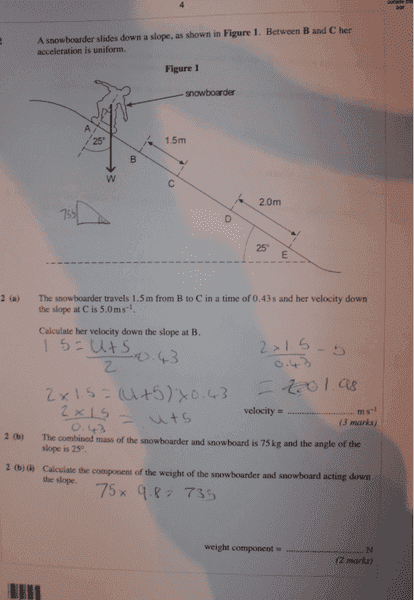
Im a little confused with this question, i can't quite seem to get the hang of it. I understand that you have to use a triangle and i understand that you need to use trigonometry, but what exactly am i even working out? What is the question asking?

The image below shows the question, i am having difficulty mainly with part B (i):
579170e117432fd87bf8ac5a91c52be3.png


If the image doesn't display go here: http://i.gyazo.com/579170e117432fd87bf8ac5a91c52be3.png
 
Physics news on Phys.org
You are looking to find the component of the weight vector that is parallel to the slope.

Vector components are usually taken to be perpendicular to each other (in a Cartesian co-ordiinate scheme). So in this case there will be a component perpendicular to the slope and one parallel to the slope, forming a right angle triangle with the weight vector as the hypotenuse.
 
##m\vec g## acts vertically downwards, right? But if you decide on a co-ordinate system which has one co-ordinate down the slope (parallel to it) and the other perpendicular to the slope then you can resolve ##m\vec g## into two components in those two directions. The sum of those two, as vectors, is completely equivalent to ##m\vec g##.
Do you understand how to find a component of a vector at a given angle to it?
 
Thread 'Correct statement about size of wire to produce larger extension'
The answer is (B) but I don't really understand why. Based on formula of Young Modulus: $$x=\frac{FL}{AE}$$ The second wire made of the same material so it means they have same Young Modulus. Larger extension means larger value of ##x## so to get larger value of ##x## we can increase ##F## and ##L## and decrease ##A## I am not sure whether there is change in ##F## for first and second wire so I will just assume ##F## does not change. It leaves (B) and (C) as possible options so why is (C)...

Similar threads

Replies
8
Views
1K
  • · Replies 21 ·
Replies
21
Views
2K
  • · Replies 9 ·
Replies
9
Views
2K
Replies
12
Views
3K
  • · Replies 2 ·
Replies
2
Views
1K
Replies
6
Views
2K
Replies
3
Views
1K
Replies
11
Views
3K
  • · Replies 1 ·
Replies
1
Views
1K
Replies
2
Views
2K