How do I find components of a vector at a given angle?

  • Thread starter Thread starter Dylex
  • Start date Start date
  • Tags Tags
    Components
Click For Summary
SUMMARY

The discussion focuses on resolving a weight vector into its components parallel and perpendicular to a slope using trigonometry. The weight vector, represented as ##m\vec g##, acts vertically downwards and can be decomposed into two components based on a coordinate system aligned with the slope. This involves forming a right triangle where the hypotenuse is the weight vector, and the two components are the sides of the triangle. Understanding this concept is essential for solving problems related to forces on inclined planes.

PREREQUISITES
  • Basic understanding of vector components
  • Knowledge of trigonometric functions (sine, cosine)
  • Familiarity with right triangles and their properties
  • Concept of coordinate systems in physics
NEXT STEPS
  • Study the process of vector decomposition in physics
  • Learn about the applications of trigonometry in resolving forces
  • Explore problems involving inclined planes and forces
  • Practice using free-body diagrams to visualize vector components
USEFUL FOR

Students in physics, educators teaching mechanics, and anyone needing to understand vector resolution in the context of forces on slopes.

Dylex
Messages
2
Reaction score
0
Im a little confused with this question, i can't quite seem to get the hang of it. I understand that you have to use a triangle and i understand that you need to use trigonometry, but what exactly am i even working out? What is the question asking?

The image below shows the question, i am having difficulty mainly with part B (i):
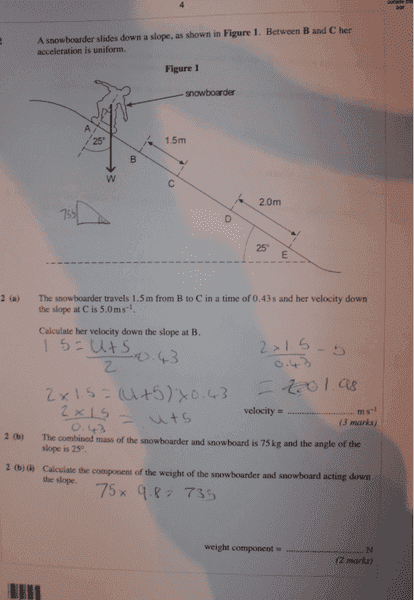
579170e117432fd87bf8ac5a91c52be3.png


If the image doesn't display go here: http://i.gyazo.com/579170e117432fd87bf8ac5a91c52be3.png
 
Physics news on Phys.org
You are looking to find the component of the weight vector that is parallel to the slope.

Vector components are usually taken to be perpendicular to each other (in a Cartesian co-ordiinate scheme). So in this case there will be a component perpendicular to the slope and one parallel to the slope, forming a right angle triangle with the weight vector as the hypotenuse.
 
##m\vec g## acts vertically downwards, right? But if you decide on a co-ordinate system which has one co-ordinate down the slope (parallel to it) and the other perpendicular to the slope then you can resolve ##m\vec g## into two components in those two directions. The sum of those two, as vectors, is completely equivalent to ##m\vec g##.
Do you understand how to find a component of a vector at a given angle to it?
 

Similar threads

Replies
8
Views
1K
  • · Replies 21 ·
Replies
21
Views
3K
  • · Replies 9 ·
Replies
9
Views
2K
Replies
12
Views
3K
  • · Replies 2 ·
Replies
2
Views
2K
Replies
3
Views
1K
Replies
6
Views
2K
Replies
11
Views
3K
  • · Replies 1 ·
Replies
1
Views
1K
Replies
2
Views
2K