How do I find the area of a Quadrilateral?

  • Thread starter Thread starter zak100
  • Start date Start date
  • Tags Tags
    Area
Click For Summary

Homework Help Overview

The discussion revolves around finding the area of a quadrilateral, with attempts to apply various methods including dividing the shape into triangles and using the distance formula. Participants explore the implications of triangle properties and area formulas.

Discussion Character

  • Exploratory, Conceptual clarification, Mathematical reasoning, Problem interpretation, Assumption checking

Approaches and Questions Raised

  • Participants discuss dividing the quadrilateral into triangles and question the correctness of the area calculations. There are inquiries about the properties of the triangles involved, particularly whether certain triangles are right triangles, and the appropriate formulas to use for area calculation.

Discussion Status

The conversation is ongoing, with various participants providing insights and suggestions. Some guidance has been offered regarding the use of the distance formula and area calculations, but there is no explicit consensus on the best approach yet.

Contextual Notes

Participants note that this is for exam preparation rather than typical homework, which may influence the nature of the guidance sought. There are also discussions about the appropriateness of the forum for this type of question.

zak100
Messages
462
Reaction score
11
Originally posted in a non-homework forum section
Hi,
I got a question from a book to find the area of a Quadrilateral. I divided the quadrilateral into two triangles but answer is not correct. Some body please guide me.

I am uploading my work in a attached file.

Zulfi.
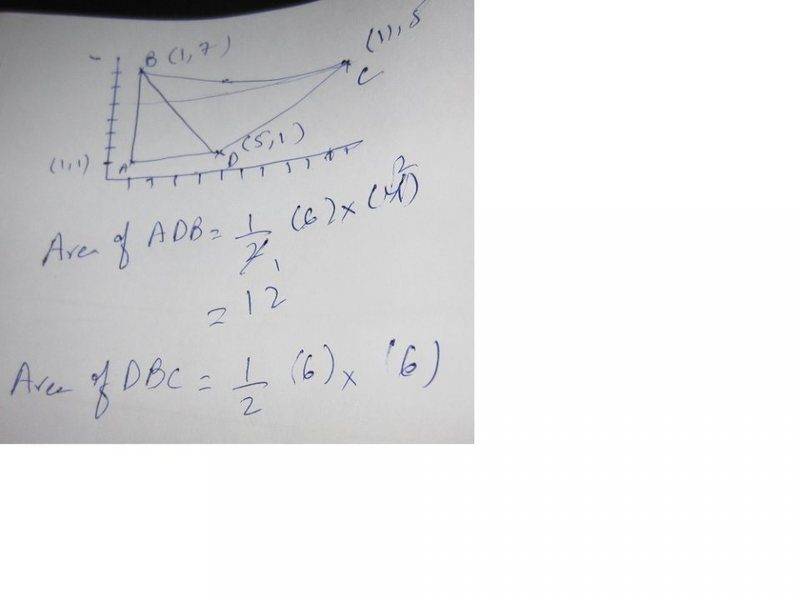
Book Page 315.jpg
 
Physics news on Phys.org
For ADB, did you write ##A=\frac {1}{2}(6)(4)^2##?

And is triangle DBC a right triangle?
 
Last edited:
Oh, and this should also be in the homework forum, not general math.
 
For ADB is correct. For the second isn't simply ##\frac{1}{2}6\times 6##, hint: calculate ##BD## and ##DC## (that are not ##6##) ...
 
  • Like
Likes   Reactions: ProfuselyQuarky
Ssnow said:
For ADB is correct. For the second isn't simply ##\frac{1}{2}6\times 6##, hint: calculate ##BD## and ##DC## (that are not ##6##) ...
distance formula :)
 
  • Like
Likes   Reactions: Ssnow
Hi,
Thanks for replies. This is not a hw. Its exam preparation. But i would put my future questions related to book in a homework forum. I think you judge hws with the usage of books?
BD= sqrt(sqr( 5-1) + sqr(1-7))
= sqrt(16 + 36)
=2 *Sqrt(13)
Ans=? (I can't use calculator in exam)
DC = sqrt(sqr(11-5) + sqr(5-1))
= sqrt(36 + 16)
= 2*sqrt(13)

area of DBC = 1/2 (2*sqrt(13)) * ( 2 *sqrt(13))
Ans = 26

Area od ABCD = 26 + 12 =38.

This is the correct answer. Thanks.

Zulfi.
 
zak100 said:
Hi,
Thanks for replies. This is not a hw. Its exam preparation. But i would put my future questions related to book in a homework forum. I think you judge hws with the usage of books?
BD= sqrt(sqr( 5-1) + sqr(1-7))
= sqrt(16 + 36)
=2 *Sqrt(13)
Ans=? (I can't use calculator in exam)
DC = sqrt(sqr(11-5) + sqr(5-1))
= sqrt(36 + 16)
= 2*sqrt(13)

area of DBC = 1/2 (2*sqrt(13)) * ( 2 *sqrt(13))
Ans = 26

Area od ABCD = 26 + 12 =38.

This is the correct answer. Thanks.

Zulfi.
How do you know that ΔDBC is a right triangle ?
 
  • Like
Likes   Reactions: ProfuselyQuarky
Hi,
No I am not saying that DBC is a right angle triangle. That's why i think they have asked me to use distance formula. However from fig it looks that ABD is a right angle triangle, so i am not using distance formula here and calculating the area directly using 1/2 alt * base formula.

I also have a question:
for triangle DBC why are we using sides DB & DC? why can't we take sides DB & BC??
Some body please guide me.

Zulfi.
 
zak100 said:
Hi,
No I am not saying that DBC is a right angle triangle. That's why i think they have asked me to use distance formula. However from fig it looks that ABD is a right angle triangle, so i am not using distance formula here and calculating the area directly using 1/2 alt * base formula.

I also have a question:
for triangle DBC why are we using sides DB & DC? why can't we take sides DB & BC??
Some body please guide me.

Zulfi.
What are you using as a formula to calculate the area of a triangle ?

The altitude is the perpendicular distance from the base to the opposite vertex.
 
Last edited:
  • Like
Likes   Reactions: ProfuselyQuarky
  • #10
ProfuselyQuarky said:
Oh, and this should also be in the homework forum, not general math.
Thread moved.

zak100 said:
Thanks for replies. This is not a hw. Its exam preparation. But i would put my future questions related to book in a homework forum. I think you judge hws with the usage of books?
This forum section is for homework and coursework, which includes problems found in textbooks.
 
  • #11
SammyS said:
How do you know that ΔDBC is a right triangle ?
SammyS said:
What are you using as a formula to calculate the area of a triangle ?

The altitude is the perpendicular distance from the base to the opposite vertex.
That is why I asked whether DBC was a right triangle or not. If DBC is not a right triangle, then you can not you ##A=\frac {1}{2}bh## to find the area. Instead, you have to use Heron’s theorem which states ##A=\sqrt {(s-a)(s-b)(s-c)}## where ##s=\frac {1}{2}(a+b+c)## and variables ##a##, ##b##, and ##c## are the sides of the triangle.
 
  • #12
ProfuselyQuarky said:
That is why I asked whether DBC was a right triangle or not. If DBC is not a right triangle, then you can not you ##A=\frac {1}{2}bh## to find the area. Instead, you have to use Heron’s theorem which states ##A=\sqrt {(s-a)(s-b)(s-c)}## where ##s=\frac {1}{2}(a+b+c)## and variables ##a##, ##b##, and ##c## are the sides of the triangle.
Are you giving the solution, or are you trying to help OP.

Heron's theorem is not needed here.
 
  • #13
SammyS said:
Are you giving the solution, or are you trying to help OP.

Heron's theorem is not needed here.
I was just helping the OP overall. Nothing to do with the specific problem :smile:
 
  • #14
One easy way to solve this kind of exercises is a variation on the "box method", illustrated here for the area of a triangle.

Add the points E(11,7) and F(11,1) to your graph, and the area of ABCD can be easily computed:

quadri.jpg


Or decompose your quadrilateral as follows:

quadri2.jpg
 
  • Like
Likes   Reactions: ProfuselyQuarky and SammyS
  • #15
@Samy_A Nice pictures. What software did you use for them?
 
  • #16
LCKurtz said:
@Samy_A Nice pictures. What software did you use for them?
Geogebra
 

Similar threads

  • · Replies 2 ·
Replies
2
Views
3K
  • · Replies 8 ·
Replies
8
Views
2K
  • · Replies 2 ·
Replies
2
Views
1K
  • · Replies 6 ·
Replies
6
Views
2K
  • · Replies 2 ·
Replies
2
Views
2K
Replies
10
Views
4K
  • · Replies 15 ·
Replies
15
Views
3K
  • · Replies 8 ·
Replies
8
Views
2K
  • · Replies 9 ·
Replies
9
Views
4K
  • · Replies 10 ·
Replies
10
Views
25K