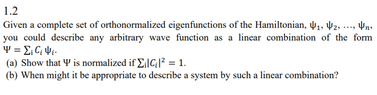
How do I normalize a wavefunction with Cn instead of Ci and Cj?

Click For Summary
SUMMARY

The discussion centers on normalizing a wavefunction represented as ##\Psi = \sum_{i=1} c_i \psi_i## using coefficients ##C_n## instead of ##C_i## and ##C_j##. Participants emphasize the importance of the inner product, specifically the relationship ##c_i c_j \langle \psi_i | \psi_j \rangle = c_i c_j \delta_{ij}##, which indicates that cross terms vanish due to orthonormality. The normalization process involves calculating the inner product of the wavefunction with itself and ensuring the sum equals one, leading to terms like ##c_1^2## for the diagonal elements. The discussion concludes with a recommendation to express the normalization in index notation for clarity.

PREREQUISITES
  • Understanding of wavefunctions and quantum mechanics
  • Familiarity with inner products and orthonormal bases
  • Knowledge of complex vector spaces
  • Proficiency in index notation for mathematical expressions
NEXT STEPS
  • Learn about normalization of wavefunctions in quantum mechanics
  • Study the properties of orthonormal bases in Hilbert spaces
  • Explore the use of index notation in quantum mechanics
  • Investigate the implications of complex coefficients in wavefunctions
USEFUL FOR

Students and professionals in quantum mechanics, physicists working with wavefunctions, and anyone interested in the mathematical foundations of quantum theory.

SinaHp
Messages
4
Reaction score
2
Homework Statement
Wavefunction normalization
Relevant Equations
Ψ is normalized if ∑i |𝐶𝑖|2 = 1
I ran into this question in my problem sheet. Does anybody know how to work it out?
 

Attachments

  • Capture.PNG
    Capture.PNG
    20.9 KB · Views: 179
Physics news on Phys.org
Take the inner product of

##\Psi = \sum_{i=1} c_i \psi_i## with itself and set it equal to 1.

Keep in mind the relationship

##c_i c_j \langle \psi_i | \psi_j \rangle= c_i c_j \delta_{ij}##

So no cross terms should generate.

Can you carry out this work and post it here?
 
PhDeezNutz said:
Take the inner product of

##\Psi = \sum_{i=1} c_i \psi_i## with itself and set it equal to 1.

Keep in mind the relationship

##c_i c_j \langle \psi_i | \psi_j \rangle= c_i c_j \delta_{ij}##

So no cross terms should generate.

Can you carry out this work and post it here?
Unfortunately no, how is that exactly?
 
SinaHp said:
Unfortunately no, how is that exactly?

What are you referring to?

The expression with the kronecker delta is the definition of an orthonormal basis which is what is stated in the question.

When you write out the whole expression

You get terms like

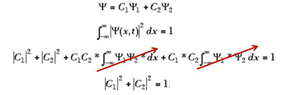
##c_1 c_1 \langle \psi_1 | \psi_1 \rangle = c_1^2##

##c_1 c_2 \langle \psi_1 | psi_2 \rangle = 0##

Carry this process out with each combination and sum them. What terms are you left with?

Your professor probably wants you to do this in index notation so I’ll leave that to you. I am just giving you specific term examples so you get the idea.

While I’m here I might as well correct my other statement. Since we’re dealing with vector spaces over complex fields.

It should technically be ##\langle \psi_i | \psi_j \rangle = c_i c_j^* \delta_{ij}## but the idea is the same.
 
something like this?
 

Attachments

  • Capture.PNG
    Capture.PNG
    12.8 KB · Views: 171
  • Like
Likes   Reactions: PhDeezNutz
SinaHp said:
something like this?
Yup! You got the idea. Now do it compactly with index notation for n terms instead of just 2 terms.
 
Got it! Only Cn instead of Ci and Cj
 
  • Like
Likes   Reactions: PhDeezNutz

Similar threads

  • · Replies 12 ·
Replies
12
Views
905
  • · Replies 3 ·
Replies
3
Views
2K
Replies
6
Views
4K
Replies
1
Views
2K
  • · Replies 11 ·
Replies
11
Views
2K
  • · Replies 7 ·
Replies
7
Views
2K
  • · Replies 1 ·
Replies
1
Views
2K
  • · Replies 20 ·
Replies
20
Views
3K
  • · Replies 1 ·
Replies
1
Views
4K
  • · Replies 5 ·
Replies
5
Views
1K