How do I solve 2 simultaneous equations using KVL?

  • Thread starter Thread starter Just_enough
  • Start date Start date
  • Tags Tags
    Kvl
Join the discussion
Ask a follow-up here, or get your own question answered by working scientists, mathematicians and engineers — people, not an autocomplete.
Real named experts · corrections over time · the nuance an AI answer skips
7 replies · 2K views
Just_enough
Messages
52
Reaction score
0
« thread moved from technical forum; so template is absent »

So I'm trying to get a better understanding of KVL by looking up practice problem and I'm having some difficulties. I'm attempting to do this problem
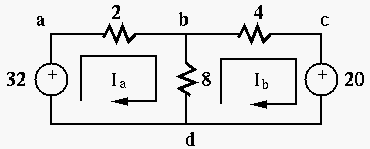
loopcurrentmethod.gif

my first step is to get an equation for Ia (32v-10ia+8ib = 0) an Ib (12ib+20v-8ia = 0), adn then solve for either b or a first and plug into the other equation, but this is where the problem occurs. on the site http://fourier.eng.hmc.edu/e84/lectures/ch2/node2.html it got a current for each mesh to be something completely different. I was wondering how they got 4 and 1 for the currents?
 
Last edited by a moderator:
Physics news on Phys.org
NascentOxygen said:
Have you checked to see whether their answers satisfy your equations?
What do you mean? That is a pratice example so I'm assuming their answers and equations are correct and if mine doesn't match up then I'm doing something wrong
 
NascentOxygen said:
Do yours "match up" or not?
at first, no and the only thing that didnt match up was that i got my 20v to be the opposite sign of what they had
 
NascentOxygen said:
Your equations are identical with theirs. You can multiply everything on both sides by –1 and the equation still holds.
no not what I mean, on the B side, i have all the other sign matching up except the 20v so multiply by -1 won't make it correct, but that's not my question I just want to know how they got their currents for each of the meshes
 
If these are your equations:
32v-10ia+8ib = 0 and
12ib+20v-8ia = 0
then they are indeed identical with those in the worked example. All signs correspond.

You are asking how to solve 2 simultaneous equations?

If we use yours, which I'll write out again neatly:
32 - 10ia + 8ib = 0 ... (i)

12ib + 20 - 8ia = 0 ... (ii)

Multiply eqn (i) by 4
Multiply eqn (ii) by -5

Then add the corresponding sides of both new equations, and the resultant term for ia has a coefficient of 0, i.e., ia disappears from the equation, and with only one unknown in the equation you can solve for it to find the value for ib.