How Do I Solve for i2 Using KVL and KCL in Circuit Analysis?

  • Thread starter Thread starter VinnyCee
  • Start date Start date
  • Tags Tags
    Circuits
Click For Summary

Homework Help Overview

The discussion revolves around a circuit analysis problem involving Kirchhoff's Voltage Law (KVL) and Kirchhoff's Current Law (KCL). The original poster seeks assistance in solving for the current i2 in a circuit with multiple loops and nodes, having already established several equations based on KVL and KCL.

Discussion Character

  • Mixed

Approaches and Questions Raised

  • The original poster attempts to apply KVL and KCL to derive equations for the currents i1, i2, and i3. Some participants suggest rewriting the equations using Ohm's law and express voltages in terms of resistances and currents. Others explore substituting derived equations into KCL to isolate variables.

Discussion Status

Participants are actively engaging with the problem, providing various approaches to manipulate the equations. There is a recognition of the need for substitution to simplify the equations, and while some guidance has been offered, the original poster expresses uncertainty about the substitution process and its application in future problems.

Contextual Notes

The original poster mentions feeling overwhelmed by the problem, indicating a potential lack of confidence in identifying independent equations and applying KCL and KVL appropriately. This suggests a need for further practice and understanding of circuit analysis principles.

VinnyCee
Messages
486
Reaction score
0
CIRCUITS: Super easy problem. Please help!

Find i1, i2 and i3:
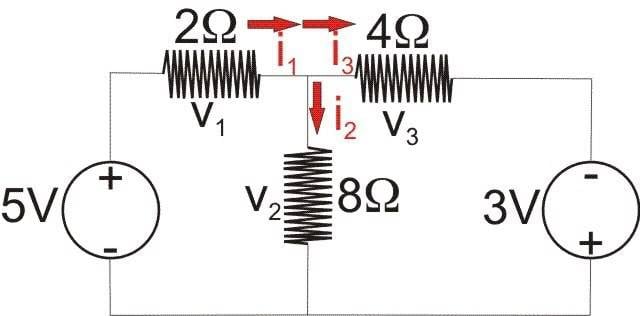
Chapter2PracticeProblem.jpg


My work so far:

KVL for left loop => [tex]5\,-\,v_1\,-\,v_2\,=\,0[/tex]

KVL for right loop => [tex]v_2\,-\,v_3\,+\,3\,=\,0[/tex]

KCL at center node => [tex]i_1\,=\,i_2\,+\,i_3[/tex]

Now I plug the KVL's into the KCL equation and I get: [tex]\frac{5}{4}\,i_1\,=\,2\,i_2\,+\,\frac{11}{8}\,V[/tex]

But how do I get the value of [itex]i_2[/itex]?

I know this is a really stupid question, but can someone help me please?
 
Last edited:
Physics news on Phys.org
You can rewrite your first two equations using ohm's law. For the first one :

[tex]5 - 2i_1 - 8i_2 = 0[/tex]
 
Express the v's in ur KVL and KVR in terms of its resistance and current. Use the relationship in KCR to help re express ur KVL for both loop and then hopefully u can solve for ur current.
 
Yup that is how I got the last equation.

KVL for loop one => [tex]5\,-\,2\,i_1\,-\,8\,i_2[/tex]

this turns into => [tex]i_2\,=\,\frac{5}{8}\,-\,\frac{1}{4}\,i_1[/tex]

KVL for loop two => [tex]8\,i_2\,-\,4\,i_3\,+\,3\,=\,0[/tex]

this turns into => [tex]i_3\,=\,2\,i_2\,=\,\frac{3}{4}[/tex]

Now I substitute these into the KCL expression => [tex]i_1\,=\,i_2\,+\,i_3[/tex]

Which produces => [tex]i_1\,=\,\frac{8}{5}i_2\,+\,\frac{11}{10}[/tex]

But now I have no idea how to get [itex]i_2[/itex]! Please help, this is supposed to be the easiest problem to do in the whole book.
 
Last edited:
VinnyCee said:
Yup that is how I got the last equation.

KVL for loop one => [tex]5\,-\,2\,i_1\,-\,8\,i_2[/tex]

this turns into => [tex]i_2\,=\,\frac{5}{8}\,-\,\frac{1}{4}\,i_1[/tex]

KVL for loop two => [tex]8\,i_2\,-\,4\,i_3\,+\,3\,=\,0[/tex]

this turns into => [tex]i_3\,=\,2\,i_2\,=\,\frac{3}{4}[/tex]

Now I substitute these into the KCL expression => [tex]i_1\,=\,i_2\,+\,i_3[/tex]

Which produces => [tex]i_1\,=\,\frac{8}{5}i_2\,+\,\frac{11}{10}[/tex]

But now I have no idea how to get [itex]i_2[/itex]! Please help, this is supposed to be the easiest problem to do in the whole book.
Substitute the last equation for i1 into the first KVL equation to get an equation with only i2. This is a typical linear equation problem with 3 equations for 3 unknowns
 
[tex]i_1\,=\,5\,-\,2\,\left(\frac{8}{5}\,i_2\,+\,\frac{11}{10}\right)\,-\,8\,i_2[/tex]

[tex]5\,-\,\frac{16}{5}\,i_2\,-\,\frac{22}{10}\,-\,8\,i_2\,=\,0[/tex]

[tex]-112\,i_2\,=\,-28[/tex]

[tex]i_2\,=\,\frac{28}{112}\,=\,0.25\,A[/tex]

That is right! Thank you much, but now I want to know how you knew to do that substitution, otherwise I will just have the same problem on the next exapmle, etc.
 
VinnyCee said:
[tex]i_1\,=\,5\,-\,2\,\left(\frac{8}{5}\,i_2\,+\,\frac{11}{10}\right)\,-\,8\,i_2[/tex]

[tex]5\,-\,\frac{16}{5}\,i_2\,-\,\frac{22}{10}\,-\,8\,i_2\,=\,0[/tex]

[tex]-112\,i_2\,=\,-28[/tex]

[tex]i_2\,=\,\frac{28}{112}\,=\,0.25\,A[/tex]

That is right! Thank you much, but now I want to know how you knew to do that substitution, otherwise I will just have the same problem on the next exapmle, etc.
There are various well known methods for solving simultaneous equations. Substitution is not bad when you have original equations with few unknowns. In this case, it was easy to recognize that you had two different equations with the same two unknowns. If all three equations had all three unknowns, you would want to use an elimination approach.

For three equations and three unknowns, the idea is to take one pair of equations and multiply or divide one or both to get the same coefficient in front of one of the unknowns. Then subtract one equation from the other to eliminate that unknown. (Or you could multiply or divide to get opposite sign coefficints for one unknown and then add.) Repeat this procedure with a different pair of equations to eliminate the same unknown as with the first pair. You will then have two equations with only two unknowns. You can solve those by a second elimination, or by substitution. Then work backwards using known values to solve for the others.
It takes some practice to master these techniques. A good Algebra II book should help you.
 
Last edited:
I think my problem is knowing which equations are independent and which are just another one stated in a different way.

The other problem I have is knowing where to apply what rule (KCL, KVL).

I guess it will just take practice, like everything else!
 

Similar threads

  • · Replies 13 ·
Replies
13
Views
1K
  • · Replies 2 ·
Replies
2
Views
2K
Replies
7
Views
1K
  • · Replies 6 ·
Replies
6
Views
3K
Replies
1
Views
2K
  • · Replies 16 ·
Replies
16
Views
2K
  • · Replies 16 ·
Replies
16
Views
2K
Replies
3
Views
971
Replies
16
Views
2K
  • · Replies 13 ·
Replies
13
Views
2K