How do I solve a tension and torque problem without prior knowledge?

  • Thread starter Thread starter marinarasauce
  • Start date Start date
  • Tags Tags
    Tension Torque
Click For Summary
SUMMARY

The discussion focuses on solving tension and torque problems using Free Body Diagrams (FBDs). Participants emphasize the importance of drawing an FBD to visualize forces, including the tension from strings and gravitational force acting on the object. They recommend writing equations to sum forces and torques to zero, and suggest selecting an appropriate axis for torque calculations. The conversation highlights the necessity of following homework guidelines to receive effective assistance.

PREREQUISITES
  • Understanding of Free Body Diagrams (FBDs)
  • Knowledge of forces and torques in physics
  • Familiarity with gravitational force concepts
  • Ability to formulate equations for static equilibrium
NEXT STEPS
  • Learn how to create and analyze Free Body Diagrams (FBDs)
  • Study the principles of static equilibrium in physics
  • Explore torque calculations and their applications
  • Review homework guidelines for physics problem-solving
USEFUL FOR

Students in physics courses, educators teaching mechanics, and anyone seeking to understand tension and torque problems effectively.

marinarasauce
Messages
1
Reaction score
0
Homework Statement
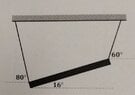
An 87 cm long metal bar has a mass of .695 kg and is supported by 2 strings

-Find the tension in each string

-Find the center of the mass for the bar relative to the left end of the bar
Relevant Equations
I think we use
Torque= F r sin theta....?
I have no idea where to start or how to do this. I haven't learned this in lecture yet
 

Attachments

  • IMG_20221101_130041495~2.jpg
    IMG_20221101_130041495~2.jpg
    38.5 KB · Views: 132
Physics news on Phys.org
Welcome to PF.

marinarasauce said:
I have no idea where to start or how to do this.
With problems like this it's best to start with a Free Body Diagram (FBD) of the object that shows all of the forces acting on it (in this case the two strings pulling up at their contact points with the angles, along with the force of gravity acting down on the bar at it's center of gravity point). Once you have your FBD drawn and labeled, you write the equations to sum all of the forces to zero and to sum all of the torques to zero.

Try sketching that FBD for us and upload it using the "Attach files" link below the Edit window.

EDIT -- Beat out by @kuruman again! :smile:
 
To elaborate on @berkeman 's reply, you need to pick an axis for the torque equation. Generally one chooses a point at which some of the forces act so that those do not feature in the equation. Occasionally it pays to pick two axes and write the torque equation for each, but for a single free body that is usually redundant since it can be deduced from the other torque equation and the linear equations.
 

Similar threads

  • · Replies 12 ·
Replies
12
Views
1K
Replies
16
Views
1K
  • · Replies 5 ·
Replies
5
Views
2K
  • · Replies 13 ·
Replies
13
Views
1K
Replies
19
Views
1K
  • · Replies 45 ·
2
Replies
45
Views
4K
  • · Replies 16 ·
Replies
16
Views
1K
  • · Replies 12 ·
Replies
12
Views
3K
Replies
2
Views
2K
  • · Replies 7 ·
Replies
7
Views
3K