How do I solve the Laplace equation using Robbin's Boundary Conditions?

  • Thread starter Thread starter shreddinglicks
  • Start date Start date
  • Tags Tags
    equation Laplace
Join the discussion
Registration is free. Ask a follow-up in this thread, or start your own.
3 replies · 2K views
shreddinglicks
Messages
225
Reaction score
7
Homework Statement
Equation

(d^2 u)/(dx^2 )+(d^2 u)/(dy^2 )=0

boundary conditions

u(0,y)=0
u(a,y)=50
u(x,0)=0
u^' (x,b)=-h[u(x,b)-70]
Relevant Equations
(d^2 u)/(dx^2 )+(d^2 u)/(dy^2 )=0
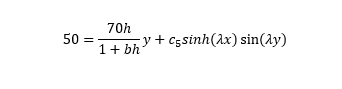
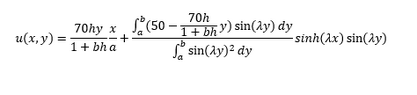
I've tried a few things. I did one method to try to accomplish the removal of the -70 in the derivative boundary condition. It came out as below. When plotting it however it gave a solution that didn't make sense.

1730136669757.png


1730136684280.png
 
Last edited:

Discussion

Physics news on Phys.org
What is the boundary condition at [itex]x = a[/itex]? What do you mean by the notation [itex]u'[/itex], since [itex]u[/itex] is a function of 2 varaibles? Do you mean [itex]\frac{\partial u}{\partial x}[/itex]? Is [itex]h[/itex] a constant?

If that is correct, then I would set [tex] u(x,y) = \frac{70h}{1 + ah}x + v(x,y)[/tex] where [itex]v[/itex] satisfies [tex]\begin{split}<br /> v(0,y) = 0, \\<br /> \frac{\partial v}{\partial x}(a,y) + hv(a,y) &= 0, \\<br /> v(x,0) &= -\frac{70h}{1 + ah}x, \\<br /> v(x,b) &= 50 - \frac{70h}{1 + ah}x. \end{split}[/tex]
 
pasmith said:
What is the boundary condition at [itex]x = a[/itex]? What do you mean by the notation [itex]u'[/itex], since [itex]u[/itex] is a function of 2 varaibles? Do you mean [itex]\frac{\partial u}{\partial x}[/itex]? Is [itex]h[/itex] a constant?

If that is correct, then I would set [tex] u(x,y) = \frac{70h}{1 + ah}x + v(x,y)[/tex] where [itex]v[/itex] satisfies [tex]\begin{split}<br /> v(0,y) = 0, \\<br /> \frac{\partial v}{\partial x}(a,y) + hv(a,y) &= 0, \\<br /> v(x,0) &= -\frac{70h}{1 + ah}x, \\<br /> v(x,b) &= 50 - \frac{70h}{1 + ah}x. \end{split}[/tex]
Yes, exactly as you said. du/dx and h is a constant.

I realized I made an error.

The conditions are actually

1730136193713.png

I'll fix it also on the original post.

It's what you have but y instead of x.

1730138509262.png

1730137038134.png


The problem is, this gives an answer where for all y when u(0,y)=0 when x should be zero, x does not equal zero.

The funny thing is if I manipulate the equation by multiplying the first term by x/a. I can plot a solution that makes sense.

1730137022111.png
 

Attachments

  • 1730136289863.png
    1730136289863.png
    2.4 KB · Views: 75
  • 1730136397561.png
    1730136397561.png
    4.8 KB · Views: 69
  • 1730136876131.png
    1730136876131.png
    2 KB · Views: 110
Last edited:
You're only satisfying the boundary condition at [itex]x = a[/itex]. No wonder you don't get the right value at [itex]x = 0[/itex].

Setting [itex]u(x,y) = \frac{70hy}{1 + bh} + v(x,y)[/itex] gives [tex]\begin{split} v(0,y) &= -\frac{70h}{1 + bh}y \\<br /> v(a,y) &= 50 - \frac{70h}{1 + bh}y \\<br /> v(x,0) &= 0 \\<br /> \left.\frac{\partial v}{\partial y}\right|_{(x,b)} + hv(x,b) &= 0. \end{split}[/tex] This gives you [tex] u(x,y) = \frac{70h}{1 + bh}y + \sum_{n=1}^\infty X_n(x) \sin k_n y.[/tex] Now [itex]X_n[/itex] is a linear combination of [itex]\cosh k_n x[/itex] and [itex]\sinh k_n x[/itex]. But instead of taking [itex]X_n(0) = 0[/itex], you must take [tex]\sum_{n=1}^\infty X_n(0) \sin k_n y + \frac{70h}{1 + bh}y = 0.[/tex] You can't just ignore the [itex]\cosh k_n x[/itex] solution, you need it to satisfy this condition.
It is, however, more convenient to take advantage of the fact that [tex]\sinh k_n(a- x) \equiv \sinh k_n a \cosh k_n x - \cosh k_n a \sinh k_n x[/tex] is a linear combination of [itex]\cosh k_n x[/itex] and [itex]\sinh k_n x[/itex] and set [tex] X_n(x) = \frac{A_n \sinh k_n(a-x) + B_n \sinh k_n x}{\sinh k_n a}[/tex] so that [tex]\begin{split}<br /> 0 &= u(0,y) = \frac{70h}{1 + bh}y + \sum_{n=1}^\infty A_n \sin k_n y \\<br /> 50 &= u(a,y) = \frac{70h}{1 + bh}y + \sum_{n=1}^\infty B_n \sin k_n y \end{split}[/tex]