How Do Magnetic Field Lines Behave Around a Long Current-Carrying Wire?

Click For Summary
SUMMARY

The discussion centers on the behavior of magnetic field lines around a long current-carrying wire placed in a uniform magnetic field parallel to its length. The user is attempting to solve question 3.7, which requires understanding the interaction between the magnetic field generated by the wire and the external magnetic field. Key insights include the suggestion to express the distance 'r' as sqrt(x^2 + y^2) and a reference to example problem 31.14 for further derivation. The correct interpretation of these concepts is crucial for accurately determining the shape of the magnetic field lines.

PREREQUISITES
  • Understanding of electromagnetic theory, specifically Ampère's Law
  • Familiarity with vector calculus and magnetic field representations
  • Knowledge of the right-hand rule for determining magnetic field directions
  • Basic proficiency in solving physics problems involving magnetic fields
NEXT STEPS
  • Review Ampère's Law and its application to current-carrying conductors
  • Study the right-hand rule in detail to visualize magnetic field orientations
  • Explore the derivation of magnetic field lines around straight wires using Biot-Savart Law
  • Analyze example problem 31.14 referenced in the discussion for practical application
USEFUL FOR

Students of physics, educators teaching electromagnetism, and anyone interested in the principles of magnetic fields and their interactions with electric currents.

Fumbles22
Messages
7
Reaction score
0
Hello,

I'm stuck on this question, and it's really annoying me. I scanned the page so it has a bit more context.
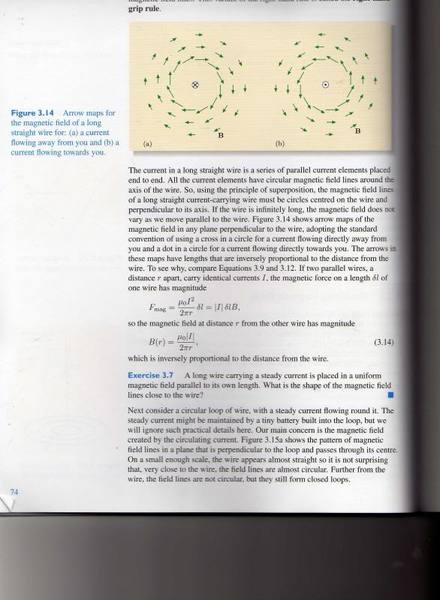
img272_zps27d9afc6.jpg


It's question 3.7: "A long wire carrying a steady current is placed in a uniform magnetic field parallel to it's own length. What is the shape of the magnetic field lines close to the wire?".

I approached the problem like this:
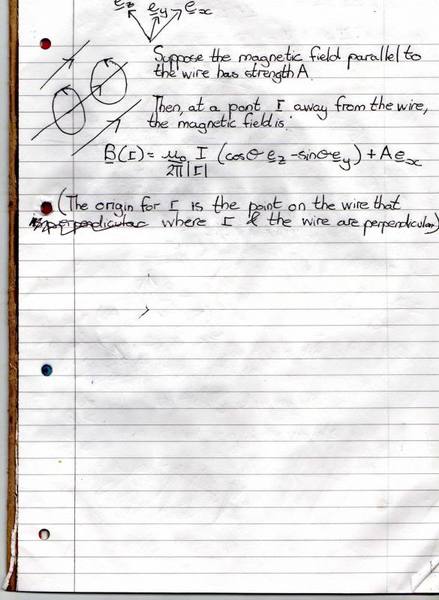
img270_zpsaeb417b8.jpg


(Sorry about my awful handwriting!)

I'm close to the answer in the back of the book (which i'll withhold for now) but it still isn't right. Unfortunately, I can't see what I've done wrong.

I was hoping that someone could point out any gaps in my working.

Thanks in advance!
 
Physics news on Phys.org
I don't see what's wrong with what you did. Maybe you could express r as sqrt(x^2 +y^2) but other than that ...
 

Similar threads

Replies
7
Views
3K
Replies
2
Views
1K
Replies
16
Views
1K
  • · Replies 12 ·
Replies
12
Views
2K
  • · Replies 8 ·
Replies
8
Views
2K
  • · Replies 12 ·
Replies
12
Views
3K
  • · Replies 2 ·
Replies
2
Views
1K
  • · Replies 5 ·
Replies
5
Views
2K
  • · Replies 3 ·
Replies
3
Views
3K
  • · Replies 8 ·
Replies
8
Views
3K