How do radial tooth clutches function?

  • Context: Engineering 
  • Thread starter Thread starter Amaelle
  • Start date Start date
  • Tags Tags
    Function Radial
Click For Summary

Discussion Overview

The discussion centers on the functioning of radial tooth clutches, specifically focusing on how they disengage from power transmission when certain torque limits are reached. Participants explore the mechanics of disengagement, the role of radial forces, and the differences between radial tooth clutches and other types of clutches.

Discussion Character

  • Technical explanation
  • Conceptual clarification
  • Debate/contested

Main Points Raised

  • One participant expresses confusion about how radial tooth clutches disengage when power transfer stops, noting that they understand the general function of clutches but seek clarification on the specific mechanics involved.
  • Another participant suggests that if the transmitted torque exceeds a certain threshold, a radial force might push the output shaft gear, leading to a cessation of power transfer.
  • A different participant argues that radial tooth clutches operate differently from traditional clutches, indicating that they do not simply slide or disengage upon reaching maximum torque, but rather engage and disengage at the operator's discretion.
  • One participant acknowledges the clarification provided about the nature of the clutch, indicating satisfaction with the information received.
  • Several participants share a cleaned-up version of a figure related to the discussion, requesting a source for the image.

Areas of Agreement / Disagreement

Participants exhibit some disagreement regarding the mechanics of radial tooth clutches and how they differ from other types of clutches. The discussion remains unresolved as various perspectives are presented without a clear consensus.

Contextual Notes

Some assumptions about the mechanics of radial tooth clutches and the definitions of terms used may not be fully articulated, leading to potential misunderstandings. The discussion also highlights the need for clarity regarding the operational differences between various clutch types.

Amaelle
Messages
309
Reaction score
54
Homework Statement
look at the image
Relevant Equations
tooth cluches
Greetings
1662994177135.jpeg

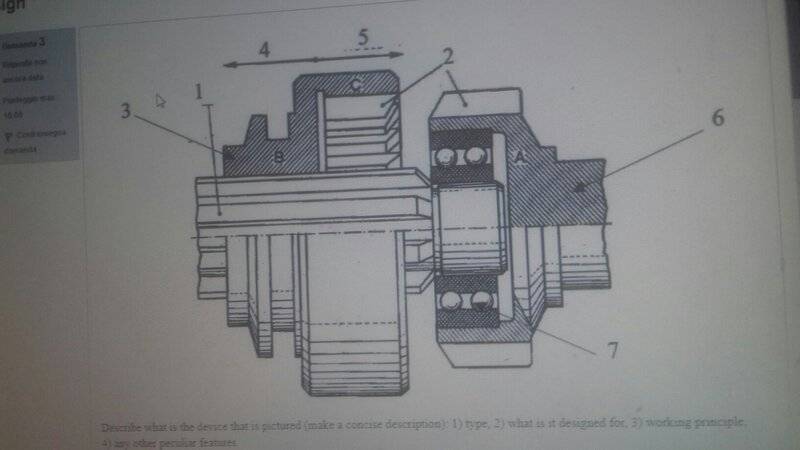
I have a hard time understanding how the radial tooth clutch function when it stops transferring power .
Basically I understand that clutches:
1) transfer power from input shaft to output shaft
3) disengage when the torque transmitted has reached a certain limit ( normally when the sliding starts)

I would like to know how the disengagement happen in the case of radial toothed clutches as the input and output shaft are connected via coupled gears? do we have slipping in gear teeth?
thank you!
 
Physics news on Phys.org
maybe
if the transmitted torque is too high it will generate a radial force big enough to push the gear of output shaft and here we stopped transferring power?
 
This type of clutch is not like the ones of your previous post, which reach a maximum torque and then slide or disengage.
This is not a clutch per se.

Part B is forced to slide over shaft 1, engaging and disengaging at will of operator.
It is common in automovile gear boxes.
 
  • Like
  • Informative
Likes   Reactions: jack action and Amaelle
Thank you very much this is what I wanted to know!
 
Here is a cleaned-up version of your figure (it still could be better). Can you give a link to the source?

Radial_Dark.jpg
 
You are welcome :smile:
RealPleasingKusimanse-size_restricted.gif
 
  • Like
  • Informative
Likes   Reactions: jim mcnamara, jack action and Amaelle
berkeman said:
Here is a cleaned-up version of your figure (it still could be better). Can you give a link to the source?

View attachment 314099
Sure , thos picture is from my syllabus of machine design
1662996231722.png
 
  • Like
Likes   Reactions: Lnewqban

Similar threads

  • · Replies 21 ·
Replies
21
Views
3K
  • · Replies 19 ·
Replies
19
Views
4K
Replies
13
Views
7K
  • · Replies 1 ·
Replies
1
Views
5K
  • · Replies 12 ·
Replies
12
Views
2K
  • · Replies 11 ·
Replies
11
Views
4K
  • · Replies 15 ·
Replies
15
Views
3K
  • · Replies 13 ·
Replies
13
Views
3K
  • · Replies 26 ·
Replies
26
Views
23K
  • · Replies 14 ·
Replies
14
Views
11K