How do the intensities change when using a polarization beam splitter?

4 replies · 6K views · last reply
kingdomoff
Messages
6
Reaction score
0
Hi,

let's assume a polarization beam splitter (PBS) that splits the unpolarized beam into two beams with opposite polarization states.
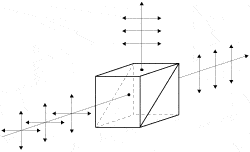
Diagram of a cube-shaped polarizing beam splitter with a diagonal interface, with unpolarized light arrows entering from the lower left and double-headed arrows showing transmitted and reflected polarization directions.


The PBS has one input port and two output ports.

1) If input beam has an intensity I, what will be the intensity of beam at each output port, Iout1 and Iout2?

2) What will be an intensity of the beam at input port, when two beams are combined at output ports of PBS?
 
no it is not homework, it is my research. i need it to mount to my experimental setup. so before doing it i want to calculate losses and to know how much power will i loose using it.
 
There is no easy answer. It depends for example on the splitting ratio of the bs, the wavelength you are working at. If you just care about having as few losses as possible, you should consider using a bs with antireflection coatings at all surfaces, which matter. But usually the losses are not dramatic.

If your light intensity is so low that is does matter, you might also need to consider that you always have two input ports, even if there is just the vacuum field present at one of these ports. But this is usually only important at really low light levels like single photon experiments in quantum optics.
 
i've some assumptions, but I'm not sure that I'm in a right direction:

for the 1-case: the intensities at two output ports will be half of the input intensity.
Pout1,2[dBm]=Pin[dBm]-3dB

for the 2-case: the intensity at input port will twice the intensities of combined beams at output ports.
Pin[dBm]=Pout1,2+3dB