eft
- 1
- 0
<Moderator's note: Moved from a technical forum and thus no template.>
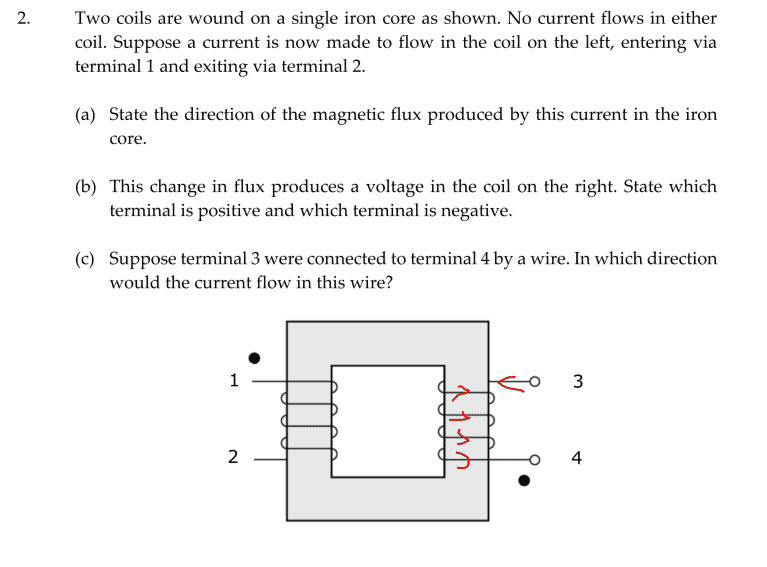
Hi all, I have attempted this question but have a few queries on how transformers work, and what the dot notation represents.
(a) The flux would be clockwise around the iron core.
(b) This is the question where it gets a bit iffy. So from my understanding, the dot notation would indicate that terminal 4 is positive. Is this because of the clockwise magnetic flux flowing through the iron core, and due to lenz law the coil will have a voltage induced in such a way to oppose the change. That is, the voltage induced in the secondary coil will produce an anticlockwise flux that opposes the initial flux producing it? That will mean that the positive charges will flow towards terminal 4 and hence make it positive.
(c) If we were to connect terminal 3 and 4 by a wire, then current would flow from 4-->3 (using the right-hand grip rule I deduced that current would flow to the right as indicated on the diagram).
In my head, the secondary coil somewhat acts like a battery since current flows the same direction as the voltage difference between terminal 3 and 4.
I don't really feel confident for all of these answers, so please explain what I am missing if I am wrong! Thanks!
Hi all, I have attempted this question but have a few queries on how transformers work, and what the dot notation represents.
(a) The flux would be clockwise around the iron core.
(b) This is the question where it gets a bit iffy. So from my understanding, the dot notation would indicate that terminal 4 is positive. Is this because of the clockwise magnetic flux flowing through the iron core, and due to lenz law the coil will have a voltage induced in such a way to oppose the change. That is, the voltage induced in the secondary coil will produce an anticlockwise flux that opposes the initial flux producing it? That will mean that the positive charges will flow towards terminal 4 and hence make it positive.
(c) If we were to connect terminal 3 and 4 by a wire, then current would flow from 4-->3 (using the right-hand grip rule I deduced that current would flow to the right as indicated on the diagram).
In my head, the secondary coil somewhat acts like a battery since current flows the same direction as the voltage difference between terminal 3 and 4.
I don't really feel confident for all of these answers, so please explain what I am missing if I am wrong! Thanks!
Attachments

Last edited by a moderator:
