How Do You Analyze Stacked Beams Without Composite Action?

Click For Summary
SUMMARY

This discussion focuses on the analysis of stacked beams that do not exhibit composite action, specifically when two beams are simply placed together rather than bonded. The transformed section method is typically used for composite beams, but in this case, each beam must be analyzed separately. Key considerations include the interpretation of allowable bending stresses and Young's moduli for both beams, as well as the potential shear stress at the interface between them. A referenced paper provides additional insights into this analysis method.

PREREQUISITES
  • Understanding of structural beam analysis principles
  • Familiarity with the transformed section method for composite beams
  • Knowledge of bending stress and Young's modulus concepts
  • Awareness of shear stress implications in beam interfaces
NEXT STEPS
  • Research the "transformed section method" for composite beam analysis
  • Study "shear stress in beam interfaces" to understand inter-beam interactions
  • Examine "bending stress calculations" for non-composite beams
  • Read the referenced paper on analyzing stacked beams without shear connection
USEFUL FOR

Structural engineers, civil engineering students, and professionals involved in beam design and analysis will benefit from this discussion, particularly those focusing on non-composite beam configurations.

ichabodgrant
Messages
48
Reaction score
0
Hi, normally when we try to analyse a structural beam with composite section, we apply transformed section method or so. But what if two beams are just put together (one onto another one) instead of having a composite relation (e.g. glued together), how am I going to analyse the forces and stresses?

Someone tells me to separately consider the two beams. But how will the action load change for the two beams? Is there any shear stress that needs be to considered in the interface between the two beams?

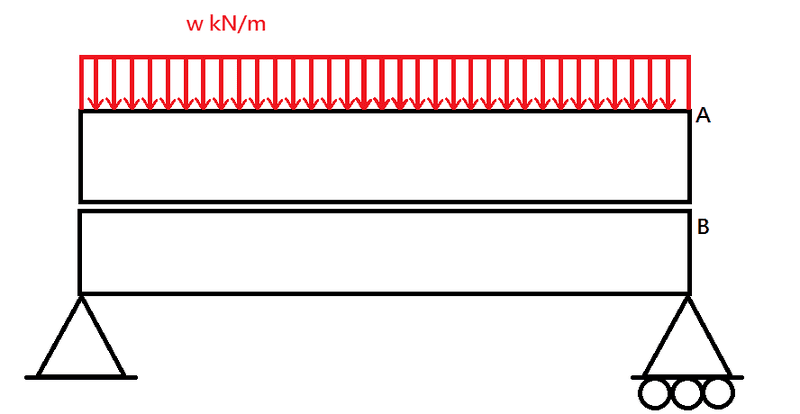
(in the following graph, it is a simply supported beam. Let's think beam A and B are of equal length, equal thickness and same cross-section. But they are not in a composite manner, just put together. And let's say it is given the required allowable bending stresses, Young's moduli for both beams, how am I going to interpret these for such a non-composite beam? What are the differences compared to that when I see it as a composite beam?)
composite beam.png
 
Engineering news on Phys.org
ichabodgrant said:
Hi, normally when we try to analyse a structural beam with composite section, we apply transformed section method or so. But what if two beams are just put together (one onto another one) instead of having a composite relation (e.g. glued together), how am I going to analyse the forces and stresses?

Someone tells me to separately consider the two beams. But how will the action load change for the two beams? Is there any shear stress that needs be to considered in the interface between the two beams?

(in the following graph, it is a simply supported beam. Let's think beam A and B are of equal length, equal thickness and same cross-section. But they are not in a composite manner, just put together. And let's say it is given the required allowable bending stresses, Young's moduli for both beams, how am I going to interpret these for such a non-composite beam? What are the differences compared to that when I see it as a composite beam?)View attachment 92906
As far as beam analysis goes, the paper below may shed some light on how to analyze beams stacked together without shear connection:

http://www.steel-insdag.org/TeachingMaterial/chapter21.pdf

Basically, each beam bends about its own N.A.
 

Similar threads

Replies
3
Views
2K
  • · Replies 9 ·
Replies
9
Views
3K
  • · Replies 1 ·
Replies
1
Views
2K
  • · Replies 15 ·
Replies
15
Views
3K
  • · Replies 7 ·
Replies
7
Views
3K
Replies
3
Views
13K
  • · Replies 4 ·
Replies
4
Views
4K
Replies
3
Views
4K
Replies
1
Views
3K
  • · Replies 4 ·
Replies
4
Views
4K