How Do You Calculate Deflection in a Simply Supported Overhanging Beam?

Click For Summary
SUMMARY

The discussion focuses on calculating deflection in a simply supported overhanging beam with two supports and a point load at the end of the cantilever. The user has successfully determined reactions at the supports but struggles with finding deflection between them. Key insights include the importance of using the correct conjugate beam method and recognizing that the beam is statically stable when restrained at one end. The user has attempted calculations using the equation P*a*x/LEI but has encountered issues with units, resulting in mm² instead of mm.

PREREQUISITES
  • Understanding of beam mechanics and deflection theory
  • Familiarity with the conjugate beam method
  • Knowledge of integration techniques for beam equations
  • Basic principles of static equilibrium in structural analysis
NEXT STEPS
  • Study the conjugate beam method for calculating deflection
  • Learn about virtual work principles in structural analysis
  • Explore finite element analysis (FEA) for beam deflection problems
  • Review the derivation of deflection equations for simply supported beams
USEFUL FOR

Civil engineers, structural analysts, and students studying mechanics of materials who need to understand deflection calculations in beam structures.

Rhysmachine
Messages
2
Reaction score
0
Hey all, first post!

Looking to find a deflection equation for a simply supported overhanging beam with two supports and a point- load at the end of the canteliever. I can determine reactions at the supports but i am having trouble finding deflection between the supports.

Any help is appreciated!

the beam in question looks like (a) in the following picture but if we call L/2 a, instead.
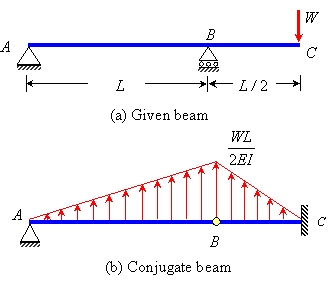
conju2.gif
 
Engineering news on Phys.org
This is a tricky problem. A simply supported beam with an overhanging load and no other appreciable loading is statically unstable. You have not provided any details about your calculations, so I am unable to comment on their validity. The so-called 'conjugate beam' you show reflects different end conditions from the original beam. The slope and deflection at C for the 'conjugate beam' must both vanish, whereas neither vanish at C for the given beam.
 
Sorry my mistake; the beam is restrained at A, vertically so I guess the triangle needs to be pointing the other way. The beam is no longer statically unstable now, right?

Ive done a number of calcs intergrating something like: P*a*x/LEI, with a number of variations to find slope then deflection, But I always seem to be ending up with an answer that would be mm^2 instead of mm. I was hoping someone might be able to go through finding the answer for me so I can find the deflection at many points along the A-B section.

Oh and the second example shouldn't be there at all. I just had to find a picture that was something like the problem I have as I couldn't upload my own pic.
 
I'd solve the beam equation to find the displacement as a function of x or get an approximate solution using virtual work or finite elements.
 

Similar threads

Replies
3
Views
3K
  • · Replies 8 ·
Replies
8
Views
2K
  • · Replies 8 ·
Replies
8
Views
2K
Replies
6
Views
4K
  • · Replies 4 ·
Replies
4
Views
4K
  • · Replies 3 ·
Replies
3
Views
2K
Replies
2
Views
2K
  • · Replies 6 ·
Replies
6
Views
2K
  • · Replies 2 ·
Replies
2
Views
3K
  • · Replies 4 ·
Replies
4
Views
3K