How do you calculate Electric Potential Energy in a Square?

Click For Summary
SUMMARY

The calculation of electric potential energy for four identical particles with charge q and mass m positioned at the vertices of a square involves using the Conservation of Energy principle. The correct formula for the final kinetic energy, represented as 4(mv^2 /2), equates to the difference in potential energy, which includes additional terms due to the non-equidistant arrangement of charges. Specifically, the correct expression incorporates terms like (2*kq^2)/(sqrt(2)*L) to account for the varying distances between the charges. This contrasts with calculations for triangular configurations, where such additional terms are not necessary.

PREREQUISITES
  • Understanding of Conservation of Energy in physics
  • Familiarity with electric potential energy calculations
  • Knowledge of Coulomb's Law and its application
  • Basic principles of charge interactions in electrostatics
NEXT STEPS
  • Study the derivation of electric potential energy for different geometric configurations, such as squares and triangles.
  • Learn about the implications of charge distribution on potential energy calculations.
  • Explore the concept of electric field strength and its relationship to potential energy.
  • Investigate advanced topics in electrostatics, including potential energy in three-dimensional charge distributions.
USEFUL FOR

Students and professionals in physics, particularly those focusing on electrostatics, electrical engineering, and anyone involved in calculating electric potential energy in various configurations.

halo168
Messages
12
Reaction score
0
Thread moved from technical section, hence no homework formatting template shown.
Four identical particles, each having charge q and mass m, are accelerated from rest at the vertices of a square of side L. How fast is each particle moving when their distance from the center of the square doubles?

I used the Conservation of Energy => Kf= -deltaU = Ui-Uf
4(mv^2 /2) = kq^2 (4/L) - kq^2 (4/2L); Solving for v, I would get the wrong answer.

However, the correct answer had 4(mv^2 /2) = kq^2 (4/L + 2/(sqrt(2)*L) - kq^2 (4/2L + 2/(2*sqrt(2)*L)

I know that the (2*kq^2)/(sqrt(2)*L) comes from:
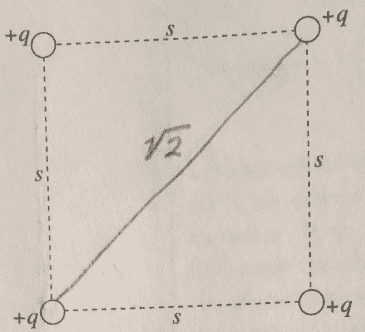
upload_2018-1-17_16-29-7.png


but when I calculate the electric potential energy of three charges (+q) at the vertices of a triangle, I don't need to add an extra term like (2*kq^2)/(sqrt(2)*L ). (Refer to here)

Can someone please explain the difference between calculating electric potential for a square and triangle?

Thanks in advance
 

Attachments

  • upload_2018-1-17_16-28-38.png
    upload_2018-1-17_16-28-38.png
    29.7 KB · Views: 637
  • upload_2018-1-17_16-29-7.png
    upload_2018-1-17_16-29-7.png
    20.5 KB · Views: 1,555
Physics news on Phys.org
Hint:
Each pair of charges contributes to the total potential energy.
 
  • Like
Likes   Reactions: halo168
halo168 said:
4(mv^2 /2) = kq^2 (4/L) - kq^2 (4/2L); Solving for v, I would get the wrong answer.
That's because the initial and final potential energy expressions are incorrect. The charges are not equidistant from each other as they are in the video you referred to.
 

Similar threads

  • · Replies 2 ·
Replies
2
Views
1K
  • · Replies 2 ·
Replies
2
Views
2K
Replies
1
Views
3K
  • · Replies 22 ·
Replies
22
Views
4K
Replies
1
Views
2K
  • · Replies 23 ·
Replies
23
Views
2K
  • · Replies 7 ·
Replies
7
Views
3K
Replies
1
Views
2K
  • · Replies 3 ·
Replies
3
Views
2K
Replies
11
Views
3K