How Do You Calculate Moments with Levers?

Click For Summary

Homework Help Overview

The discussion revolves around calculating moments produced by forces in a biomechanics context, specifically involving levers and rotational dynamics. The original poster seeks assistance with a problem set that includes examples of forces and distances related to moments about an axis of rotation.

Discussion Character

  • Exploratory, Conceptual clarification, Problem interpretation, Assumption checking

Approaches and Questions Raised

  • Participants discuss the calculation of moments by multiplying force and distance, with some uncertainty about the correctness of their approaches. Questions arise regarding the consideration of other forces and the effects of angles on force components.

Discussion Status

There is an ongoing exchange of ideas, with some participants attempting to clarify their understanding of the problem and others providing guidance on the need to show work. Multiple interpretations of the problem setup are being explored, particularly regarding the role of angles and additional forces.

Contextual Notes

Participants mention the need to adhere to homework guidelines, including showing work for better assistance. There is uncertainty about the specific details of the examples provided, as well as the implications of the instructions regarding directionality of moments.

KINmajor
Messages
5
Reaction score
0
Hi everyone, my name is Alex. I am a Kinesiology major and taking a biomechanics course which has a lot of physics. I need some help on a problem set involving calculating moments

instructions: calculate the moment produced by the force F in each case about the axis of rotation.

i have attached two examples, hope the drawings are clear enough.

Thank you for your help!
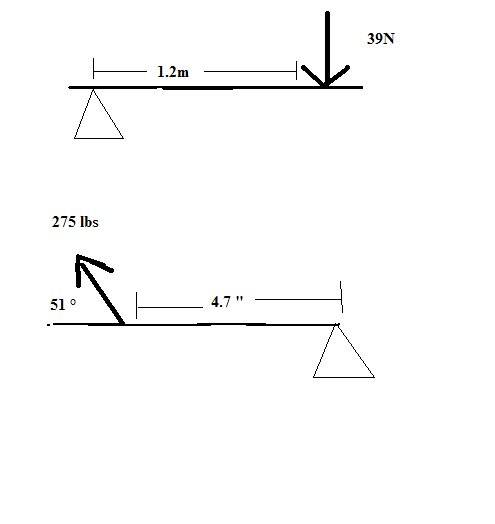
kinproblems.jpg
 
Physics news on Phys.org
i read the sticky about why no one answers and maybe i needed to show some work to get a response.

for the first one i am pretty sure you just multiply the 39 N by the 1.2 m for an answer of -46.8 (the instructions state the counter clockwise is negative)
again I am not sure if that's correct though.

for the other i honestly don't have any idea, not asking for answers just not even sure how to approach it.

thanks!
 
Howdy,
There's a kind of standard format to use for asking homework questions. People are helpful, but they want to see some attempted work first. Do you know the formula for the moments? If so, do you see which quantities go into it?
 
i am a new guy too... lol, but i think i can solve the problem...
but do you consider other forces in the problem?
 
i don't believe you need to consider other forces (gravity, normal) or anything like that.
this is review and its actually driving me nuts i can't remember how lol.
 
You posted while I was, so I didn't see. Sorry.
So, does that 39N force tend to cause a CW or CCW rotation?
Look under your keyboard. You seem to have dropped some units of measure.:wink:
In the second part, what do you know about calculating the effective force when there is an angle given?
 
ya i figured our posts overlapped.
i know the it will be a clockwise rotation, but is it really just as simple as multiplying the force and distance?

the angle one i assume i make it into a right triangle and use sin51 = x/275lbs to find the vertical component?
 
well i was getting help and then everyone vanished?
was i on the right track?
 

Similar threads

  • · Replies 8 ·
Replies
8
Views
1K
Replies
25
Views
2K
Replies
24
Views
4K
  • · Replies 1 ·
Replies
1
Views
3K
  • · Replies 22 ·
Replies
22
Views
3K
Replies
4
Views
2K
  • · Replies 4 ·
Replies
4
Views
1K
Replies
1
Views
2K
Replies
5
Views
3K
  • · Replies 9 ·
Replies
9
Views
3K